




Introduction
An MBA (Master of Business Administration) is a popular postgraduate programme for students and working professionals who want to build careers in management, marketing, finance, human resources, consulting, entrepreneurship, and business analytics.
One of the most important steps toward MBA admission is selecting the right management entrance examination. India offers several national-level and university-specific exams, each accepted by different business schools and management institutions.
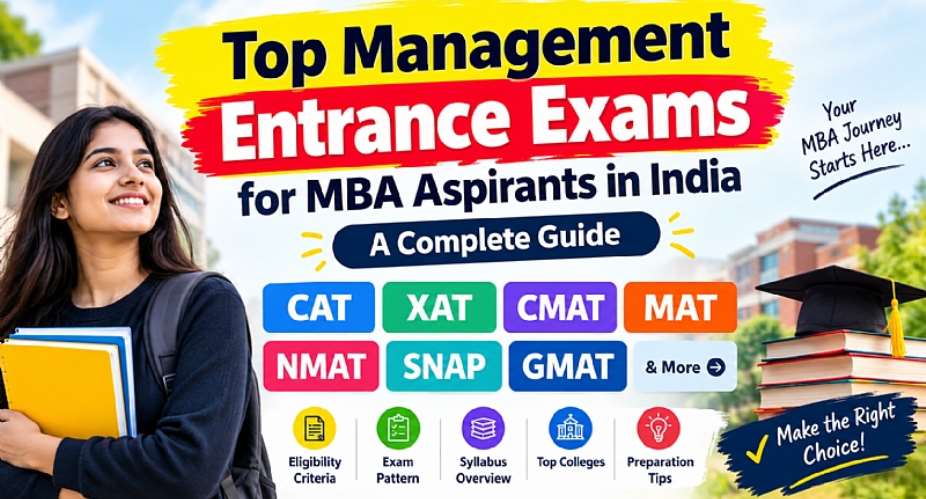
The top management entrance exams for MBA aspirants in India include CAT, XAT, CMAT, MAT, NMAT, SNAP, and other examinations. Understanding their eligibility requirements, exam patterns, and target colleges can help candidates make better decisions about their MBA journey.
In this guide, we explain the major MBA entrance exams in India and share practical tips to help you choose the most suitable option.
1. Common Admission Test (CAT)
The Common Admission Test (CAT) is one of India's most prominent management entrance examinations. It is conducted by the Indian Institutes of Management (IIMs) on a rotating basis.
CAT scores are used by IIMs and numerous other business schools for admission to MBA and related management programmes.
Key features of CAT:
- Conducting body: Indian Institutes of Management.
- Exam mode: Computer-based test.
- Main sections: Verbal Ability and Reading Comprehension (VARC), Data Interpretation and Logical Reasoning (DILR), and Quantitative Aptitude (QA).
- Frequency: Generally once a year.
- Best suited for: Candidates targeting IIMs and other CAT-accepting institutions.
Why Choose CAT?
CAT is a strong option for students aiming for highly competitive MBA programmes. The examination tests mathematical ability, reading comprehension, analytical thinking, and time management.
Candidates should prepare through regular practice, mock tests, revision, and analysis of previous questions where available.
2. Xavier Aptitude Test (XAT)
The Xavier Aptitude Test (XAT) is conducted by XLRI Jamshedpur and is accepted by XLRI and other participating management institutions.
XAT is known for its Decision Making section, which evaluates candidates' ability to assess situations and choose appropriate solutions.
Key features of XAT:
- Conducting body: XLRI Jamshedpur.
- Exam mode: Computer-based test.
- Main areas: Verbal Ability and Logical Reasoning, Decision Making, Quantitative Aptitude and Data Interpretation, and General Knowledge.
- Frequency: Generally once a year.
- Best suited for: Candidates targeting XLRI and other XAT-accepting colleges.
Why Choose XAT?
XAT is a useful choice for aspirants who want to expand their business-school options beyond CAT-based admissions. Candidates should practise case-based Decision Making questions and review the latest exam pattern before beginning focused preparation.
3. Common Management Admission Test (CMAT)
The Common Management Admission Test (CMAT) is conducted by the National Testing Agency (NTA). It is a national-level examination for admission to management programmes at institutions that accept CMAT scores.
Key features of CMAT:
- Conducting body: National Testing Agency.
- Exam mode: Computer-based test.
- Main sections: Quantitative Techniques and Data Interpretation, Logical Reasoning, Language Comprehension, General Awareness, and Innovation and Entrepreneurship.
- Frequency: Generally once a year.
- Best suited for: Candidates considering colleges that accept CMAT scores.
Why Choose CMAT?
CMAT provides another route to management education in India. Its syllabus includes aptitude-based subjects, general awareness, and innovation and entrepreneurship.
Candidates must check the eligibility requirements and selection procedures of individual colleges because taking CMAT does not automatically guarantee admission.
4. Management Aptitude Test (MAT)
The Management Aptitude Test (MAT) is conducted by the All India Management Association (AIMA). It is accepted by participating business schools for admission to various management programmes.
Key features of MAT:
- Conducting body: All India Management Association.
- Exam modes: Paper-based and computer-based options may be offered according to the current schedule.
- Main areas: Language Comprehension, Intelligence and Critical Reasoning, Mathematical Skills, Data Analysis and Sufficiency, and Economic and Business Environment.
- Frequency: Multiple test sessions may be offered each year.
- Best suited for: Candidates applying to participating MAT-accepting institutions.
Why Choose MAT?
MAT may suit students who want to explore a broader range of management colleges and prefer additional examination opportunities during the year.
Before registering, candidates should check the latest test schedule, available modes, fees, and the colleges accepting scores for their preferred admission cycle.
5. NMAT by GMAC
NMAT is a management entrance examination administered by the Graduate Management Admission Council (GMAC). It is accepted by participating institutions in India and selected institutions in other countries.
Key features of NMAT:
- Conducting body: Graduate Management Admission Council.
- Exam mode: Computer-based.
- Main sections: Language Skills, Quantitative Skills, and Logical Reasoning.
- Exam window: Dates are announced for each testing cycle.
- Best suited for: Candidates targeting NMAT-accepting institutions, including applicable NMIMS programmes.
Why Choose NMAT?
NMAT can be useful for candidates who value its testing-window structure and want to apply to institutions that specifically accept its scores.
The number of permitted attempts, scheduling rules, fees, and score-acceptance policies should be confirmed on the official NMAT website for the relevant cycle.
6. Symbiosis National Aptitude Test (SNAP)
The Symbiosis National Aptitude Test (SNAP) is conducted for admission to eligible management programmes offered by participating institutes of Symbiosis International (Deemed University).
Key features of SNAP:
- Conducting body: Symbiosis International (Deemed University).
- Exam mode: Computer-based test.
- Main areas: General English, Analytical and Logical Reasoning, and Quantitative, Data Interpretation and Data Sufficiency skills, according to the current pattern.
- Frequency: Generally conducted during the annual admission cycle, with the number of permitted attempts specified in the notification.
- Best suited for: Candidates targeting SNAP-accepting Symbiosis institutes.
Why Choose SNAP?
SNAP is particularly relevant for students interested in management programmes at Symbiosis institutes, including SIBM Pune and other participating institutions.
Candidates should research their preferred programme, check the latest exam pattern, and confirm the institute's separate application and selection requirements.
7. Graduate Management Admission Test (GMAT)
The Graduate Management Admission Test (GMAT) is a standardised management admissions examination administered by GMAC. It is used by participating business schools in India and internationally.
Key features of GMAT:
- Conducting body: Graduate Management Admission Council.
- Exam mode: Computer-based.
- Main sections: Quantitative Reasoning, Verbal Reasoning, and Data Insights.
- Testing availability: Offered through scheduled testing options under current GMAC rules.
- Best suited for: Candidates targeting business schools or management programmes that accept GMAT scores.
Why Choose GMAT?
GMAT may be relevant for candidates considering international business schools or Indian programmes that accept its scores. Requirements vary between institutions and programmes, particularly for full-time MBA, executive MBA, and other postgraduate management courses.
Candidates should check score validity, fees, test availability, and the specific programme's admission policy before registering.
8. State-Level MBA Entrance Exams
In addition to national-level examinations, several states conduct entrance tests for MBA and management admissions at participating colleges and universities.
Examples include:
- MAH MBA/MMS CET: Used for eligible MBA and MMS admissions in Maharashtra.
- TANCET: Used for applicable postgraduate management admissions in Tamil Nadu.
- AP ICET: Used for eligible MBA and MCA admissions in Andhra Pradesh.
- TG ICET: Used for eligible MBA and MCA admissions in Telangana.
- Karnataka PGCET: Used for applicable postgraduate management admissions in Karnataka.
These exams can be valuable for students who want to study in a particular state or apply to institutions participating in the relevant admission process.
Eligibility, counselling procedures, examination dates, and participating colleges differ by state. Candidates should consult the relevant official examination authority.
Comparison of Top MBA Entrance Exams in India
| Exam | Conducting body | Main purpose | Best suited for |
| CAT | IIMs | National-level management admission | IIMs and other CAT-accepting colleges |
| XAT | XLRI Jamshedpur | National-level management admission | XLRI and other XAT-accepting colleges |
| CMAT | NTA | National-level management admission | CMAT-accepting institutions |
| MAT | AIMA | Management admission | Participating MAT-accepting colleges |
| NMAT | GMAC | Management admission | NMAT-accepting institutions |
| SNAP | Symbiosis International | Symbiosis management admissions | Participating Symbiosis institutes |
| GMAT | GMAC | Management admissions in India and abroad | Business schools accepting GMAT |
| State-level exams | Relevant state authorities | Regional management admissions | Participating state colleges |
Exam patterns, application windows, eligibility criteria, and score acceptance can change. Always verify current details on official websites.
Eligibility Criteria for MBA Entrance Exams
Most MBA entrance examinations require candidates to have a recognised bachelor's degree. However, eligibility conditions vary by exam and institution.
Common requirements may include:
- A bachelor's degree from a recognised university.
- A minimum graduation percentage or equivalent CGPA where specified.
- Permission for eligible final-year undergraduate students to apply.
- Additional requirements imposed by particular colleges or programmes.
Work experience is not compulsory for many regular two-year MBA programmes, although some institutions consider it during selection. Executive and specialised programmes may have different experience requirements.
Before applying, read the official notification and the admission criteria of your target colleges.
How to Choose the Right MBA Entrance Exam
Selecting an examination should begin with your career goals and preferred business schools.
1. Identify Your Target Colleges
Make a list of the institutions where you want to study. Check which entrance exams they accept and whether they require separate applications.
2. Understand the Exam Pattern
Compare the sections, time limits, marking rules, and question formats. Choose an examination strategy that fits your strengths and preparation time.
3. Check Eligibility
Review academic requirements, graduation marks, final-year rules, and any programme-specific conditions.
4. Compare Application Costs
Exam fees and college application fees are separate in many cases. Estimate the total cost before registering for multiple examinations.
5. Consider Your Career Goals
Research the MBA specialisations, faculty, internships, placement outcomes, location, and total programme fees of your preferred institutions.
6. Choose a Practical Exam Combination
Candidates often consider more than one entrance exam. A combination such as CAT and XAT, or CAT and another exam accepted by their target colleges, may provide additional options. The right combination depends on the schools being considered and the time available for preparation.
Preparation Tips for MBA Entrance Exams
A consistent preparation plan can improve performance across multiple management entrance examinations.
Understand the Syllabus
Review the latest official syllabus and examination pattern. Identify overlapping topics and exam-specific sections.
Create a Study Timetable
Divide your preparation time between quantitative aptitude, verbal ability, reasoning, data interpretation, and any additional subjects required by your chosen exam.
Strengthen Basic Concepts
Build a solid foundation in mathematics, reading comprehension, grammar, and analytical reasoning before attempting advanced questions.
Practise Mock Tests
Mock tests help you understand time pressure, question selection, accuracy, and areas that require improvement.
Analyse Your Mistakes
After every mock test, identify incorrect answers, slow-solving questions, and topics that need revision. Use this information to adjust your study plan.
Prepare for Exam-Specific Sections
CAT candidates should practise VARC, DILR, and Quantitative Aptitude. XAT candidates should also work on Decision Making. CMAT candidates should prepare General Awareness and Innovation and Entrepreneurship, while other exams may require their own focused preparation.
Follow Official Updates
Keep track of application dates, admit cards, test windows, results, and counselling notices through official examination websites.
Common Mistakes MBA Aspirants Should Avoid
Avoid these common errors when preparing for management entrance exams:
- Selecting an exam without checking which colleges accept its scores.
- Relying on outdated information about eligibility or deadlines.
- Ignoring mock-test analysis.
- Preparing for all exams without a clear study plan.
- Underestimating college application and tuition costs.
- Assuming that a high entrance-test score guarantees admission.
- Forgetting that colleges may conduct interviews, written assessments, group discussions, or other selection rounds.
A well-researched plan can help students use their time and application budget more effectively.
Frequently Asked Questions (FAQs)
1. Which are the top management entrance exams for MBA aspirants in India?
Some of the major exams are CAT, XAT, CMAT, MAT, NMAT, SNAP, GMAT, and state-level tests such as MAH MBA/MMS CET and TANCET. The best option depends on the colleges and programmes you want to target.
2. Which MBA entrance exam is best for IIM admission?
CAT is the standard entrance examination for IIM MBA admissions. Candidates should check the current admission criteria of each IIM and programme.
3. Can I take more than one MBA entrance exam?
Yes. Candidates may apply for multiple examinations if they meet the eligibility requirements and can manage the fees and preparation. Choose exams according to the admission policies of your preferred colleges.
4. Are MBA entrance exams open to students from all undergraduate streams?
Many MBA entrance exams accept graduates from different academic disciplines, subject to the stated eligibility criteria. Applicants should verify the requirements for each exam and institution.
5. Is work experience necessary for an MBA in India?
Work experience is not compulsory for many regular two-year MBA programmes. However, some colleges consider it during selection, and executive MBA programmes may require relevant professional experience.
6. How long does MBA entrance exam preparation take?
Preparation time varies according to your starting level, target exam, and daily schedule. Some students prepare for several months, while others may need more time to strengthen their fundamentals and improve mock-test performance.
7. Where can I find official information about MBA entrance exams?
Use the official examination websites and the admission pages of your target institutions. These sources provide the most reliable information about eligibility, application deadlines, exam patterns, fees, and score acceptance.
Conclusion
Choosing the right management entrance examination is an important step toward MBA admission in India. CAT, XAT, CMAT, MAT, NMAT, SNAP, GMAT, and state-level exams offer different pathways to management education.
Rather than focusing only on popularity or perceived difficulty, candidates should compare the colleges they want to attend, the exams those institutions accept, and the preparation each test requires.
With careful research, a realistic study schedule, and regular mock-test practice, MBA aspirants can make informed decisions and work toward their academic and career goals.
For more information about entrance exams, colleges, courses, and admissions, explore MyCampusReview and stay updated on opportunities that can support your educational journey.

 Ghana's $10bn trade surplus masks risks of gold dependence – ISSER
 NACOC boss reveals how drug cartels in Ghana acquiring scanners, exploiting insi...
 Artisanal and small-scale mining sector generated $10.8bn in foreign exchange in...
 Obuasi SHTS sexual scandal: 'Veep’s silence does not mean inaction' – Hamza Su...
 October 21: Cedi sells at GHS12.25 on forex market, GHS11.61 on BoG interbank
 GES often favour school managers in sexual abuse investigations – Kofi Asare
 Veep’s silence on Obuasi SHTS scandal worrying – Miracles Aboagye
 ECOWAS deepens EU cooperation to improve disaster response in West Africa
 Nigeria confirms Ebola case as Bundibugyo virus reaches fifth country
 DVLA cautions public against fake SMS payment links and online fine scams


