




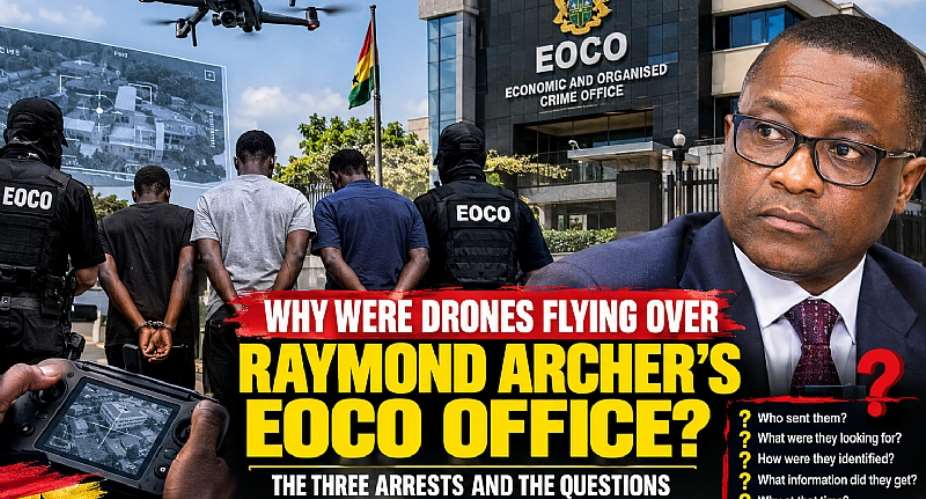
A drone hovering over an ordinary commercial building may be nothing more than photography, surveying or curiosity. But a drone flying over the premises of Ghana's Economic and Organised Crime Office (EOCO)—a law‑enforcement institution handling sensitive investigations—raises a very different set of questions.
According to a report published on October 1, 2026, three people have been arrested after drones were flown over EOCO’s premises while Manhyia South MP Nana Agyei Baffour Awuah was at the office answering questions. The report has immediately created a second security story around an already controversial EOCO investigation.
But there is an important problem: the publicly available reporting at the time of writing does not yet establish the identities of the three arrested persons, who commissioned the drone operation, their occupations, the precise purpose of the flight, or what information they allegedly obtained. Those details should not be invented or presented as fact. And that is precisely where the story becomes more interesting.
The timing is the first major question
The reported drone operation did not occur at an apparently random time. It happened while Baffour Awuah was at EOCO in connection with an investigation that has already generated considerable controversy.
EOCO had previously said that it invited the MP twice in February 2026 to assist with an ongoing investigation. After an attempted arrest at the Accra High Court on September 23, the matter escalated into a public dispute over whether the MP had properly been invited and whether EOCO followed the appropriate procedure. A High Court subsequently issued a warrant authorising EOCO to arrest him after the agency told the court that it had exhausted reasonable means of securing his voluntary attendance. JoyNews reported on October 1 that Baffour Awuah was expected to report himself to EOCO that day.
Against that background, three people allegedly flying drones over EOCO while the MP was inside is bound to attract attention. Why that particular day? Was it coincidence? Was somebody trying to obtain images of the EOCO compound? Were they interested in who was entering and leaving? Were they trying to establish whether Baffour Awuah was actually inside? Were they recording the arrival or departure of particular investigators? Or was the operation simply legitimate drone activity that happened to take place at the same time?
Those are questions for investigators, not conclusions for journalists.
Who were the three people?
This is perhaps the biggest unanswered question. The report confirms three arrests, but the reliable publicly accessible material available so far does not establish their names, occupations or affiliations. That distinction matters. It would be irresponsible to take names of drone operators found elsewhere on the internet and attach them to this case simply because they happen to work in drone mapping, photography, surveying, media or security.
The investigation should establish:
- Who owned the drone?
- Who was physically operating it?
- Who else was present?
- Who paid for the operation?
- Was the drone registered?
- Was the operator licensed?
- Was the flight authorised?
- What was recorded?
- Where was the drone being controlled from?
- What was contained on its memory card?
- What phones were being used?
- What communications took place before the flight?
- Who instructed the operators to go there?
Until those questions are answered by EOCO, the police, the Ghana Civil Aviation Authority (GCAA) or a court, the identities and motives of the three suspects remain matters for investigation.
What were they looking for?
This may ultimately become the most important question in the entire incident. A drone can provide information that a person standing outside a building cannot easily obtain. It can capture:
- photographs
- video
- vehicle movements
- building layouts
- entrances and exits
- security arrangements
- movements of individuals
- surrounding structures
- patterns of activity
But none of this establishes that the three suspects were actually doing any of those things. Investigators will have to determine what the drone’s camera was pointed at and what material was captured.
If the drone’s footage contains nothing connected to EOCO’s activities, the explanation could be relatively mundane. If, however, the footage shows systematic observation of EOCO’s premises, vehicles, personnel or security arrangements, investigators would understandably want to know why.
And who sent them?
This is the question that could transform a relatively simple drone incident into a much larger investigation. If the three acted independently, investigators may be dealing with unauthorised drone activity. But if they were acting on instructions, the investigation could move beyond the operators to the person who commissioned the operation.
Who made the telephone call?
Who transferred the money?
Who arranged the drone?
Who selected the location?
Who selected the time?
Who knew that Baffour Awuah would be at EOCO?
And perhaps the most important question: How did whoever commissioned the operation know that this was the moment to fly the drones?
What did EOCO recover?
The public reporting currently available does not provide a verified inventory of everything allegedly recovered from the three suspects. That information should eventually become central to the case.
Were the drones seized?
Were their controllers seized?
Were memory cards recovered?
Were mobile phones taken?
Were laptops or tablets found?
Were there photographs or videos of EOCO?
Were there WhatsApp messages?
Were there payment records?
Were there GPS coordinates or flight logs?
Modern drones and their associated applications can retain substantial operational information. If investigators have access to the relevant devices and data, those records could potentially help establish where the drone travelled, when it flew and how it was operated.
Ghana already has rules governing drones
The drone question is not legally unregulated. The Ghana Civil Aviation Authority regulates remotely piloted aircraft systems (RPAS), commonly called drones. GCAA says all unmanned aircraft systems fall under its regulatory framework.
GCAA guidance states that operators cannot simply fly RPAS in restricted, prohibited or danger areas without appropriate authorisation. It also sets requirements concerning registration, permits, operating conditions and other safety considerations.
GCAA’s specific No‑Fly Zones framework was developed with the Ministry of National Security and covers locations regarded as high‑risk or restricted operational zones. GCAA also has a procedure for obtaining approval to operate in a no‑fly zone, including approval linked to the specific location, drone and period of operation.
That makes one question unavoidable: Did these operators have permission?
If they did, who authorised them?
If they did not, why did they fly there?
Can flying a drone over EOCO lead to imprisonment?
This requires legal caution. Unauthorised drone activity does not automatically mean that somebody will be sent to prison. GCAA’s published RPAS sanctions framework includes civil penalties for various violations, including operating an unregistered RPAS and certain unauthorised operations.
However, Ghanaian aviation law also contains criminal provisions concerning unsafe aircraft operations. The Civil Aviation Act framework, for example, has historically criminalised dangerous flying that causes or is likely to cause unnecessary danger to persons or property, with possible fines or imprisonment.
Therefore, whether the three suspects could face imprisonment would depend on what investigators establish, the precise legal provision invoked, whether the conduct satisfies the elements of that offence, and what charges are eventually brought.
There is an important difference between:
- “They flew a drone without authorisation.”
- and
- “They committed a specific criminal offence punishable by imprisonment.”
The second proposition requires the facts and the applicable law to be established.
Could other criminal offences become relevant?
Potentially—but only if the evidence supports them. For example, if investigators established that the drone operation was part of a broader scheme involving unlawful surveillance, interference with an investigation, threats, trespass, obstruction, destruction or attempted acquisition of protected information, additional offences could potentially arise depending on the facts.
But there is currently no verified public evidence establishing that the three committed such offences. That is why the investigation should proceed from evidence to charge, not from arrest to assumption of guilt.
Why is this incident particularly sensitive?
EOCO is not a normal private office. It is Ghana’s specialised institution for investigating economic and organised crime. The agency has recently been handling politically sensitive and financially significant investigations, including the matter involving Baffour Awuah.
Raymond Archer has also publicly stressed the increasingly sophisticated use of technology by organised criminal networks, including social media, digital systems and other technologies. Consequently, a drone appearing over EOCO’s premises naturally attracts more scrutiny than a drone taking pictures at a wedding.
But the same principle must apply: Security concerns cannot replace evidence.
The Baffour Awuah connection raises another question
There is another extraordinary coincidence. The drone incident reportedly occurred while Baffour Awuah was answering questions at EOCO. His relationship with EOCO has already become a major public controversy.
EOCO says it invited him twice in February and that he did not honour the invitations. Baffour Awuah disputes aspects of that account and says a representative of his law firm subsequently cooperated with EOCO’s investigation and provided information and a written statement.
So investigators will inevitably need to establish whether the drone operation had anything whatsoever to do with the MP. That does not mean it did. It means the timing makes the question legitimate.
Was somebody watching EOCO or watching Baffour Awuah?
This is perhaps the question nobody should ignore. Suppose the drone was deliberately deployed. There are several fundamentally different possibilities:
- Legitimate commercial work
- Recording a person or event at EOCO
- Gathering information about EOCO’s premises
- Monitoring the movement of Baffour Awuah
- Working for a media organisation
- Working for a private individual
- Acting on behalf of an unknown third party
- Entirely unrelated to Baffour Awuah or EOCO’s investigation
Only evidence can distinguish among these possibilities.
What should EOCO tell Ghanaians?
Because EOCO itself has confirmed that it is handling a sensitive investigation involving Baffour Awuah, transparency about the drone incident would help prevent speculation. Subject to legitimate investigative and security considerations, the public deserves answers to basic questions:
- Who reported the drone to EOCO?
- Who detected it?
- How was the drone operator located?
- Where were the three suspects when they were arrested?
- Were they arrested inside or outside EOCO’s premises?
- Were the drones recovered?
- Were the drones registered with GCAA?
- Did the operators possess GCAA approval?
- What footage was recovered?
- Did the footage contain images of EOCO personnel or security arrangements?
- Were phones or computers seized?
- Did investigators find communications with another person?
- Did the suspects identify anyone who commissioned the operation?
- Were they professional drone operators?
- What was their stated reason for being there?
- Have they been charged or merely detained for questioning?
- Where are they now?
- Has the GCAA become involved?
- Has the Ghana Police Service or National Security been involved?
- Does EOCO believe the incident was connected to Baffour Awuah’s appearance?
These are not accusations. They are the basic questions required to understand an unusual security incident.
And perhaps the biggest question of all: Why would anyone choose EOCO?
If someone wanted aerial photography, Ghana has thousands of buildings, businesses, construction sites and properties that could be photographed. Why fly over an institution whose core business is investigation and intelligence? Why on the day a politically prominent lawyer and MP was inside answering questions? Why use a drone rather than simply observe from a public location? And if the operation was legitimate, why were three people arrested?
The answers could eventually make the incident look far less mysterious—or considerably more serious.
The story is not yet complete
The most responsible conclusion at this stage is not that the three suspects were spies, agents or criminals. It is this:
Three people have reportedly been arrested over drone activity above EOCO’s premises at a particularly sensitive moment. The circumstances warrant investigation, but the public evidence presently available does not establish their identities, motive, employer, client, intended target or whether they committed a criminal offence.
The crucial evidence will be what investigators find on the drones, phones and other devices—and what the three suspects tell EOCO.
And there is one question that could ultimately unlock the entire mystery:
Were the three men simply flying drones, or were they flying them because somebody wanted to know what was happening inside Raymond Archer’s EOCO?
Until that question is answered with evidence, the arrest is the beginning of the story, not the end.
By: Patrick Belebang Yagsori
0240292413
[email protected]

 Ghana gaining notoriety for cocaine — Bawumia
 Bawumia exposes NDC's ‘scam’ promises to Ghanaians
 NPP chairmanship: Sammy Crabbe backs John Boadu in last-minute show
 EOCO detention won't stop me from representing Salomey – Baffour Awuah
 NPP’s focus is to reclaim power in 2028 — Osahen Afenyo-Markin
 NPP must put aside differences, unite to rebuild party – Odeneho Kwaku Appiah
 NPP delegates approve 14 constitutional amendment motions
 NDC's 24-hour economy has turned into ‘24-hour demolition’ — Bawumia
 NPP adopts amendment to make flagbearer party leader
 NDC delegation exit NPP conference over delays, poor communication


