




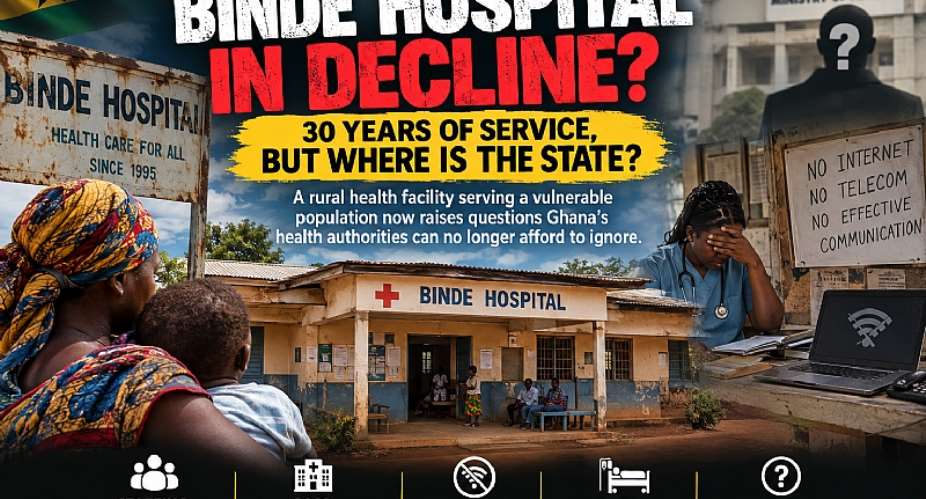
A rural health facility serving a vulnerable population now raises questions Ghana’s health authorities can no longer afford to ignore.
There are some questions that are uncomfortable to ask.
And then there are questions that become unavoidable when human lives are involved.
How can a hospital that has served the people of Binde and surrounding communities for decades struggle with staffing, infrastructure and basic connectivity in an era when Ghana is proudly talking about digital healthcare?
How can health workers be expected to deliver modern healthcare when the facility reportedly struggles even with reliable telecommunications and internet connectivity?
And perhaps the most uncomfortable question of all:
Does the Ministry of Health in Accra really understand the condition of Binde Hospital and the people who depend on it?
Binde Hospital is not an imaginary facility. It is officially recognised within Ghana's health system. Government records identify Binde Hospital as a health facility under the Ministry of Health, while earlier government documents identify it as Binde Rural Hospital in the Bunkpurugu-Yunyoo area.
Yet the questions surrounding its current condition demand urgent answers.
A hospital that has already survived one crisis
Binde's healthcare story is not new.
In fact, the hospital has experienced institutional difficulties before.
In 2007, the Binde Rural Hospital was reportedly closed for about three months following a dispute involving the Catholic Diocese and Rural MediCare over revenue and operational arrangements. At the time, the Ghana Health Service was responsible for staff salaries, while the Catholic Church had reportedly built the hospital structure and Rural MediCare supplied drugs.
The crisis was serious enough for the then Northern Regional Minister to demand its reopening, warning that closing a hospital in a deprived community could have devastating consequences.
That history should make today's concerns even more disturbing.
Because after surviving closure, institutional disputes and years of challenges, why should a hospital still be fighting for the basic tools required to function effectively?
WHO EXACTLY DOES BINDE HOSPITAL SERVE?
Binde Hospital is located in the Binde area of the present-day North East Region and forms part of the health infrastructure serving the Bunkpurugu/Nakpanduri area.
Government planning documents have previously described the district as having numerous health facilities, but also noted significant challenges in access. One government budget document reported that the district had 13 health facilities and that the Binde Rural Hospital had been reopened after a prolonged closure.
Binde is therefore not simply a hospital serving one small settlement.
Its importance lies in its role within a wider rural health network.
The facility has been identified in health research and disease-surveillance work, including a 2024 investigation into a suspected meningitis case at Binde Hospital.
That raises another question:
If national disease surveillance and public-health programmes depend on facilities such as Binde, why should those facilities themselves be allowed to operate without adequate human and technological resources?
THE STAFFING QUESTION: WHO IS SUPPOSED TO WORK THERE?
This may be the most serious issue.
A hospital is a building.
Healthcare, however, is delivered by people.
Doctors.
Nurses.
Midwives.
Laboratory professionals.
Pharmacists.
Administrators.
Records officers.
IT personnel.
Technicians.
Support staff.
If a hospital is inadequately staffed, its buildings become little more than empty promises.
So the Ministry of Health must answer:
What is the approved staff establishment of Binde Hospital?
How many staff members are currently working there?
How many positions are vacant?
How many health professionals have been posted to Binde in the last five years?
How many accepted postings but never reported?
How many requested transfers away from Binde?
And perhaps the question nobody wants to ask:
Is Binde Hospital being deliberately or unintentionally starved of the human resources necessary to function?
If staff are not being posted, who is responsible for making the postings?
If staff are being posted but refusing to report, what is the Ministry doing about it?
If workers are leaving because of accommodation, security, transportation or working conditions, what has the Ministry done to make Binde an attractive place for health professionals?
And if the problem is simply that there are not enough health workers nationally, why are some facilities consistently better positioned than others?
These are not political questions.
They are management questions.
And they deserve answers.
THE INTERNET QUESTION IS EVEN MORE EMBARRASSING
Ghana has spent years talking about digital transformation in healthcare.
The Ministry of Health itself has previously highlighted the Lightwave project and the networking of hospitals as part of the country's digital-health agenda.
And remarkably, Binde Hospital was specifically listed by the Ministry among facilities connected under the national hospital-networking initiative. In a 2022 Ministry of Health publication, Binde Hospital was named among health facilities in the northern part of Ghana that had been networked under the Lightwave project.
This creates a question that demands clarification:
If Binde Hospital was officially reported as networked, why are there reports of the facility struggling with internet or telecommunications connectivity?
Is the network no longer functioning?
Was the connection installed but not maintained?
Is there equipment but inadequate service?
Is the problem mobile network coverage rather than the government hospital network?
Or is there a disconnect between what is recorded in Accra and what health workers actually experience on the ground?
Who checked whether the connection was still working?
When was the last technical assessment conducted?
Who is responsible for maintaining it?
How much has been spent on connectivity at Binde Hospital?
These questions cannot be dismissed.
Because digital healthcare cannot exist merely in government presentations.
It has to work inside the hospital.
WHAT DOES THE HEALTH MINISTRY ACTUALLY KNOW ABOUT BINDE?
Here is perhaps the most uncomfortable question:
When was the last time a senior Ministry of Health official physically visited Binde Hospital to assess its challenges?
Not a report.
Not a spreadsheet.
Not a Zoom meeting.
Not a regional briefing.
Physically visited.
Walked through the wards.
Spoke to the nurses.
Spoke to the doctors.
Spoke to patients.
Checked the equipment.
Checked the internet.
Checked the staff accommodation.
Checked the laboratory.
Checked the maternity unit.
Checked the water supply.
Checked the electricity.
Checked the roads.
And asked one simple question:
"What do you need to provide better healthcare here?"
If that visit has happened, what were the findings?
And if it has not happened, why not?
WHAT ABOUT THE CHIEFS AND THE PEOPLE OF BINDE?
Government cannot carry the entire burden of healthcare infrastructure alone.
The people of Binde and their traditional authorities also have a legitimate role to play.
Historically, Binde's health story contains examples of community and non-state involvement. The Catholic Church, for example, played a significant role in establishing the rural hospital, while other partners contributed to medicines and operations. A 2004 international cooperation record also documents support for water collection and storage at Binde Rural Hospital.
There has also been evidence of organised interest in supporting the facility: a GCB Bank record, for example, lists a Binde Rural Hospital Donor Pool Fund.
But the questions remain:
What have the chiefs contributed to the hospital over the years?
What land, buildings, accommodation, fundraising or advocacy have traditional leaders provided?
Has the community established a sustainable hospital support fund?
How many development partners have the chiefs approached?
How often have community leaders formally petitioned the Ministry of Health?
And perhaps the most important question:
Have the people of Binde demanded enough from government or have they become accustomed to accepting too little?
Because government accountability becomes stronger when citizens refuse to remain silent.
BINDE'S CHILDREN DESERVE THE SAME HEALTHCARE STANDARD
Imagine a child becoming seriously ill at night.
Imagine a pregnant woman requiring urgent attention.
Imagine a patient needing a referral.
Imagine a laboratory professional needing to communicate urgently with another facility.
Imagine a doctor needing access to electronic medical information.
Now remove reliable connectivity.
Remove adequate staffing.
Add difficult roads.
Add distance.
Add poverty.
Add emergencies.
What remains?
Risk.
And in rural healthcare, delays can become deaths.
This is why Binde should not be treated as simply another remote hospital somewhere in northern Ghana.
THE MINISTRY OF HEALTH MUST ANSWER THESE QUESTIONS
The people of Binde deserve clear answers to at least these questions:
1. What is the current staff establishment of Binde Hospital?
2. How many approved positions remain vacant?
3. Why are qualified health professionals not being posted to fill those vacancies?
4. How many doctors, nurses, midwives, laboratory scientists, pharmacists and other professionals are currently stationed there?
5. What is the Ministry's plan to address the staffing gap?
6. When was Binde Hospital last comprehensively assessed by the Ministry of Health?
7. What is the current state of its medical equipment?
8. Is the hospital currently connected to the national health network?
9. If yes, why are there complaints about internet and telecommunications connectivity?
10. Who is responsible for maintaining the facility's connectivity?
11. How much public money has been allocated to Binde Hospital over the past five years?
12. How much has actually been released and spent?
13. What infrastructure projects have been completed at the hospital?
14. What projects remain outstanding?
15. What is the Ministry's long-term plan for Binde Hospital?
And finally:
Does the Ministry consider Binde Hospital a strategic healthcare facility or merely a name on a government list?
THE BIGGER QUESTION: DOES LOCATION DETERMINE THE VALUE OF A GHANAIAN LIFE?
This is where the Binde story becomes bigger than Binde.
Ghana's Constitution guarantees the right to adequate medical care and places responsibilities on the state to protect the health of its citizens.
Yet the reality of healthcare access can look very different depending on whether a person lives in Accra, Kumasi, Tamale or a rural community such as Binde.
That is the uncomfortable contradiction.
We speak about Universal Health Coverage.
We speak about digital healthcare.
We speak about modern hospitals.
We speak about transforming Ghana's healthcare system.
But can transformation be declared successful when rural facilities are still struggling with the basics?
BINDE DOES NOT NEED SYMPATHY. IT NEEDS A PLAN.
The people of Binde do not need another delegation to come, take photographs and promise that "something will be done."
They need measurable action.
Staff.
Equipment.
Reliable connectivity.
Infrastructure.
Accommodation for health workers.
Maintenance.
Accountability.
And a clearly published plan showing what the government intends to do and by when.
Because after decades of service, the question should no longer be:
"How long can Binde Hospital survive?"
The question should be:
"Why has a hospital serving rural Ghana for so many years not yet been given the resources necessary to thrive?"
And perhaps the question that should haunt the Ministry of Health most is this:
If Binde Hospital were located in Accra, would the Ministry tolerate the same conditions?
That is the question nobody should be afraid to ask.
By:
Patrick Belebang Yagsori
+233240292413
[email protected]

 Police arrest mother of suspected Nsawam highway robbery leader for hiding gun; ...
 How police busted armed robbery gang targeting gold dealers in Ashanti, Western ...
 Family demands answers over reported disappearance of corpse at Battor Catholic ...
 How errand boy murdered Dr Jesse Amuah and his wife and now arrested for hiding ...
 Police dismantle robbery gangs across Ghana; AK-47s and ammunition recovered
 Effiduase Asokore MP threatens to sue Reverend Owusu Bempah over defamation
 NPP Nasara wing in Ashanti condemns Reverend Owusu Bempah over divisive comments...
 Gov’t spent over GH¢49m to evacuate Ghanaians from South Africa's xenophobic ten...
 “The direction this country is going is dangerous, Ghana is sick" – Rev. Fr. Adu...
 Gov’t supports farmers for large-scale dry-season tomato cultivation to boost su...

