




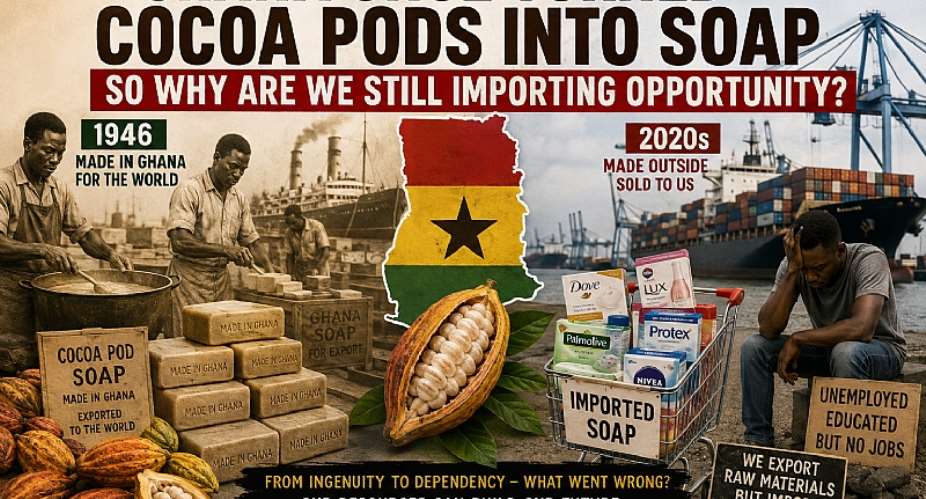
We are a country blessed with cocoa, gold, oil, bauxite, manganese, timber, shea, salt, arable land and a young population desperately looking for work. Yet decades after independence, we continue to debate how to create jobs, how to industrialise and how to reduce our dependence on foreign financing.
And nowhere is this contradiction more striking than in something most people hardly notice: the cocoa pod.
But before we romanticise history, there is an important correction that must be made.
There is no reliable evidence that in 1946 the Gold Coast had a large industrial cocoa-pod soap industry exporting soap internationally in the way the popular story sometimes suggests. What is well documented is that cocoa-pod husk has long been used in traditional soap-making in Ghana and West Africa, and that Ghanaian scientists and institutions have repeatedly demonstrated the potential to turn cocoa waste into soap and other products.
That correction actually makes the question more disturbing, not less.
Because if ordinary Ghanaian communities could understand the value of agricultural waste, why have successive governments struggled to transform that indigenous knowledge into a major modern industry?
THE FIRST QUESTION: WHO WAS PRESIDENT OF GHANA IN 1946?
There was no President of Ghana in 1946.
Ghana did not become independent until 6 March 1957. In 1946, the country was still the British Gold Coast colony.
The 1946 constitutional reforms were nevertheless significant. Africans gained a majority in the Legislative Council, with 21 of its 32 members being African. The first meeting of that legislature took place in July 1946.
The colonial governor at the time was Sir Alan Burns, who served as Governor of the Gold Coast from 1942 to 1947.
And here is where the historical comparison becomes uncomfortable.
It would be wrong to claim that Ghana had some visionary elected president in 1946 who personally built a cocoa-pod soap empire. That is not what the evidence shows.
The better question is:
If Ghanaian communities already possessed the knowledge to transform agricultural materials into useful products, why did successive governments after independence fail to build a much larger industrial system around that knowledge?
That is a much harder question.
THE COCOA POD: THE "WASTE" THAT ISN'T REALLY WASTE
When farmers harvest cocoa, the valuable beans are removed from the pod.
The enormous outer pod is left behind.
For decades, this has largely been treated as agricultural waste.
But scientifically, cocoa pod husk is anything but useless.
Cocoa pod husks contain significant potassium and other useful compounds. Research has identified possibilities including soap, animal feed, activated carbon, biofuels, chemicals and other value-added products.
One review notes that cocoa pod husks can constitute roughly 60–75% of the cocoa fruit, making the quantity of material generated potentially enormous.
Think about that.
Ghana does not need to discover a completely new natural resource.
We already have the raw material.
The question is whether we have the industrial system to exploit it.
THE KNOWLEDGE NEVER REALLY DISAPPEARED
Perhaps the most frustrating part of this story is that Ghana has not forgotten the technology.
Far from it.
Researchers at the Cocoa Research Institute of Ghana (CRIG) have worked on cocoa-pod-husk soap.
A 2015 study by researchers associated with CRIG documented soap made using potash derived from cocoa pod husk and vegetable oils. The researchers reported strong local demand and recommended expansion for local and international markets.
So the problem cannot simply be:
"We don't know how."
We do.
And we have known for a long time.
GHANA EVEN BUILT PILOT INDUSTRIES AROUND COCOA WASTE
This is where the story becomes almost unbelievable.
The International Cocoa Organization documents a Ghana project that investigated commercial uses for cocoa by-products.
The project examined:
cocoa-pod husk for animal feed and soft soap;
cocoa sweatings for alcohol, jelly, jam, wine, vinegar and soft drinks;
discarded cocoa beans for cocoa-butter soap and pomade.
Pilot plants were established in Ghana.
The cocoa-pod-husk operation was designed for an annual capacity of about 5,500 tonnes of pelletised animal feed and 100,000 500-gram tablets of soft soap.
So this is not merely an idea invented by today's critics.
Ghana has repeatedly experimented with converting cocoa waste into commercial products.
The tragedy is that the experiments did not automatically become major industries.
And that raises the question politicians rarely want to answer:
How many Ghanaian pilot projects have died after governments changed, funding ended, reports were written and officials moved on to their next assignments?
THE MOST DAMNING QUESTION: WHY DID WE NOT SCALE IT?
This may be the central question Ghana must confront.
We have universities.
We have research institutions.
We have engineers.
We have chemists.
We have entrepreneurs.
We have cocoa farmers.
We have millions of tonnes of agricultural biomass.
We have unemployed young people.
We have domestic demand for soap and personal-care products.
We have international markets increasingly interested in natural and sustainable products.
So what is missing?
The raw material? No.
The scientific knowledge? No.
The young people? No.
The market? No.
Then what?
Is it capital?
Is it industrial policy?
Is it political continuity?
Is it procurement?
Is it infrastructure?
Is it regulatory bottlenecks?
Is it poor commercialisation of research?
Is it weak private-sector financing?
Is it the absence of serious value-chain development?
Or, more uncomfortably:
Is Ghana's political system better at announcing industrialisation than actually building industries?
WE KEEP TALKING ABOUT JOBS BUT ARE WE LOOKING IN THE RIGHT PLACES?
Ghana's unemployment figures make this question impossible to ignore.
According to the Ghana Statistical Service, unemployment averaged 12.8% during the first three quarters of 2025, while youth unemployment averaged 21.9% among people aged 15–35. Nearly two million young people in that age group were classified as not in employment, education or training by the third quarter of 2025.
The situation was even worse for younger people in 2024: unemployment averaged 32% among people aged 15–24.
Yet we continue asking:
"Where will the government find jobs for the youth?"
Perhaps the more useful question is:
Why isn't government deliberately building entire industries around materials Ghana already produces?
Cocoa pods could be one example.
Not the entire solution.
But an example.
IMAGINE A COCOA-POD INDUSTRY
Imagine cocoa-producing communities having organised collection centres.
Instead of farmers leaving pods to rot, local enterprises could collect and process them.
One facility could produce potash.
Another could produce black soap.
Another could process fibre.
Another could produce animal feed where technically and economically appropriate.
Another could process biomass for energy.
Research facilities could develop higher-value chemicals.
Packaging companies could supply the industry.
Transport companies could move the products.
Marketing companies could build Ghanaian brands.
Exporters could sell finished products abroad.
Banks could finance processors.
Technical schools could train workers.
Universities could provide research.
Government could provide infrastructure, standards and incentives.
Suddenly, one cocoa pod becomes part of an economic ecosystem.
That is how industrialisation works.
It is not simply about building a factory.
It is about building an entire value chain.
AND GHANA'S SCIENTISTS ARE STILL SHOWING WHAT IS POSSIBLE
Recent research from Ghana has continued exploring cocoa-pod waste.
A 2025 study investigated cocoa-pod husk as a feedstock for biomethane and estimated potential methane yields of approximately 200–300 cubic metres per tonne of cocoa-pod husk, suggesting possible applications in renewable energy.
Another recent study involving researchers from the University of Cape Coast examined sustainable soap production using cocoa-pod ash and lemon-peel oil.
Researchers have also investigated thermochemical conversion of Ghanaian cocoa-pod husks into bio-oil, biochar and other potentially valuable products.
So the science is moving.
The question is:
Where is the industrial policy moving?
ARE WE ACTUALLY GOING BACKWARDS?
Not entirely.
That would be too simplistic.
Ghana today has universities, modern banking, telecommunications, sophisticated financial systems, advanced medical facilities, digital services, technology companies and industries that simply did not exist in 1946.
We cannot honestly say Ghana is technologically worse than it was eight decades ago.
But there is another form of backwardness.
Economic backwardness.
A country can have smartphones in every pocket and still export raw materials while importing finished products made from those same materials.
A country can produce cocoa and import chocolate.
It can produce agricultural waste and import chemicals.
It can produce oil and still struggle with refined petroleum products.
It can produce gold and struggle to manufacture sophisticated gold-based products at scale.
It can have millions of young people looking for work while enormous quantities of agricultural resources remain underexploited.
That is not technological backwardness.
That is structural underdevelopment.
THE IMF QUESTION
Ghana's current economic reality makes this debate even more urgent.
Ghana entered a major IMF-supported programme following the severe economic and debt crisis of the early 2020s. The IMF's 2026 assessment says the programme has contributed to stabilisation, falling inflation, stronger reserves and improved debt sustainability.
So it would be intellectually dishonest to say:
"The IMF has done nothing for Ghana."
It has provided financing and policy support during a difficult period.
But another question remains.
Can a country permanently borrow its way into development?
Loans can stabilise an economy.
They can finance infrastructure.
They can buy time.
But loans do not automatically create an industrial base.
Only productive investment, competitive industries, exports, productivity and sustained economic transformation can do that.
And that is where Ghana must be careful.
Because the ultimate objective cannot simply be:
"How much more financing can we obtain?"
It must become:
"How do we build an economy that increasingly needs less external financing?"
DID OUR PREDECESSORS UNDERSTAND SOMETHING WE HAVE FORGOTTEN?
Perhaps.
But not because people in 1946 were magically more intelligent than today's leaders.
They were not.
The difference may have been the nature of the economic problem they faced.
They lived much closer to the source of production.
Waste was expensive to ignore.
Imported goods were expensive.
Local production mattered.
Community knowledge mattered.
Resourcefulness mattered.
Today, Ghana has become much more sophisticated but sophistication can sometimes create distance between policymakers and production.
We produce reports.
We organise conferences.
We launch programmes.
We establish committees.
We hold ceremonies.
We make speeches about industrialisation.
But the farmer still looks at the cocoa pod lying on the ground.
And asks:
"What value are you going to create from this?"
THE LEADERSHIP QUESTION WE MUST NOT RUN AWAY FROM
Are Ghana's leaders the problem?
That question deserves a serious answer rather than a partisan one.
It would be unfair to blame every failure on every politician.
Ghana's development problems are also linked to colonial economic structures, commodity dependence, financing constraints, infrastructure deficits, weak industrial linkages, global market conditions, policy inconsistency and private-sector constraints.
But political leadership matters enormously.
Governments decide priorities.
Governments design incentives.
Governments fund research.
Governments build infrastructure.
Governments negotiate trade agreements.
Governments create regulatory systems.
Governments decide whether successful pilot projects are scaled.
And governments can either maintain industrial policy across administrations or abandon programmes every time political power changes hands.
So the question should not simply be:
NDC or NPP?
It should be:
Why has Ghana struggled to maintain a 20-, 30- or 50-year industrial strategy regardless of which party occupies Jubilee House?
That question is much more dangerous.
Because it attacks the system rather than a party.
WHY ARE WE STILL EXPORTING RAW VALUE?
Here is perhaps the question Ghana's political class should be forced to answer:
Why should Ghana remain satisfied with selling the world cocoa beans when the world makes chocolate, cosmetics, beverages, pharmaceuticals and other products from cocoa?
And why should cocoa pods be treated as waste when they contain materials that can support additional value chains?
The cocoa pod is a metaphor for Ghana itself.
We often extract the most obvious value and throw the rest away.
Then we complain that we are poor.
WHAT ARE GHANAIANS REALLY ASKING?
Increasingly, citizens are asking questions that go beyond political slogans.
Why are we always importing what we can potentially manufacture?
Why do governments announce factories without ensuring long-term competitiveness?
Why do promising research projects struggle to become businesses?
Why do universities produce research that rarely reaches commercial scale?
Why do politicians campaign on jobs but rarely publish detailed industrial job-creation value chains?
Why does every administration seem to want its own flagship programme instead of building upon what already works?
Why are young people encouraged to "start businesses" without sufficient access to affordable capital, markets, technology and industrial infrastructure?
And perhaps the most uncomfortable question:
Why does Ghana repeatedly discover solutions, document them, celebrate them and then fail to scale them?
THE YOUTH SHOULD BE ASKING A DIFFERENT QUESTION
Ghana's youth cannot afford to see unemployment purely as a government recruitment problem.
The country needs a completely different economic conversation.
Not:
"How many jobs will government create?"
But:
"What industries can Ghana build that create 10,000, 50,000 or 100,000 jobs?"
That requires thinking about cocoa waste, palm waste, cassava waste, plantain waste, rice husks, coconut waste, plastics, electronic waste, agricultural processing and countless other resources.
The future may not belong to countries that simply possess resources.
It may belong to countries that are best at converting resources into products.
GHANA DOES NOT HAVE A RESOURCE PROBLEM IT HAS A VALUE-CREATION PROBLEM
That may be the hardest conclusion of all.
The cocoa pod is only one example.
Ghana does not necessarily need another resource discovery.
We need to ask what we can do with what we already have.
We need industrial laboratories.
We need commercialisation funds.
We need patient capital.
We need technical skills.
We need reliable electricity.
We need efficient transport.
We need standards and certification.
We need export support.
We need government procurement that gives credible Ghanaian manufacturers a market.
We need policies that survive elections.
And above everything else:
we need leaders who think beyond the next election.
THE 1946 QUESTION IS NOT REALLY ABOUT SOAP
That is the biggest lesson.
The question is not:
"Why can't Ghana make soap from cocoa pods?"
Ghana actually can.
People are still doing it.
Researchers are still improving it.
Businesses are still producing black soap.
The question is:
Why has Ghana not turned this kind of knowledge into a large, competitive, technology-driven industrial ecosystem?
That is a completely different question.
And perhaps it should be asked about hundreds of other Ghanaian resources.
THE FINAL QUESTION GHANA MUST ANSWER
Maybe Ghana has not forgotten how to make soap.
Maybe we have forgotten something more important:
how to think about production.
A cocoa pod should not merely be a cocoa farmer's rubbish.
It can be a raw material.
A raw material can become a product.
A product can become an industry.
An industry can create jobs.
Jobs can create incomes.
Incomes can create businesses.
Businesses can generate taxes.
Taxes can reduce dependence on borrowing.
And reduced dependence on borrowing can strengthen national sovereignty.
That is the chain Ghana needs to build.
So perhaps the question we should be asking our political leaders is not simply:
"Where is the next IMF loan coming from?"
It should be:
"What are you building today that will make Ghana need fewer loans tomorrow?"
And when a young Ghanaian looks at a cocoa farm and sees thousands of discarded pods lying on the ground, perhaps the most painful question is this:
If the cocoa pod can become soap, energy, feed and industrial raw material, what else are we throwing away and then borrowing money to replace?
That is not merely an agricultural question.
It is not merely an economic question.
It is a leadership question.
And ultimately, it is a question about whether Ghana is truly moving forward or simply becoming more sophisticated at explaining why we have not yet developed.
By:
Patrick Belebang Yagsori
+233240292413
[email protected]
 No NPP General Secretary who lost election has ever been retained – Boakye Antwi
 G.Bissau votes 'yes' in referendum for new constitution
 IMF reaches agreement with Senegal on new $2.2 bn loan programme
 Police arrest suspected armed robber over Accra-Kumasi Highway robberies
 NPP demands answers over disappearance of Dambai resident
 Three killed, 15 injured in violent land dispute at New Winneba
 TOR returns to profit in almost a decade with GH¢1.09bn net gain in 2025
 Mahama calls for strengthening coordination among Non-Aligned Movement member st...
 Adu Boahene trial: Justice Achibonga gives Atta-Akyea one more day to conclude c...
 Seidu Dapilah defends SIGA report, says NEDCo cut losses by 54% from GH¢650.75m ...

