




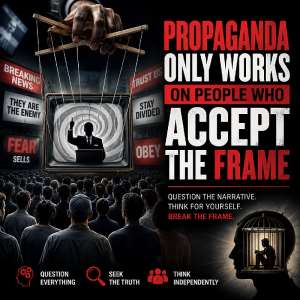
"A lie repeated often enough becomes accepted as truth not because it is true, but because people stop questioning it."
Every generation believes it is too intelligent to be manipulated. Yet history repeatedly proves otherwise. Some of the world's greatest tragedies from wars and genocides to corruption, authoritarianism, economic collapse, and social division did not begin with bullets or bombs. They began with stories. Carefully crafted stories. Stories designed not to inform people but to control how they think.
That is propaganda.
The frightening truth is this: propaganda does not succeed because it is true; it succeeds because people accept the frame through which the lie is presented.
Once people accept the frame, they often reject facts that contradict it. Reality itself becomes negotiable.
This is one of the greatest threats facing modern democracies, including Ghana and many nations around the world.
What Exactly Is Propaganda?
Propaganda is the deliberate use of information whether true, half-true, misleading, or completely false to influence people's beliefs, emotions, and behaviour for political, ideological, religious, military, or commercial purposes.
Unlike education, propaganda does not seek understanding.
It seeks obedience.
Unlike journalism, it does not encourage questions.
It discourages independent thinking.
Unlike science, it does not welcome criticism.
It fears criticism.
Its purpose is simple:
Control the narrative, and you control the people.
Why Does Propaganda Work?
This question has fascinated psychologists, neuroscientists, political scientists, and historians for decades.
If intelligent people can solve complex mathematical equations, why can they also believe obvious falsehoods?
The answer is uncomfortable.
Human beings are emotional before they are rational.
Research in psychology shows that people rarely evaluate information objectively. Instead, they often interpret facts in ways that protect their identity, political loyalty, religious beliefs, or social group.
Scientists describe this through concepts such as:
- Confirmation bias
- Motivated reasoning
- Cognitive dissonance
- Social identity theory
- Groupthink
These psychological tendencies make people naturally attracted to information that confirms what they already believe while rejecting evidence that challenges them.
The brain is designed to conserve mental energy.
Believing familiar stories is easier than questioning them.
Why Do Intelligent People Believe Propaganda?
Because intelligence alone does not protect anyone.
In fact, highly educated people sometimes become even better at defending false beliefs because they possess greater skills for rationalising them.
People believe propaganda because:
- They trust the messenger more than the evidence.
- They fear social rejection.
- They confuse repetition with truth.
- They want certainty in uncertain times.
- They seek emotional comfort rather than factual accuracy.
Fear, anger, hope, tribal loyalty, religion, ethnicity, and political identity are often far stronger than logic.
Why Do Politicians Use Propaganda Even When They Know It Is False?
This is perhaps one of democracy's greatest paradoxes.
Many politicians publicly preach honesty, integrity, accountability, and religious values.
Yet some deliberately spread misleading narratives.
Why?
Because propaganda is often politically profitable.
It can:
- Shift attention away from failures.
- Create imaginary enemies.
- Divide voters.
- Manufacture heroes.
- Destroy opponents.
- Rewrite public memory.
- Protect power.
Power has always rewarded those who successfully control public perception.
Unfortunately, perception and reality are not always the same.
The Religious Contradiction Nobody Wants to Discuss
Across many societies, political leaders publicly quote scripture.
They ask citizens to pray.
They speak about morality.
They condemn dishonesty.
Yet many knowingly circulate misleading information.
This raises uncomfortable questions.
If lying is condemned in every major religion...
Why does political lying often receive applause?
Why do followers excuse dishonesty simply because it comes from "their side"?
If ordinary citizens lied repeatedly at work, would they keep their jobs?
Why should public leaders be judged by lower moral standards than ordinary people?
Does political success now require abandoning the very moral principles leaders claim to defend?
These are questions many citizens quietly ask but few openly discuss.
What Do Scientists Say?
Behavioural scientists argue that misinformation spreads because it activates emotion before reason.
Neuroscientific studies suggest emotionally charged information is remembered more easily than neutral facts.
Political scientists warn that democracies weaken when propaganda replaces evidence-based debate.
Communication experts repeatedly stress that repeated exposure even to false information can increase familiarity, making it feel more believable over time.
This phenomenon is often called the "illusory truth effect."
In simple terms:
The more people hear something...
The more likely some are to believe it.
Even when it is false.
The Cost to Society
Propaganda rarely destroys a nation overnight.
It slowly weakens its foundations.
When lies become normal:
Trust disappears.
Institutions weaken.
Competence becomes less important than loyalty.
Experts are dismissed.
Journalists are attacked.
Citizens become divided.
Facts become political.
Eventually, national development slows.
Why?
Because good decisions require accurate information.
A country cannot solve problems it refuses to acknowledge.
Can a Nation Develop on Propaganda?
This may be the most important question.
Roads cannot be built with slogans.
Hospitals cannot be improved through political spin.
Schools cannot educate children on misinformation.
Economic growth cannot be sustained through manipulated statistics.
Foreign investors seek transparency.
Scientists require evidence.
Businesses require predictability.
Citizens deserve truth.
History consistently shows that societies built on deception eventually face painful consequences.
How Does Propaganda Begin?
It rarely starts with one massive lie.
It often begins with small distortions.
Selective facts.
Emotional headlines.
False comparisons.
Blaming others.
Creating fear.
Rewarding loyalty over truth.
Over time, these distortions become accepted narratives.
Eventually, questioning them becomes socially dangerous.
That is when propaganda becomes culture.
What Is the World Thinking?
Around the world, researchers, journalists, educators, and democratic institutions increasingly warn about the dangers of misinformation and propaganda.
Many countries are investing in media literacy because they recognise that an informed citizenry is essential to democracy.
Globally, truth is increasingly viewed as a national security issue.
A population unable to distinguish facts from manipulation becomes vulnerable not only to domestic deception but also to foreign influence.
Should Young People Learn This Behaviour?
Here is another uncomfortable question.
Would respected professionals encourage their own children to build careers by spreading deliberate falsehoods?
Would teachers advise students that dishonesty is the path to leadership?
Would judges encourage manipulation over justice?
Would doctors prescribe deception instead of medicine?
If the answer is no...
Why should society celebrate public figures who rely on propaganda?
Young people learn more from what leaders do than from what leaders say.
The Questions Nobody Wants Citizens to Ask
Instead of asking:
"Who said it?"
Perhaps we should ask:
- Is there credible evidence?
- Who benefits from this narrative?
- What facts are missing?
- Why is emotion being used instead of evidence?
- Would this claim survive independent verification?
- What happens if the opposite were true?
- Are we defending truth or merely defending our political tribe?
- If today's lie benefits us, what prevents tomorrow's lie from hurting us?
- Can democracy survive if citizens reward manipulation instead of honesty?
- Have we become so loyal to personalities that we no longer demand integrity?
What Are Ordinary People Saying?
Across many societies, citizens increasingly express frustration over political messaging that appears to prioritise image over substance.
Some argue that propaganda has become easier to spread through social media, where sensational content often travels faster than verified information.
Others worry that constant exposure to conflicting narratives leaves people confused, cynical, or distrustful of all institutions including those that deserve public confidence.
Still, many citizens believe the solution is not censorship, but stronger critical thinking, independent journalism, media literacy, and a culture that values evidence over emotion.
Conclusion: The Greatest Defence Is a Questioning Mind
Propaganda is not powerful because it is truthful.
It is powerful because too many people stop asking questions.
A healthy democracy does not fear scrutiny.
Honest leaders do not fear evidence.
Strong institutions do not fear transparency.
The greatest defence against propaganda is not merely intelligence.
It is intellectual humility the willingness to examine evidence, challenge our own assumptions, and change our minds when the facts demand it.
Perhaps the future of every nation depends not on how loudly its leaders speak, but on how courageously its citizens think.
Because in the end, propaganda only works on people who accept the frame.
The moment citizens begin asking better questions, propaganda begins to lose its power.
And perhaps that is exactly why some people fear informed citizens more than informed opponents.
By:
Patrick Belebang Yagsori
+233240292413
[email protected]
 Lands Ministry opens up on galamsey: 8,900 hectares lost, 258 arrested, 4,000 ex...
 Dzifa Gomashie orders demolition of illegal structures around Forts and Castles
 Monies spent on national cathedral could have completed some Agenda 111 Hospital...
 Ghanaians deserve to know the Mahama relative named in Asante Berko bribery case...
 Upper East: Nurses to get 1,320 medical kits under free primary healthcare
 ‘Terrible’ Bolga-Wa road will soon be history – Road Minister assures Mahama dur...
 Mahama backs UTAS medical school in Navrongo, secures funding for abandoned lab
 Adonten Division destools Aduaben Krontihene on Asantehene’s directive
 GCB denies robbery attempt at Labone Branch after Police shoot two suspects
 Death toll rises to 12 in Pokuase-Achimota multi-vehicle accident

