




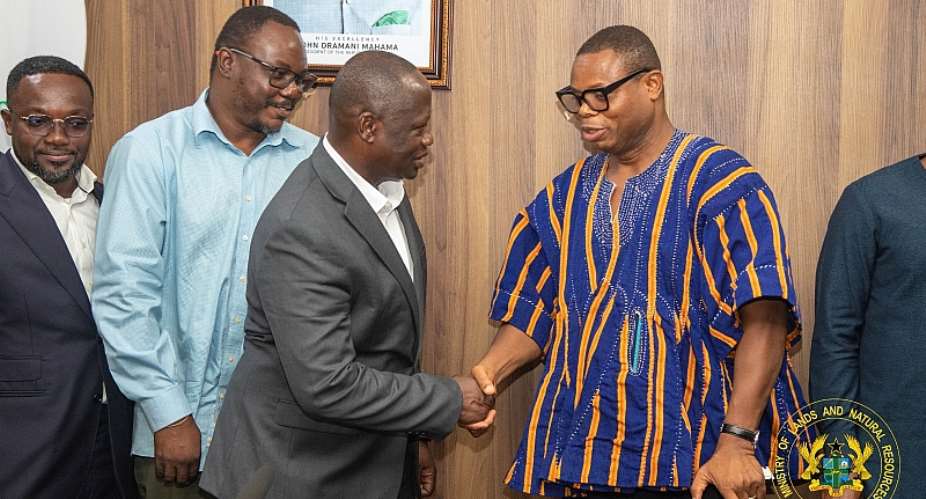
The Ministry of Lands and Natural Resources has disclosed sweeping new details about Ghana’s fight against illegal mining, including the destruction of about 8,900 hectares of forest reserves, the arrest of 258 suspects, the seizure of 200 excavators and a new import control regime that has left more than 4,000 excavators awaiting clearance at the ports.
The Ministry also revealed plans to reduce the maximum initial duration of large scale mining leases from 30 years to 20 years, strengthen community participation in licensing and tighten rules governing mineral concessions.
The disclosures were made during a strategic working visit and policy dialogue between the Ministry of Lands and Natural Resources and the IMANI Centre for Policy and Education at the Ministry in Accra.
IMANI had formally requested the engagement to examine the Ministry’s inherited baseline, performance, operational challenges, reforms and major policy initiatives. Its August 10, 2026 letter described the exercise as a fact finding and alignment dialogue intended to provide a deeper empirical understanding of the sector.
Present were Minister for Lands and Natural Resources Emmanuel Armah Kofi Buah, senior officials of the Ministry and representatives of agencies including the Forestry Commission, Minerals Commission, Lands Commission and Ghana Geological Survey Authority, alongside other technical officials.
The IMANI delegation was led by Franklin Cudjoe, Founding President and CEO, and included Selorm Branttie, Vice President for Strategy; Kay Codjoe, writer and IMANI associate; and Ransford Brobbey, IMANI associate.
8,900 HECTARES OF FOREST DESTROYED
Kofi Buah told the meeting that Ghana has 288 forest reserves, but illegal mining and other destructive activities had caused severe degradation in a number of them.
According to the Minister, about 8,900 hectares of forest reserve had been completely degraded, an area he compared to roughly 12,500 football fields.
Nine reserves were identified among the most severely affected, with some areas becoming so difficult to control that Forestry Commission personnel struggled to enter because of the number of illegal miners, violence and the presence of weapons.
The Minister said earlier estimates had understated the extent of destruction because they relied on older data, with the updated assessment revealing a substantially larger affected area.
Showing images of damaged reserves during the presentation, Kofi Buah remarked:
“What you are looking at is not an earthquake. It is a forest reserve.”
He said restoring the devastated forest landscape would require enormous financial resources.
258 ARRESTED, 200 EXCAVATORS SEIZED
A Ministry presentation titled “Illegal Mining in Forest Reserves”, with figures current as of July 2026, showed extensive enforcement activity.
Enforcement item Total as of July 2026
Suspects arrested 258
Excavators seized 200
Excavators immobilised 34
Pumping machines seized 1,469
Pumping machines immobilised 1,259
Changfan machines seized 950
Changfan machines immobilised 774
Tricycles seized 48
Tricycles immobilised 96
Motorbikes seized 285
Motorbikes immobilised 32
Structures immobilised 801
Gold detectors seized 82
The figures mean 234 excavators, 2,728 pumping machines and 1,724 changfan machines had either been seized or immobilised in the forest reserve operations.
Another 461 motorbikes and tricycles had similarly been seized or immobilised.
The data offers a picture of illegal mining as an organised operation sustained by heavy machinery, water pumping systems, transport networks, structures and specialised equipment.
MORE THAN 4,000 EXCAVATORS AWAITING PORT CLEARANCE
Kofi Buah separately disclosed during his oral presentation that more than 4,000 excavators were being held at the ports pending compliance with a new documentation and clearance system.
Under the new regime, importers are expected to establish who is importing the equipment, the intended end user and where the excavator will operate before it is cleared.
The Minerals Commission has established a presence at the port as part of the system.
The Minister said approved equipment could subsequently be fitted with tracking technology and geofenced to its declared operational area.
The objective, he said, was eventually to bring every excavator operating in Ghana within a traceable system.
Commercial importers who bring in excavators for resale have also been asked to establish legitimate orders and prospective end users.
The policy represents an attempt to stop illegal mining equipment before it reaches mining sites rather than waiting for security agencies to chase excavators after environmental damage has already occurred.
“THE PROBLEM IS PROSECUTION”
Despite the enforcement numbers, Kofi Buah acknowledged a significant weakness in the anti galamsey campaign.
“The challenge we are having is not the arrest. It is the prosecution.”
The Ministry’s own July figures show 258 arrests, but the presentation did not provide a corresponding breakdown of how many suspects had been charged, prosecuted, convicted, acquitted or still had cases pending.
The Minister said the Ministry was working with the Attorney General’s Department on the prosecution challenge.
The disclosure creates a major accountability test for the anti illegal mining campaign.
The State can now show how many people it has arrested and how much equipment it has seized.
It must also show what happens when those suspects enter the justice system.
CHANGFAN SUPPLY CHAIN UNDER SCRUTINY
The 1,724 changfan machines seized or immobilised also prompted questions about where the equipment originates.
Kofi Buah said many changfans are fabricated locally, describing areas where workshops manufacture the machines before they are transported to mining sites and water bodies.
That shifts attention beyond miners found at the rivers to the broader network supplying the illegal operations.
It raises questions about who manufactures the machines, who finances their production, who buys them and how they reach protected forests and rivers.
2,728 PUMPING MACHINES AND THE WATER QUESTION
The seizure or immobilisation of 2,728 pumping machines also puts the environmental outcome of the enforcement campaign under scrutiny.
The Minister identified the pollution of water bodies as one of the most serious consequences of illegal mining.
Government has also recruited and trained approximately 2,000 Blue Water Guards as community based intelligence sources and first responders around affected water bodies.
Kofi Buah acknowledged that the programme had experienced disciplinary challenges, including allegations that some guards had accepted bribes, but maintained that the initiative was generally producing useful results.
The bigger question is whether the removal of thousands of machines is now producing measurable improvements in the quality of affected rivers.
MINING LEASES TO DROP FROM 30 TO 20 YEARS
Government is also moving to restructure the mining licensing regime.
Kofi Buah said the proposed new mining framework would reduce the maximum initial duration of large scale mining leases from 30 years to 20 years.
Government also wants to impose tighter obligations on holders of exploration and prospecting rights.
According to the Minister, Ghana has allowed individuals and companies to acquire concessions and hold them for years without undertaking meaningful exploration or development.
“People are just sitting on concessions for 30, 40 years. They are not doing anything. They are waiting for the next big investor to come so they can cash out,” he said.
The new approach is intended to require licence holders to demonstrate genuine work within prescribed periods.
COMMUNITIES TO GET GREATER SAY
The Ministry is also proposing District Mining Committees to increase local participation before some mining licences are approved.
Applications would be considered within affected districts, allowing officials and communities to examine the condition of the proposed mining area, including the presence of water bodies, farms and settlements.
Mining companies would additionally be required to enter into community development agreements.
Kofi Buah said companies should not simply determine their own corporate social responsibility priorities while communities have different needs.
The agreements are intended to create clearer development obligations between miners and affected communities.
ADAMUS: “WE HAVE A COUNTRY”
The Minister also used the engagement to defend regulatory action involving Adamus Resources, describing the case as a test of whether Ghana’s mining laws apply equally to large companies and smaller operators.
Kofi Buah said concerns had been raised through a report by a regional Chief Inspector of Mines and subsequently examined by another team dispatched from Accra.
According to the Minister, the second team found even more serious issues.
He alleged breaches relating to permits and unauthorised mining activity and said the company had not adequately cooperated with regulatory processes.
He also referred to questions concerning taxes, royalties, statutory fees and other financial obligations, although detailed supporting documentation for all the claims was not presented during the meeting.
“We have a country. We have institutions. The Minerals Commission is supposed to be the policeman in the industry,” Kofi Buah said.
He maintained that the decisions taken were justified but said the Ministry would respect any lawful review by a higher competent authority.
The discussion also opened a possible pathway towards resolving the dispute.
Franklin Cudjoe urged the Minister to consider offering Adamus Resources a final pathway through which the company could be shepherded by the Ministry to correct identified breaches and comply fully with the requirements of any future agreement.
Cudjoe argued that firm regulation should not necessarily foreclose remediation where an investor is genuinely prepared to correct breaches and comply with Ghanaian law.
He stressed particularly that Ghanaian investors in the mining sector must receive the same institutional protection, fairness and opportunity to regularise their operations as foreign investors.
The intervention effectively placed two principles alongside each other: mining companies must not be permitted to disregard the regulator, but legitimate local investors should equally be assured that regulatory power will be exercised fairly and consistently.
Kofi Buah indicated that the Ministry was open to such engagement where an operator demonstrated a genuine willingness to correct breaches and ensure that the problems did not recur.
The allegations against Adamus remain the Minister’s account of the regulatory dispute and require a substantive response from the company.
FROM ENFORCEMENT NUMBERS TO RESULTS
Taken together, the disclosures paint a picture of government attempting to fight illegal mining at several levels: equipment importation, field enforcement, forest protection, community surveillance, licensing reform, geological mapping and prosecution.
But they also establish clear benchmarks against which the policy can now be measured. The Ministry says 8,900 hectares of forest have been completely degraded.
ed.
It reports 200 excavators seized, alongside thousands of pumping and changfan machines taken out of operation.
It says more than 4,000 excavators are awaiting clearance at the ports under a tougher control system.
The next stage of accountability is therefore not another set of announcements. It is evidence of outcomes.
How many of the 258 suspects have been successfully prosecuted? How much of the 8,900 hectares has actually been reclaimed?
Are polluted rivers becoming cleaner?
Who owns the seized excavators and other equipment?
Has the State reached the financiers and organisers behind illegal mining rather than only the operators found at the sites?
Those are now the numbers that will determine whether Ghana’s latest anti-galamsey effort represents a sustained change in the system or simply a larger enforcement operation.
BY Kay Codjoe, Writer and IMANI Associate

 Lands Ministry opens up on galamsey: 8,900 hectares lost, 258 arrested, 4,000 ex...
 Dzifa Gomashie orders demolition of illegal structures around Forts and Castles
 Monies spent on national cathedral could have completed some Agenda 111 Hospital...
 Ghanaians deserve to know the Mahama relative named in Asante Berko bribery case...
 Upper East: Nurses to get 1,320 medical kits under free primary healthcare
 ‘Terrible’ Bolga-Wa road will soon be history – Road Minister assures Mahama dur...
 Mahama backs UTAS medical school in Navrongo, secures funding for abandoned lab
 Adonten Division destools Aduaben Krontihene on Asantehene’s directive
 GCB denies robbery attempt at Labone Branch after Police shoot two suspects
 Death toll rises to 12 in Pokuase-Achimota multi-vehicle accident

