




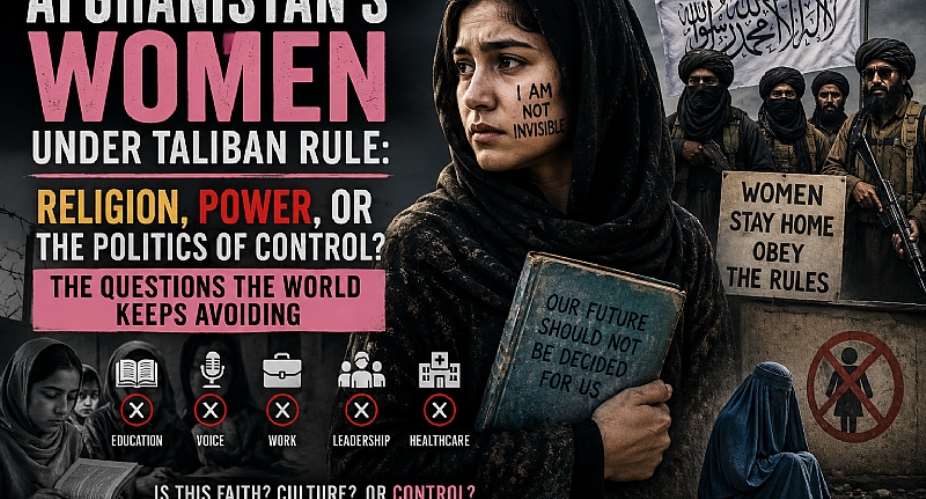
For centuries, religion has inspired compassion, justice, education, charity, and social order. Yet history also shows that religion has sometimes been interpreted or manipulated to justify political control, discrimination, and oppression. Nowhere is this debate more urgent than in Afghanistan under the Taliban.
Today, Afghanistan has become the only country in the world where girls are systematically prohibited from receiving education beyond certain levels and where women face sweeping restrictions on nearly every aspect of public life. International human rights organizations, including the United Nations, have described these policies as among the gravest contemporary violations of women's rights.
But before judging, another important question deserves attention: What reasons do the Taliban themselves give for these policies? Understanding their stated rationale does not require agreeing with it. If the world hopes to influence change, it must first understand the thinking behind it.
Beyond Headlines: What Is Really Happening?
Since returning to power in August 2021, the Taliban have imposed restrictions that include limiting girls' education beyond primary school, restricting many forms of women's employment, requiring women in many situations to travel with a close male relative (mahram), enforcing strict dress codes, and reducing women's participation in public life.
To many observers, these measures represent a systematic removal of women from society.
This raises one unavoidable question:
Can a nation truly achieve its full potential when half of its population is prevented from contributing fully to education, healthcare, science, business, governance, and innovation?
Religion or Political Authority?
The Taliban insist that their policies are based on their interpretation of Islamic law and Afghan cultural values.
Yet many respected Islamic scholars, governments from Muslim-majority countries, and international Islamic organizations have publicly challenged this interpretation. Across the Muslim world, women serve as doctors, professors, judges, engineers, entrepreneurs, parliamentarians, ministers, and university lecturers while observing Islamic principles.
This raises another difficult question:
If Islam is practiced in more than 50 Muslim-majority countries, why is Afghanistan an extreme outlier regarding women's participation in public life?
Is this truly a religious requirement?
Or is religion being interpreted in a uniquely restrictive way to reinforce political authority?
What Are Afghan Women Saying?
Despite enormous personal risk, many Afghan women have continued to speak out.
Some describe feeling "erased" from society.
Others say they fear their daughters may never experience opportunities they themselves once had.
Many have organized peaceful protests, written anonymous testimonies, or continued teaching girls through underground schools.
At the same time, it is also true that some women support the Taliban's vision, arguing that it protects traditional family values, modesty, and social stability. Their voices receive less international attention but are part of the broader picture.
This complexity reminds us that Afghan women are not a single, uniform group. Their experiences and opinions vary.
Did They Grow Up Accepting This?
One of the most uncomfortable questions is whether generations of restriction can become normalized.
When someone grows up under severe limitations, do they view those limitations as ordinary?
History suggests this can happen in many societies. Practices once considered normal including racial segregation, child labor, denial of voting rights to women, and caste discrimination were eventually challenged because people questioned what had long been accepted.
This raises a profound question:
If someone has never experienced freedom, how do they know what freedom feels like?
Why Restrict Education?
Education has always been one of humanity's greatest equalizers.
Doctors treat patients because someone educated them.
Engineers build bridges because someone taught them.
Teachers educate future generations because someone invested in their learning.
So why deny girls access to education?
The Taliban argue that educational systems should conform to their interpretation of Islamic values and that existing structures require reform.
Critics respond by asking:
If education is valuable for boys, why is it not equally valuable for girls?
If educated women can become female doctors, midwives, and teachers, who will care for Afghan women in communities where cultural norms limit interactions with male professionals?
Can healthcare improve while restricting the education of future female medical professionals?
Governance Without Women?
History consistently demonstrates that diverse leadership often leads to more representative decision-making.
Women bring perspectives shaped by experiences that men do not share.
When women are absent from government, policy-making, and public institutions, critical issues affecting families, healthcare, education, and social welfare may receive less attention.
This leads to another important question:
Can decisions about women truly be complete when women themselves have no meaningful voice in making them?
The Taliban's Stated Concerns
Supporters of the Taliban often argue that modern society has become increasingly sexualized, materialistic, and morally permissive. They point to issues such as pornography, exploitation of women in advertising, family breakdown, substance abuse, and changing attitudes toward sexuality in some Western societies.
Some also express concern about developments such as the growing visibility and legal recognition of LGBTQ+ people in parts of Europe and North America, arguing that they wish to shield Afghan society from cultural influences they believe conflict with their religious values.
Whether one agrees or disagrees with these views, it is important to represent them accurately rather than dismiss them outright.
However, another question naturally follows:
Can protecting cultural or religious values justify restricting fundamental rights such as education, freedom of movement, or participation in public life?
Is there a middle ground where societies preserve their moral convictions while also recognizing women's equal dignity and opportunities?
Is Fear Driving Policy?
Another difficult question deserves careful reflection.
Is the exclusion of women rooted in confidence or insecurity?
Societies that educate women often experience improvements in public health, economic growth, and literacy.
Could empowering women strengthen Afghanistan rather than weaken it?
Or does greater female independence threaten existing power structures?
These are questions worth asking not only about Afghanistan but about any society where one group is systematically excluded from decision-making.
The Cost to Afghanistan
Beyond the human rights debate lies an economic one.
Excluding millions of educated women from the workforce reduces national productivity, limits innovation, weakens healthcare systems, and discourages international investment.
A country rebuilding after decades of conflict can scarcely afford to sideline half of its human capital.
The long-term consequences may extend far beyond this generation.
Questions the World Should Also Ask
While criticism of the Taliban is widespread, the international community must also look inward.
Why has diplomatic pressure produced so little change?
Have sanctions helped ordinary Afghan women or made their lives even harder?
Could greater engagement with Afghan civil society achieve more than isolation?
What responsibility do neighboring Muslim-majority countries have in encouraging interpretations of Islam that support both faith and women's participation in society?
Questions Afghan Women May One Day Ask Themselves
- If our daughters are denied education today, what opportunities will they have tomorrow?
- Can silence protect us, or does it prolong our struggles?
- What kind of Afghanistan do we hope future generations inherit?
- Is dignity something granted by governments or something every human being possesses by virtue of being human?
A Global Reflection
Afghanistan's crisis is not simply about Afghanistan.
It forces humanity to confront timeless questions about power, faith, culture, freedom, and human dignity.
Religion has inspired extraordinary acts of compassion throughout history. It has also, at times, been invoked by those seeking to consolidate authority. The challenge for every society is to distinguish between authentic religious conviction and the political use of religion.
The central question may not be whether Afghanistan is becoming more religious.
It may be whether religion is being interpreted in ways that enable justice, compassion, and human flourishing or in ways that primarily consolidate political control.
Ultimately, every society must wrestle with the same enduring question:
Can a nation truly become stronger by limiting the potential of half its population, or does lasting strength come from enabling every citizen women and men alike to contribute fully to the nation's future?
History will judge not only the decisions made in Afghanistan, but also how the rest of the world responded to them with wisdom, humility, consistency, and an unwavering commitment to the dignity of every human being.
By:
Patrick Belebang Yagsori
+233240292413
[email protected]

 Lands Ministry opens up on galamsey: 8,900 hectares lost, 258 arrested, 4,000 ex...
 Dzifa Gomashie orders demolition of illegal structures around Forts and Castles
 Monies spent on national cathedral could have completed some Agenda 111 Hospital...
 Ghanaians deserve to know the Mahama relative named in Asante Berko bribery case...
 Upper East: Nurses to get 1,320 medical kits under free primary healthcare
 ‘Terrible’ Bolga-Wa road will soon be history – Road Minister assures Mahama dur...
 Mahama backs UTAS medical school in Navrongo, secures funding for abandoned lab
 Adonten Division destools Aduaben Krontihene on Asantehene’s directive
 GCB denies robbery attempt at Labone Branch after Police shoot two suspects
 Death toll rises to 12 in Pokuase-Achimota multi-vehicle accident

