




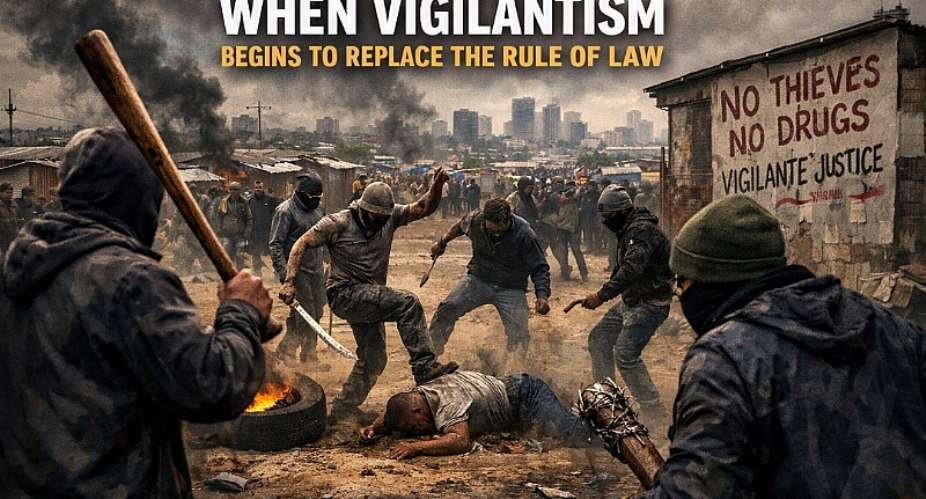
For decades, South Africa has been admired as one of Africa's greatest democratic success stories a nation that emerged from apartheid with a Constitution celebrated around the world for its commitment to human rights, equality, and the rule of law. Yet today, troubling scenes repeatedly shared across social media and international news platforms have raised uncomfortable questions about whether that constitutional promise is being tested in unprecedented ways.
Videos showing groups of self-appointed citizens confronting landlords, demanding proof of tenants' immigration status, threatening businesses, intimidating foreign nationals, and claiming to enforce immigration laws have sparked heated debate both within South Africa and across the African continent.
Whether these actions are carried out by organised groups or spontaneous community movements, they raise a fundamental question that no democratic society should ignore:
When ordinary citizens begin performing functions reserved for the state, who is truly governing the country?
Vigilantism or Frustration?
Supporters of these actions often argue that they are filling a vacuum left by ineffective governance. They point to unemployment, illegal immigration, rising crime, pressure on public services, and economic hardship as reasons communities have become impatient.
Many South Africans feel abandoned by institutions they believe have failed to protect their interests.
Yet frustration, however genuine, does not automatically justify vigilantism.
In every constitutional democracy, there is a clear distinction between demanding government accountability and assuming government authority.
Immigration enforcement belongs to trained law enforcement agencies and immigration officials not neighbourhood patrols, political activists, or angry crowds.
Once citizens begin deciding who belongs and who does not, the line between law enforcement and mob justice becomes dangerously blurred.
The Government's Contradictory Message
The South African government has repeatedly maintained that South Africa is not a xenophobic or Afrophobic nation. Officials frequently distinguish between criminal acts by individuals and the values of the Republic itself.
Legally and constitutionally, this position has merit.
However, perception often shapes international opinion more than official statements.
If videos repeatedly show foreign nationals being intimidated, businesses being threatened, or communities taking immigration enforcement into their own hands, many observers will judge the country by those images rather than government press conferences.
This creates an uncomfortable contradiction.
If the government insists there is no widespread xenophobia, why do these incidents continue to occur?
If law enforcement agencies are functioning effectively, why are ordinary citizens repeatedly stepping into their role?
If these actions are unlawful, why do many perpetrators appear confident enough to carry them out publicly?
These questions deserve honest answers not political slogans.
Is the State Losing Its Monopoly on Authority?
Political scientists often argue that one defining characteristic of a functioning state is its monopoly on the legitimate use of force and legal enforcement.
When unofficial groups begin enforcing immigration policy, inspecting communities, threatening landlords, or intimidating businesses, the issue extends beyond immigration.
It becomes a question of governance.
It raises concerns about whether state institutions are sufficiently present, trusted, and capable of carrying out their constitutional responsibilities.
Whether or not one agrees with the motives of these groups, allowing parallel systems of enforcement to become normal risks weakening respect for the rule of law.
The Economic Cost Few Are Talking About
South Africa remains one of Africa's largest economies and a major destination for investment, tourism, trade, and skilled professionals.
International investors do not only evaluate tax policies or infrastructure.
They also examine political stability, legal certainty, and institutional strength.
When headlines and viral videos suggest instability or arbitrary intimidation, they can influence investor confidence.
Potential consequences include:
- Reduced foreign direct investment.
- Lower tourism confidence.
- Greater concern among international businesses about operational risks.
- Damage to South Africa's reputation as a regional commercial hub.
- Increased insurance and security costs for businesses.
For local entrepreneurs, the uncertainty can be equally damaging.
Businesses thrive where laws not fear determine outcomes.
The Human Cost
Behind every statistic is a person.
Foreign nationals living legally in South Africa contribute as teachers, engineers, doctors, traders, academics, construction workers, and entrepreneurs. Many have built families, created jobs, paid taxes, and become part of their communities.
When lawful residents feel unsafe because of their nationality, fear replaces belonging.
At the same time, many South Africans living abroad also depend on the goodwill and protection of host countries.
Africa cannot demand dignity for its citizens overseas while remaining indifferent to the treatment of fellow Africans at home.
The principle must remain consistent.
Human dignity cannot depend on nationality.
The Zimbabwe Warning
Some commentators have drawn comparisons with Zimbabwe's period of political and economic decline, when tolerance of political violence, intimidation, and weakened institutions contributed to long-term instability. While South Africa's political and economic context is different, the comparison is used as a warning rather than a prediction: when governments fail to consistently uphold the rule of law and allow unlawful coercion to become normalized, reversing that trajectory can become increasingly difficult.
South Africa's institutions remain stronger than those of many countries on the continent.
But history repeatedly shows that institutions are weakened gradually not overnight.
What Are People Saying?
Public opinion is deeply divided.
Some South Africans argue that the government has failed to secure borders and enforce immigration laws, leaving communities to protect themselves.
Others believe these actions undermine the Constitution, fuel fear, and unfairly target people based on nationality rather than legal status.
Across Africa, many observers view the recurring incidents with concern, worrying that they strain regional solidarity and damage South Africa's standing as a leader on the continent.
International commentators have also questioned whether the country's institutions are responding consistently and effectively enough to reassure citizens, businesses, and investors.
Regardless of perspective, the debate reflects a broader challenge: restoring confidence that grievances can be addressed through lawful institutions rather than through public confrontation.
Questions South Africa Cannot Afford to Ignore
Perhaps the greatest danger facing South Africa today is not disagreement.
Democracies are built on disagreement.
The greater danger is losing confidence that disagreements can only be resolved through lawful institutions.
So the country must confront difficult questions:
- If citizens believe they must enforce immigration laws themselves, what does that reveal about public confidence in state institutions?
- Can a constitutional democracy remain credible if unofficial groups increasingly assume policing roles?
- How many investors quietly decide not to invest after watching videos of intimidation?
- How many skilled professionals decide not to relocate because they fear instability?
- How many tourists choose another destination because perception outweighs reality?
- Can South Africa remain the economic gateway to Africa if its international reputation continues to suffer?
- What message does it send to South Africans living abroad if foreigners at home are seen as unsafe?
- Does political silence reduce tensions or unintentionally embolden those willing to take the law into their own hands?
- How can legitimate concerns about immigration be addressed while fully protecting constitutional rights and the rule of law?
- If the law is no longer seen as the primary means of resolving disputes, what safeguards remain against future abuses?
Conclusion
South Africa possesses resilient democratic institutions, an independent judiciary, and one of the world's most progressive constitutions. Those strengths should remain the foundation for addressing difficult issues such as immigration, unemployment, crime, and social cohesion.
The long-term solution lies not in intimidation, but in effective governance; not in mob action, but in lawful enforcement; not in fear, but in institutions that command public confidence.
The world is watching not simply how South Africa confronts its challenges, but whether it does so in a manner consistent with the constitutional values that have long distinguished the nation.
The enduring question is not whether South Africa faces serious pressures. It clearly does. The real question is whether those pressures will strengthen the rule of law or erode it.
By:
Patrick Belebang Yagsori
+233240292413
[email protected]

 Ato Forson pays tribute to Omane Boamah, describes him as selfless and patriotic...
 Appeal Court backs District Court ruling against Zuriah FM broadcaster
 'Don't be negligent, verify before you buy' — CDA Consult on counterfeit goods a...
 Tension brews as Kpandai and Nkanchina communities threaten to shut down nursing...
 'Complete existing Accra-Kumasi Highway works before expressway' — Minority tell...
 'Fix existing Accra-Kumasi highway; expressway is not the solution to current pr...
 Delegate system is destroying Ghana – Asiedu Nketiah
 Ghana Water Ltd announces three-day shutdown of Kpong-Tema pipelines for mainten...
 Education Minister's claim on recruitment of 2023-trained teachers is factually ...
 Fuel intervention: 'Global shocks affect Ghana; NDC must admit that'— Adomako Ki...

