




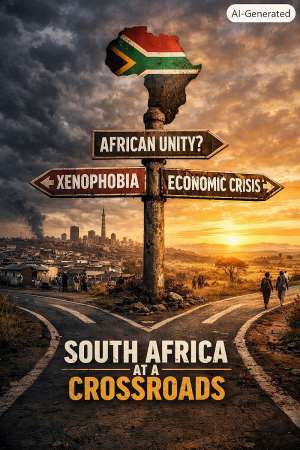
For decades, South Africa was presented to the world as a symbol of hope a nation that defeated apartheid, embraced democracy, and promised a future where dignity, equality, and human rights would rise above hatred and division.
But today, a painful question is confronting the continent and the world:
What happens when a nation that once fought against oppression begins to be accused of oppressing others?
South Africa stands at a dangerous crossroads. The country is not only battling unemployment, poverty, inequality, crime, and political distrust; it is also facing a growing crisis of identity a crisis that has placed African unity under severe pressure.
The recurring violence and hostility directed toward foreign Africans living and working in South Africa have forced the world to ask difficult questions:
Has economic frustration turned into a search for someone to blame?
Has the dream of African solidarity been replaced by a new form of exclusion?
And has South Africa forgotten that its own liberation was supported by Africans beyond its borders?
The Xenophobia Question: Is South Africa Fighting the Wrong Enemy?
One of the most uncomfortable realities facing South Africa is that many ordinary citizens are suffering genuine economic hardship.
Millions of South Africans struggle with unemployment, rising living costs, poor public services, and limited opportunities. For many young people, the promise of democracy has not translated into economic freedom.
But the deeper question is:
Why has the anger of the unemployed citizen often been directed at fellow Africans instead of the systems responsible for creating economic inequality?
Foreign nationals from countries such as Nigeria, Ghana, Zimbabwe, Mozambique, Ethiopia, and others have often been accused of taking jobs, controlling businesses, or increasing crime.
But critics ask:
Are migrants truly the architects of South Africa’s economic problems, or have they become convenient targets for frustrations caused by decades of policy failures, corruption, poor economic planning, and inequality?
A difficult question South Africa must confront is:
If millions of migrants suddenly disappeared tomorrow, would unemployment, poverty, and inequality automatically disappear with them?
Or would the country still face the same structural problems?
The Government’s Responsibility: Has Leadership Failed the People?
A government’s greatest responsibility is not only to create laws but to shape national attitudes.
The South African government has repeatedly condemned xenophobic violence and called for unity. However, critics argue that condemnation alone is not enough.
The harder question is:
Has the government done enough to address the economic conditions that create fertile ground for hatred?
When young people have no jobs, when communities feel abandoned, and when inequality becomes unbearable, frustration can easily transform into anger.
But another question remains:
Why has political leadership sometimes allowed the language of “foreigners stealing opportunities” to gain popularity instead of confronting the deeper failures of governance?
A nation cannot solve unemployment by creating enemies.
A nation cannot build prosperity by blaming vulnerable communities.
A nation cannot achieve greatness by turning neighbours into threats.
The Contradiction of South Africa’s African Identity
South Africa’s history creates one of the biggest moral questions facing the continent.
During apartheid, South Africans received support from across Africa. Countries sacrificed economically and politically to oppose apartheid. Many African nations welcomed South African freedom fighters, provided resources, and stood with the struggle.
This creates a painful question:
Does South Africa remember the African solidarity that helped bring its freedom?
When African migrants are attacked on South African soil, many Africans ask:
Has South Africa become disconnected from the very continent that supported its liberation?
The issue is not about denying South Africans their right to protect their jobs, borders, and resources.
Every country has that responsibility.
The question is whether protection has been replaced by hostility.
Economic Reality: Are Migrants Really the Problem?
South Africa’s economy is one of the most advanced in Africa, yet it remains one of the most unequal societies in the world.
This contradiction raises deeper questions:
How can a country with enormous natural resources, strong financial institutions, and developed infrastructure still leave millions of its citizens economically excluded?
Why are ordinary Africans fighting each other at the bottom while economic power remains concentrated among a small group at the top?
Some economists argue that migration can also contribute positively to economies through entrepreneurship, skills, investment, and consumer activity.
Many foreign nationals have created businesses, employed South Africans, and contributed to local economies.
So the uncomfortable question becomes:
Is South Africa attacking migrants because they are truly responsible for economic struggles, or because it is easier to blame outsiders than confront powerful internal systems?
The World Is Watching: South Africa’s Global Image at Risk
The world today is asking serious questions about South Africa.
A country that once inspired global admiration because of Nelson Mandela’s message of reconciliation now faces criticism over violence against African migrants.
The international concern is not only about individual incidents.
It is about what they represent.
The world is asking:
Can a country preach human rights internationally while struggling to protect the dignity of foreigners within its own borders?
Can South Africa continue to present itself as Africa’s economic leader while facing accusations of African exclusion?
What message does this send to investors, tourists, students, and future generations?
A nation’s reputation is not built only by its economy.
It is built by how it treats the vulnerable.
The Failure of African Unity: Is Pan-Africanism Dying?
The African Union and the dream of continental unity were built on the belief that African countries must work together.
But xenophobia exposes a painful weakness:
How united is Africa when Africans cannot peacefully live and work among themselves?
African leaders frequently speak about integration, free movement, and cooperation.
But ordinary Africans are asking:
Are these promises only speeches at international conferences, or realities that citizens experience every day?
The dream of a borderless Africa cannot survive if Africans see each other as enemies.
The Questions South Africa Must Answer
South Africa must face questions that cannot be avoided:
1. If foreigners are the main cause of unemployment, why has unemployment remained high despite years of immigration control efforts?
2. If migrants are stealing opportunities, why are many South African companies and industries still struggling with productivity and skills shortages?
3. If African unity matters, why do African migrants sometimes feel unsafe in the country that claims continental leadership?
4. Is South Africa protecting its citizens from competition, or protecting failed systems from accountability?
5. What kind of Africa are we building if Africans need protection from other Africans?
The Final Challenge: South Africa’s Choice
South Africa’s future depends on the choice it makes today.
It can choose a path of fear where economic pain creates hatred, where neighbours become enemies, and where history is forgotten.
Or it can choose a path of leadership where it confronts inequality, reforms its economy, strengthens institutions, and rebuilds trust with the continent.
The greatest danger facing South Africa is not only xenophobia.
The greatest danger is refusing to ask why xenophobia exists.
Because nations do not collapse only when they lose wealth.
Sometimes they collapse when they lose their moral direction.
South Africa once taught the world that reconciliation was possible.
The question now is:
Can South Africa teach Africa that unity is still possible or will history remember it as the country that helped break the dream of African brotherhood?
By:
Patrick Belebang Yagsori
+233240292413
[email protected]

 Mid-Year Budget Review: 'GH¢30bn in promised projects remain unexecuted' — Oppon...
 'This is the first Mid-Year Review that failed to account for programme executio...
 Police arrest 'fake' pastor over alleged marriage scam and intimate image blackm...
 'Ato Forson is spending prudently, not recklessly' — Titus Beyuo
 Zenith University College Law Faculty ranks among Ghana's top five at Supreme Co...
 Mid-Year Budget Review: 'The Finance Minister was loudly silent on the 24-hour e...
 GES sets August 15 for dispatch of teacher promotion letters
 Mahama welcomes Gabon's President for three-day bilateral talks on trade, securi...
 Multiple deaths in Japan mall collapse after 7.1-magnitude earthquake
 Anglican Church leader visits slave trade project on Africa tour

