




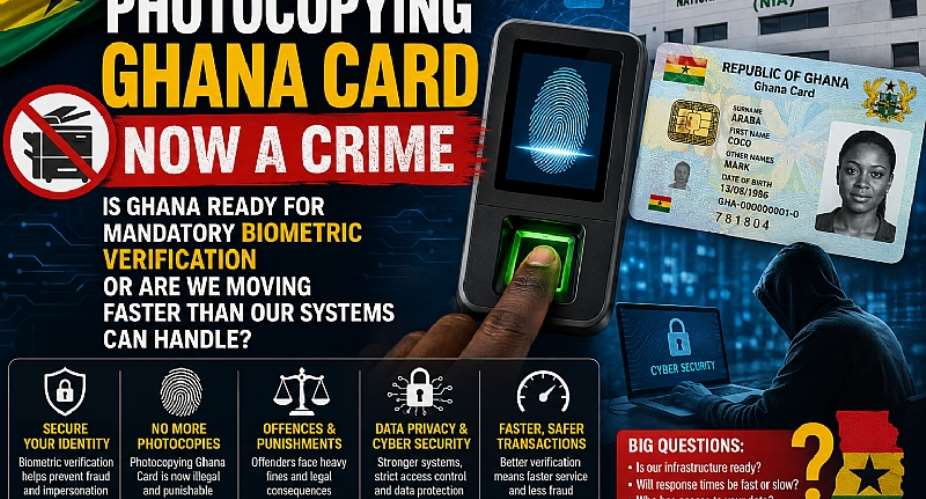
For years, Ghanaians have walked into banks, telecom shops, government offices, hospitals and private institutions carrying photocopies of their Ghana Cards. Some institutions requested two copies, others demanded coloured copies, while many simply glanced at the card and approved transactions.
That era is officially coming to an end.
The National Identification Authority (NIA) has announced that photocopying or visually inspecting the Ghana Card for transactional purposes is now an offence. Biometric verification has become mandatory under the amended identity registration regulations. Institutions are now expected to verify identities electronically through the NIA's identity verification platform.
This decision could become one of the most significant digital governance reforms in Ghana's history. However, it raises several difficult questions that many people are afraid to ask.
What Exactly Is the Difference Between the Ghana Card and Biometric Verification?
Many Ghanaians believe the Ghana Card itself is the verification tool. It is not.
The Ghana Card is simply an identity document that contains your personal information and links you to the national identity database.
Biometric verification, on the other hand, is the process of confirming that you are truly the owner of that identity by using unique biological identifiers such as fingerprints or facial recognition.
In simple terms:
Ghana Card = your digital identity.
Biometric verification = proving that the identity belongs to you.
This means possessing someone's Ghana Card or a photocopy will no longer be enough to impersonate them during transactions.
Why Has Government Taken This Decision?
The reasons are both technological and security-related.
For years, identity fraud has become increasingly sophisticated. Criminals have used:
Stolen Ghana Card photocopies.
Fake identification documents.
SIM registration fraud.
Bank account impersonation.
Mobile money scams.
Forged signatures.
Multiple identities during registration exercises.
Biometric verification makes such crimes significantly more difficult because fingerprints and facial data cannot easily be photocopied or forged.
The decision also aligns with Ghana's broader digitalisation agenda and the increasing use of the Ghana Card across the banking and telecommunications sectors. Earlier directives have already positioned the Ghana Card as the primary identity document for financial transactions.
But Has Ghana Properly Educated Its Citizens?
This may be where the biggest challenge lies.
Ask the average Ghanaian today:
What is biometric verification?
Will I need internet connectivity?
Can my fingerprint fail?
What happens if the NIA servers go offline?
Can elderly people easily verify their identities?
What happens in rural communities?
Many citizens still do not fully understand the difference between registration and verification.
Public education cannot simply consist of a press release or a television announcement.
A reform of this magnitude requires:
Radio campaigns.
Community education.
Market sensitisation.
Local language explanations.
Institutional training.
Digital literacy programmes.
Without adequate education, many Ghanaians may panic when institutions begin rejecting photocopies of their Ghana Cards.
Is Ghana's Infrastructure Ready?
This is perhaps the most uncomfortable question.
Biometric verification sounds excellent in policy documents. Implementation is where nations succeed or fail.
Several questions remain unanswered:
Can NIA servers handle millions of daily verification requests?
What is the expected response time?
Will verification take two seconds or two minutes?
What happens during internet outages?
What happens during system maintenance?
Will businesses stop operating when systems go down?
Are backup systems available nationwide?
Imagine:
Thousands of bank customers waiting.
Hospitals processing emergencies.
Telecom shops activating SIM cards.
Mobile money agents conducting transactions.
If verification takes too long, queues across Ghana could become unbearable.
Digital transformation should not become digital frustration.
Will Businesses Become Faster or Slower?
If implemented properly, businesses could become faster than ever.
Benefits include:
Faster customer onboarding.
Reduced fraud.
More accurate identity verification.
Less paperwork.
Improved record keeping.
Increased trust in transactions.
However, poor implementation could produce:
System downtimes.
Longer queues.
Higher operational costs.
Service delays.
Customer dissatisfaction.
Everything depends on infrastructure reliability.
Cybersecurity: Ghana's Biggest Challenge
The Ghana Card database is arguably one of Ghana's most valuable digital assets.
If compromised, the consequences could be devastating.
Cybercriminals today are not merely stealing money. They are stealing identities.
Questions we must ask include:
Is biometric data encrypted?
How secure are the NIA servers?
Are there regular cybersecurity audits?
Is there continuous monitoring?
Are employees receiving cybersecurity training?
Are third-party institutions properly secured?
A cyberattack against identity infrastructure could potentially affect:
Banks
Telecom companies
Government services
Financial institutions
Insurance companies
Healthcare systems
Biometric verification is only as secure as the systems protecting it.
Who Will Have Access to Our Data?
This remains one of the most important concerns.
Will every institution be allowed to see all your information?
Ideally, the answer should be NO.
Institutions should only receive:
Confirmation of identity.
Minimal information required for the transaction.
For example, a telecom company does not necessarily need access to your entire identity profile. A bank should not have unrestricted access to unrelated personal information.
Access control is critical.
There must be:
Strict authorisation policies.
Role-based access controls.
Audit trails.
Data protection compliance.
Severe penalties for data misuse.
Otherwise, insiders may become a greater threat than hackers.
What Crimes Could Arise?
Ironically, stronger security systems often attract more sophisticated criminals.
Potential crimes include:
Biometric spoofing attempts.
Insider data theft.
Illegal access to verification platforms.
Identity trafficking.
Social engineering scams.
Fake biometric devices.
Unauthorised data sharing.
Cyber extortion.
Criminals may also attempt to trick citizens into providing fingerprints or facial scans through fraudulent means.
Public awareness will therefore become as important as technological security.
What Are the Punishments?
Institutions that continue to rely on photocopies or visual inspection of Ghana Cards for transactional purposes now commit offences under the amended regulations.
Reports indicate that organisations may face fines ranging from 500 to 2,000 penalty units, while individuals may also face substantial penalties upon conviction. Based on the current value of a penalty unit, these fines could amount to thousands of Ghana cedis.
What Will Be the Role of the National Communications Authority?
The National Communications Authority (NCA) will have a significant role to play.
The NCA's responsibilities may include:
Telecommunications compliance.
Secure digital communications.
SIM registration oversight.
Data transmission standards.
Network reliability.
Regulatory collaboration with institutions.
Biometric verification depends heavily on digital communication infrastructure. Without stable and secure networks, verification services could be disrupted nationwide.
Can NIA Deliver Verification Responses Quickly?
This may determine whether the reform succeeds or fails.
The public deserves clear answers:
Will verification occur in seconds?
Is the system available 24/7?
What are the service-level guarantees?
What is the maximum downtime permitted?
How many simultaneous requests can the platform handle?
Institutions integrating with the NIA verification platform will expect speed, reliability and consistency.
If response times become slow, businesses across Ghana may suffer productivity losses.
The Questions Nobody Wants to Ask
Perhaps the most difficult questions are these:
Are we implementing technology faster than we are educating citizens?
Are our institutions cyber-secure enough for biometric transactions?
Can rural Ghana benefit equally from this reform?
What happens if the entire verification infrastructure goes offline?
Will small businesses be able to afford integration costs?
Have adequate data protection mechanisms been independently audited?
Are there sufficient penalties for government officials or institutional insiders who misuse citizen data?
Who watches the people who have access to our most sensitive information?
Are we building trust alongside technology?
Final Thoughts
The decision to prohibit photocopying of the Ghana Card and mandate biometric verification is, in principle, a bold and commendable step toward a more secure and digitally advanced Ghana. It has the potential to significantly reduce identity fraud, strengthen cybersecurity, and improve confidence in both public and private sector transactions.
However, technology alone is not enough. Successful implementation will depend on robust infrastructure, public education, strong cybersecurity safeguards, institutional preparedness, and transparent data governance.
The Ghana Card is more than just an identity card it is becoming the foundation of Ghana's digital economy. If this system works as intended, it could transform how Ghanaians access services and conduct transactions. If it is poorly implemented, it risks creating delays, exclusion, and new vulnerabilities.
The real question is not whether biometric verification is the future. It is whether Ghana is fully prepared for that future.
By:
Patrick Belebang Yagsori
+233240292413
[email protected]

 'Chief Justice was talking as a citizen; you have to look at the context in whic...
 Mandatory towing to remove broken-down, stationary vehicles from roads to begin ...
 Domelevo backs OSP probe into alleged GH¢70,000 payment to Appiagyei despite den...
 WAEC releases 2026 WASSCE results, cancels entire results of 861 candidates for ...
 Baffour Agyeman-Duah explains why profitability may not be only reason behind SO...
 Kofi Bentil defends Mahama’s dissolution of nine State Boards
 5-year-old girl dies after falling into water-filled manhole at Winneba
 Sierra Leone ex-president to return after treason case dropped
 'Explain how you spent your Common Fund' — Boako, Annoh Dompreh challenge Tano N...
 Ghana ends South Africa evacuation; brings home nearly 1,900

