




"We want the law to work until the law reaches our doorstep."
Perhaps no sentence captures Ghana's greatest national contradiction better than this.
Following devastating floods that have repeatedly claimed lives, destroyed homes, and caused millions of cedis in property damage across the country, many Ghanaians demand stronger enforcement of planning regulations, building codes, and environmental laws. Citizens ask why buildings are allowed on waterways, why illegal structures remain untouched, and why authorities wait until tragedy strikes before acting.
Yet when state institutions finally move to enforce those same laws, resistance often follows.
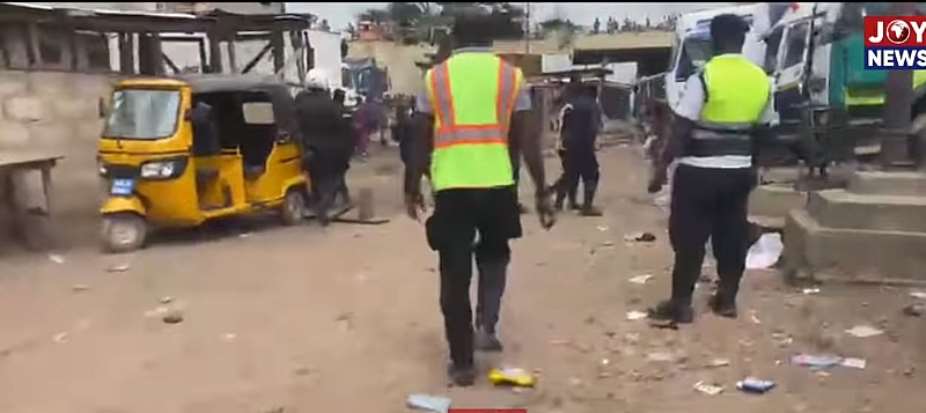
The recent demolition exercise by the Kumasi Metropolitan Assembly (KMA) at Asafo, which reportedly turned chaotic after some residents allegedly attacked members of the demolition taskforce including security personnel with stones and clubs, has once again exposed a difficult national question:
Do Ghanaians truly want the rule of law, or do we only support it when it affects someone else?
A Historical Problem, Not a New One
This is not a challenge created by one political party or one government.
For decades, successive governments have struggled to enforce development control regulations. Illegal construction on waterways, wetlands, road reservations, and public lands has continued despite existing laws.
Why?
Because enforcement has often collided with political pressure, public resistance, legal delays, and fears of electoral consequences.
Every administration promises discipline.
Every administration eventually faces resistance.
The result is predictable.
The laws exist.
The institutions exist.
Yet enforcement remains inconsistent.
Then disaster strikes.
The Flood Cycle That Never Ends
The cycle has become painfully familiar.
Heavy rains fall.
Communities flood.
Lives are lost.
Businesses collapse.
Government spends millions on relief.
Citizens blame government.
Experts identify blocked drains and illegal structures.
Government announces demolition.
Demolition begins.
The same citizens accuse government of being insensitive.
Politicians condemn the exercise.
The exercise slows.
Months later...
Another flood arrives.
And the cycle repeats.
The Questions Nobody Wants to Ask
Perhaps it is time to ask the uncomfortable questions.
Can a country develop if every attempt to enforce the law becomes a political battlefield?
Should emotions override planning laws that exist to protect lives?
Why do we demand accountability after disasters but resist preventive action before disasters occur?
If a structure is illegally built on a waterway, does its age suddenly make it legal?
If government refuses to demolish illegal structures and floods kill innocent people, who should bear responsibility?
Can sympathy replace engineering?
Can political slogans redirect floodwaters?
Can social media outrage stop a river from reclaiming its natural course?
These are uncomfortable questions.
But they deserve honest answers.
Democracy Is Not the Absence of Law
Some have begun asking whether democracy itself is the problem.
That question deserves careful consideration.
Democracy is often misunderstood.
Democracy does not mean every government decision will be popular.
It does not mean every enforcement action should be suspended because people protest.
True democracy is built on institutions, equality before the law, transparency, accountability, and respect for legal processes.
Countries widely regarded for effective governance including places such as Singapore, Rwanda, Japan, and the Germany operate under different political systems and histories. However, they share an important characteristic:
When planning laws are enforced, institutions generally carry out their mandates with relatively limited political interference, and legal disputes are typically addressed through established judicial processes rather than violence.
No country is perfect.
But development becomes difficult when laws exist only on paper.
Ghana's Political Culture
One of Ghana's greatest democratic achievements has been peaceful transfers of power.
Yet one of its greatest weaknesses is the tendency for almost every national issue to become politically polarized.
Floods become political.
Fire outbreaks become political.
Road accidents become political.
Power outages become political.
Illegal structures become political.
Even the enforcement of existing laws often becomes a contest between political parties rather than a discussion about public safety.
Instead of asking:
"How do we solve this problem?"
The debate often becomes:
"Which political party benefits?"
That shift weakens institutions and distracts from long-term solutions.
Rights Come With Responsibilities
Every citizen has rights.
But every citizen also has responsibilities.
The right to own property does not include the right to build illegally on waterways.
The right to protest does not include violence against public officials or security personnel.
The right to criticize government does not remove the obligation to obey laws that exist to protect everyone.
No society can function if rights are demanded while responsibilities are ignored.
Leadership Must Also Be Consistent
This conversation is not only about citizens.
Governments must also be held to a high standard.
The law should be enforced fairly, transparently, and without political favour.
Illegal structures should not be tolerated for years only to be demolished after disasters or during politically sensitive periods.
Authorities should strengthen public education, improve urban planning, provide clear notices, follow due process, and ensure that affected persons have access to lawful avenues to challenge decisions where appropriate.
Consistency builds public trust.
Selective enforcement destroys it.
The Future Ghana Must Choose
Perhaps the biggest question is this:
Do we want a nation governed by laws or by emotions?
Because the two cannot always coexist.
If Ghana truly wants cleaner cities, safer communities, proper drainage systems, orderly urban development, and fewer flood disasters, then difficult decisions will have to be made.
Some structures will have to be removed.
Some illegal developments will have to stop.
Some powerful individuals will have to face the same laws as ordinary citizens.
That is the price of building a nation where institutions matter more than influence.
Final Thoughts
The chaos witnessed during the Asafo demolition exercise should concern every Ghanaian not because enforcement occurred, but because it highlights how difficult it remains to uphold the rule of law consistently.
The challenge before Ghana is larger than one demolition exercise or one flood season.
It is whether the nation is prepared to support lawful, fair, and consistent enforcement even when it is inconvenient.
Because if we celebrate the rule of law only when it affects others but reject it when it affects us we risk remaining trapped in the same cycle of preventable disasters, public outrage, and delayed action.
The question is no longer whether Ghana has enough laws.
The real question is whether Ghana has the collective will to respect them.
By:
Patrick Belebang Yagsori
+233240292413
[email protected]
 Police arrest alleged notorious land guard wanted over multiple criminal cases
 Alleged $8 million romance scam suspect Abu Trica extradited to United States
 Mahama announces maize processing factory for Sissala under Agro-Industrialisati...
 Mahama announces procurement process for new Wa Airport
 Former NAFCO CEO released by EOCO after airport re-arrest
 Bagbin refers constitutional amendment bill to committee following Council of St...
 'Ghana has been whether very apt or lucky to avoid terror attacks but threat rem...
 Regional Tribunal Bill will uphold human rights — A-G assures Ghanaians
 High Court injuncts Sunyani East NPP constituency election
 July 9: Cedi sells at GHS12.20 on forex market, GHS11.45 on BoG interbank

