




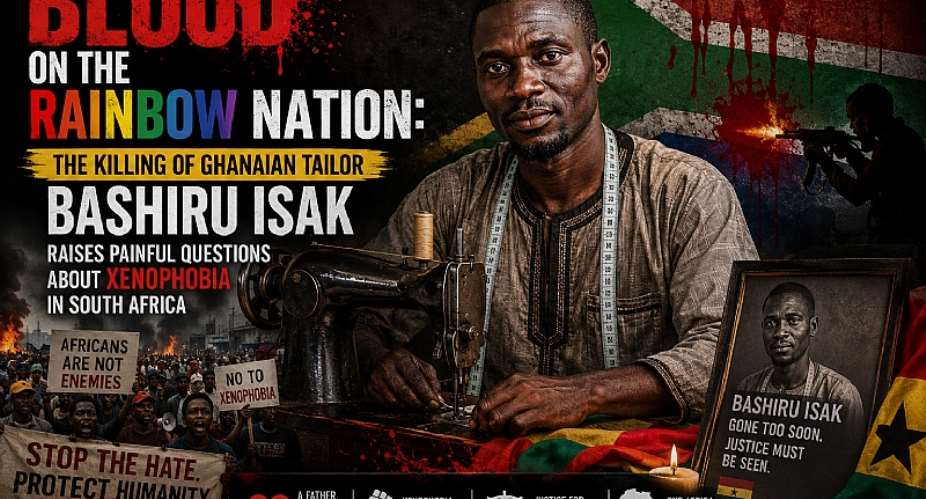
The fatal shooting of a Ghanaian during South Africa's latest wave of anti-immigrant protests has once again exposed the dangerous consequences of xenophobia. While South African authorities had promised a heavy security presence and assured the public that violence would not be tolerated, one Ghanaian lost his life in what Ghana has described as a senseless act of violence.
Who Was the Ghanaian?
The victim has been identified by Ghana's Ministry of Foreign Affairs as Bashiru Isak, a Ghanaian tailor who had lived and worked in South Africa for approximately 20 years. According to Ghanaian officials, he was 40 years old, although some reports have listed his age differently. He operated his tailoring business in Khayelitsha, Cape Town, where he was reportedly shot during the unrest.
He leaves behind three children, the oldest being about ten years old.
Why Did He Remain in South Africa?
As violence escalated, Ghana encouraged its citizens who wished to leave South Africa to register for voluntary evacuation, and hundreds eventually returned home. However, there is no official evidence that Bashiru Isak deliberately refused to return to Ghana.
Like many migrants, he had built a business, established a family life, and spent nearly two decades in South Africa. There is no public statement from him explaining why he stayed, so any claim that he "refused" to return would be speculative.
What Happened Before He Was Killed?
On 30 June 2026, nationwide anti-immigrant marches were organised by the March and March movement and other groups after months of escalating anti-foreigner campaigns.
Authorities had deployed thousands of police officers, cancelled police leave, and placed security forces on standby after fears that protests could become violent. Despite these measures, unrest broke out in several communities. Bashiru Isak was reportedly inside his tailoring shop when he was shot.
Who Shot Him?
At the time of writing:
South African authorities have not publicly identified the shooter.
Police have not confirmed whether the killing was directly linked to protesters or another individual.
No official evidence has yet established exactly who fired the fatal shot.
What Does the South African Police Say?
The South African Police Service has confirmed investigations are underway.
Authorities have:
not released full investigative findings,
not identified suspects publicly,
not confirmed arrests directly connected to Bashiru Isak's death.
Police arrested more than 900 people nationwide during the protests for various offences, but officials have not stated that any of those arrests relate specifically to the Ghanaian's killing.
What Did the South African Government Promise?
Before the demonstrations:
President Cyril Ramaphosa condemned violence.
The government deployed extensive security.
Approximately R600 million was reportedly committed to security operations.
Authorities insisted peaceful protest would be protected but violence would not be tolerated.
Yet one Ghanaian was killed despite those assurances.
What Has Jacinta Ngobese-Zuma Said?
Jacinta Ngobese-Zuma, leader of the March and March movement, has consistently argued that her campaign targets undocumented immigrants, not foreigners generally. She has rejected accusations that the movement is inherently xenophobic and has accused critics, including Ghana, of exaggerating some earlier incidents.
As of the latest verified reports available, there has been no confirmed public statement from her specifically addressing Bashiru Isak's shooting. It would therefore be inaccurate to attribute comments to her about this killing without further evidence.
What Is Ghana Doing?
The Government of Ghana has:
strongly condemned the killing,
demanded a full investigation,
called for the immediate arrest and prosecution of those responsible,
begun arrangements to repatriate Bashiru Isak's body,
instructed Ghana's High Commission in Pretoria to continue engaging South African authorities.
What Is the Family Saying?
Public information remains limited.
Authorities have confirmed that Bashiru Isak is survived by three children, but no detailed public statements from his immediate family have been released. The family is currently being supported through arrangements to return his body to Ghana.
Have the Killers Been Arrested?
As of 2 July 2026:
No arrests have been publicly announced in connection with Bashiru Isak's killing.
Is the South African Government Supporting Xenophobic Marches?
There is no evidence that the South African government officially supports xenophobic violence.
Government leaders have repeatedly condemned violence and called for law enforcement to protect lives. However, critics argue that repeated outbreaks of xenophobic attacks raise difficult questions about whether official responses have been sufficiently effective.
The Bigger Questions Nobody Wants to Ask
The death of Bashiru Isak forces uncomfortable questions:
Why do similar attacks continue despite repeated government promises?
Why do many documented migrants also become victims if campaigns are said to target only undocumented immigrants?
Has political rhetoric unintentionally legitimised hostility toward foreign Africans?
Why are hardworking African entrepreneurs increasingly viewed as enemies instead of contributors?
How many more African families must bury loved ones before lasting solutions are implemented?
Can the African Union play a stronger role in preventing recurring xenophobic violence?
If South Africa benefited from African solidarity during apartheid, what responsibility does it bear toward fellow Africans today?
What Could This Mean for South Africa?
If xenophobic violence continues, South Africa risks:
worsening diplomatic relations with African countries,
discouraging foreign investment,
damaging tourism,
harming regional economic integration,
increasing labour shortages in sectors dependent on migrant workers,
weakening its international human rights reputation.
What Should Ghana Do Next?
Many analysts suggest Ghana could:
1. Continue diplomatic engagement with South Africa.
2. Closely monitor the police investigation.
3. Support Bashiru Isak's family.
4. Strengthen protection and registration systems for Ghanaians abroad.
5. Work through the African Union and regional bodies to push for stronger measures against xenophobic violence.
6. Ensure accountability through continued diplomatic pressure if justice is delayed.
Conclusion
Bashiru Isak's death is more than the story of one Ghanaian tailor. It is a stark reminder that xenophobia remains one of Africa's most pressing human rights challenges. Until those who incite violence are held accountable and the root causes of hostility are addressed, promises of protection will ring hollow for thousands of African migrants who continue to live and work far from home.
By:
Patrick Belebang Yagsori
+233240292413
[email protected]
 TOR rules out immediate removal of refinery margin citing debt burden
 GES debunks viral claims of flood-damaged WASSCE papers
 Accra floods: 1,000 vehicles damaged at Odawna
 Prove NLA’s GH₵3bn giveaway allegation — Razak Kojo Opoku challenges The Fourth ...
 Illegal miners invade Adansi Asokwa Agenda 111 Hospital site
 Trader loses 15 shops in Odawna disaster
 July 2: Cedi sells at GHS12.30 on forex market, GHS11.36 on BoG interbank
 Alajo resident explains why he requested GH¢3,000 from NADMO officers before ret...
 GH¢350 million transferred for flood relief after Mahama orders Finance Ministry
