




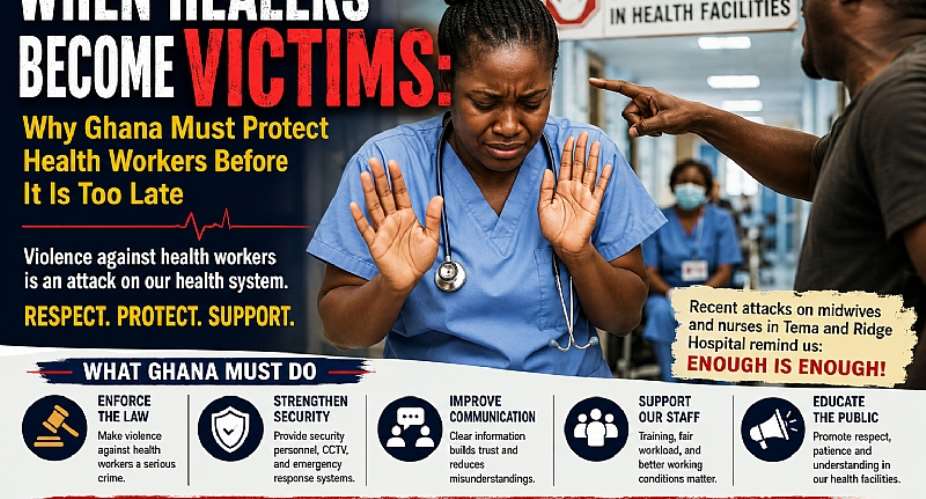
A hospital is meant to be a place of healing, hope, and compassion. It is where people seek comfort in times of illness and distress. Yet, for many healthcare professionals in Ghana today, the workplace is increasingly becoming a place of fear, intimidation, and violence.
The recent assault on a senior staff midwife at the Community 22 Polyclinic in Tema has once again drawn national attention to a disturbing reality: healthcare workers are increasingly becoming victims of verbal abuse, threats, and physical attacks while performing their duties.
The incident, which reportedly occurred while the midwife was enforcing the facility's visiting-hours policy, sparked widespread condemnation from the Ministry of Health, the Ghana Health Service (GHS), and the Ghana Registered Nurses and Midwives Association (GRNMA). Beyond the headlines, however, lies a deeper question: How did those entrusted with caring for the sick become targets of violence?
A Growing Threat to Healthcare Delivery
Healthcare workers dedicate their lives to saving others. They work long hours under stressful conditions, often with limited resources, while making critical decisions that affect human lives. Despite these sacrifices, many face hostility from the very people they seek to help.
Unfortunately, the Tema incident is not an isolated case. Healthcare professionals at the Greater Accra Regional Hospital (Ridge Hospital) have also experienced physical attacks from patients' relatives, leading to arrests and investigations by law enforcement authorities. Such incidents are becoming increasingly common across healthcare facilities in Ghana.
Research supports these concerns. A study by Boafo and Hancock (2017) found that workplace violence against nurses is a significant problem in Ghana, with relatives of patients often identified as the main perpetrators. Similarly, recent findings published in BMC Public Health revealed that healthcare workers continue to experience verbal abuse, harassment, threats, and physical violence in health facilities across the country.
Violence against healthcare workers is not merely a personal attack on an individual nurse, doctor, midwife, pharmacist, or administrator. It is an attack on the entire healthcare system. It weakens staff morale, contributes to burnout, increases turnover, and ultimately affects the quality of care provided to patients.
Why Do These Conflicts Occur?
Several factors contribute to tensions between healthcare providers and patients or their relatives. These include:
- Poor communication between health workers and clients.
- Long waiting times in healthcare facilities.
- Inadequate understanding of hospital policies and procedures.
- Emotional distress and anxiety experienced by patients and their families.
- Unrealistic expectations regarding treatment outcomes.
- Lack of accessible grievance and complaint mechanisms.
While these frustrations may be understandable, violence can never be justified. No healthcare worker should fear being insulted, threatened, or assaulted for performing his or her professional duties.
Communication: The Most Powerful Preventive Tool
One of the most effective ways to reduce conflict in healthcare settings is through communication.
Many disputes arise not because patients are denied care, but because they feel uninformed, ignored, or misunderstood. Patients and their families are often under immense emotional pressure, making clear and compassionate communication essential.
Healthcare professionals should therefore be encouraged to:
- Explain medical conditions and procedures in simple and understandable language.
- Provide regular updates on treatment progress.
- Listen actively to patients' concerns.
- Demonstrate empathy and professionalism.
- Manage difficult conversations with patience and respect.
Likewise, patients and their relatives must be encouraged to communicate respectfully and seek clarification whenever concerns arise.
Communication builds trust. Trust reduces suspicion. And when trust exists, conflicts are less likely to escalate into violence.
Policy Measures Ghana Cannot Afford to Ignore
While communication is essential, it alone cannot solve the problem. Strong institutional and national policies are equally necessary.
1. Enact and Enforce Laws Protecting Health Workers
Violence against healthcare professionals should attract strict legal consequences. Just as the law protects law enforcement officers and public officials while performing their duties, healthcare workers must receive similar protection.
2. Strengthen Security Systems in Health Facilities
Healthcare facilities should invest in:
- Adequate security personnel.
- Functional CCTV surveillance systems.
- Emergency response protocols.
- Controlled visitor access systems.
3. Establish Effective Complaint Resolution Mechanisms
Patients should have accessible and transparent channels to express concerns without resorting to aggression or violence.
4. Train Staff in Conflict Resolution
Continuous training in communication, customer care, emotional intelligence, and conflict management can equip healthcare workers with the skills needed to de-escalate potentially volatile situations.
5. Intensify Public Education
The public must understand the challenges healthcare workers face daily and appreciate that respectful engagement contributes to better healthcare outcomes.
6. Improve Working Conditions
Overcrowded facilities, staff shortages, and excessive workloads can increase tensions and negatively affect communication. Investment in human resources and healthcare infrastructure is therefore crucial.
Protecting Health Workers Means Protecting Patients
Every day, healthcare professionals report to work knowing that lives depend on them. They deserve to perform their duties in an environment that is safe, respectful, and free from violence.
The recent attacks on healthcare workers in Ghana should serve as a wake-up call to policymakers, healthcare managers, community leaders, and the public. Failure to address this growing problem risks undermining the very foundation of our healthcare system.
Protecting healthcare workers is not merely about safeguarding employees; it is about safeguarding healthcare delivery itself. A nation that values quality healthcare must also value and protect the people who provide it.
As Ghana continues its journey toward achieving universal health coverage and improving healthcare outcomes, one principle must remain clear: those who heal others must never become victims in the process of caring for society.
When we protect health workers, we protect healthcare. When we protect healthcare, we protect lives.
References
- Boafo, I. M., & Hancock, P. (2017). Workplace Violence Against Nurses. SAGE Open.
- BMC Public Health. Prevalence, Risk Factors and Psychological Consequences of Workplace Violence Among Health Workers in the Greater Accra Region, Ghana.
- Ministry of Health/Ghana Health Service statements on the assault of a midwife at Community 22 Polyclinic, Tema (June 2026).
- Reports on attacks against healthcare workers at Greater Accra Regional Hospital (Ridge Hospital).
- Ghana Registered Nurses and Midwives Association (GRNMA) statements advocating stronger protection for health workers.
About the Author
Emmanuel Twum Barimah is a Senior Administrative Manager with the Ghana Health Service. He holds a Bachelor of Arts (BA) degree and a Master of Business Administration (MBA) in Health Service Management. He is currently pursuing a Bachelor of Laws (LL.B.) degree at the Faculty of Law, Pentecost University, Ghana. His research interests include health policy and management, healthcare administration, medical law, public health governance, and healthcare ethics. He is passionate about promoting accountability, effective healthcare management, and legal reforms that strengthen health systems and improve patient outcomes in Ghana and beyond.
Contact: Emmanuel Twum Barimah
Email: [email protected]
Affiliation: Ghana Health Service / Student Faculty of Law, Pentecost University, Ghana.

 August 6: Cedi sells at GHS12.35 on forex market, GHS11.75 on BoG interbank
 Students are being influenced by social media and hard drugs – Deputy Education ...
 'You've done worse before so what's the demo for?' — Solomon Owusu question's NP...
 Government holds national inter-faith memorial service to mark one year since Au...
 NDC sets October 20 to open nominations for national executive elections
 Police intercept 866 parcels of suspected cocaine hidden in Gari at Tema Port; a...
 GES condemns assault on Obuasi SHTS headmaster, vows sanctions against students
 Ghana spent over GH¢52bn on diesel and petrol imports in 2025 as fuel dependence...
 I don’t feel safe because I talk; I feel that my mouth will put me into trouble ...
 NPP supporters gather at Supreme Court for 'Democracy Under Attack' protest

