




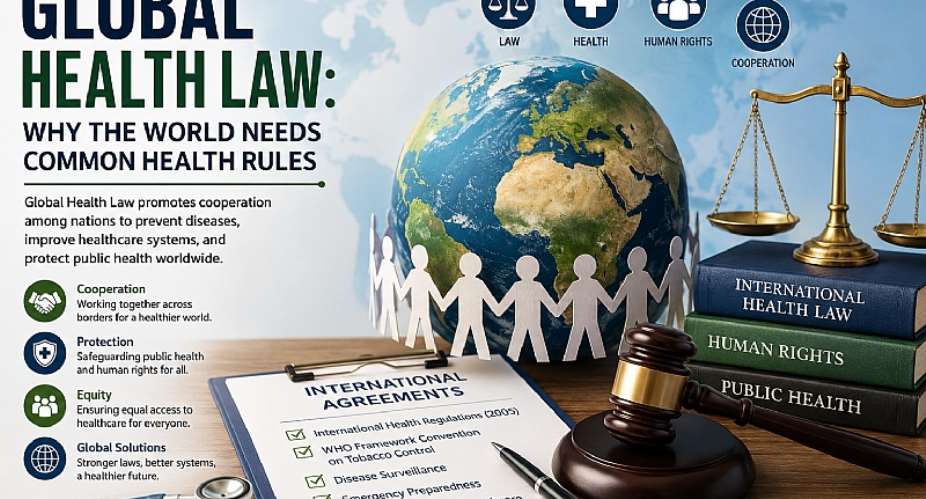
The world has become more connected than ever before. People travel across countries every day, goods move freely across borders, and information spreads instantly. While this has created many opportunities, it has also made health problems more global than ever. Diseases can travel from one country to another within hours, making it impossible for nations to tackle major health challenges alone. This is where Global Health Law becomes important.
Global Health Law refers to the rules, agreements, and legal principles that guide countries in addressing health issues that affect people across national borders. It promotes cooperation among nations to prevent diseases, improve healthcare systems, and protect public health worldwide.
Why Global Health Law Matters
Health challenges do not respect national boundaries. Outbreaks such as COVID-19, Ebola, and other infectious diseases have shown that a health crisis in one country can quickly become a global emergency. Global Health Law provides a framework for countries to work together, share information, and coordinate responses during health emergencies.
The main goal is simple: to ensure that everyone, regardless of where they live, has the opportunity to enjoy good health and access quality healthcare services.
The Evolution of Global Health Law
The idea of international cooperation in health is not new. In the nineteenth century, deadly diseases such as cholera spread rapidly across Europe and other parts of the world. Countries soon realized that they could not fight these diseases individually.
This led to the first International Sanitary Conference in 1851, where nations met to discuss disease prevention and public health measures. Over time, more agreements and institutions were created to strengthen global health governance.
A major milestone occurred in 1948 with the establishment of the World Health Organization (WHO). Since then, WHO has played a leading role in promoting international health standards and coordinating responses to health emergencies.
Human Rights and Health
One of the most important principles of Global Health Law is that health is a fundamental human right. Every person deserves access to healthcare services, medicines, clean water, and a safe environment.
International human rights instruments recognize the right to the highest attainable standard of health. Governments therefore have a responsibility to create policies that promote health and ensure that healthcare services are accessible to all citizens without discrimination.
When people are denied healthcare because of poverty, location, disability, or social status, their human rights may be compromised. Global Health Law seeks to address such inequalities.
International Agreements That Protect Health
Several international agreements have strengthened Global Health Law. These agreements help countries coordinate their efforts and establish common standards.
Examples include:
- The International Health Regulations (IHR), which guide countries in responding to disease outbreaks and public health emergencies.
- The WHO Framework Convention on Tobacco Control, which helps reduce tobacco-related illnesses and deaths.
- Various international agreements that encourage disease surveillance, information sharing, and emergency preparedness.
These agreements demonstrate the importance of cooperation in protecting global health.
Challenges Facing Global Health Law
Despite significant progress, many challenges remain.
First, not all countries have the same resources to implement international health standards. Developing countries often struggle with limited funding, inadequate healthcare infrastructure, and shortages of healthcare professionals.
Second, political differences sometimes make international cooperation difficult. Countries may prioritize national interests over collective health goals.
Third, globalization has increased the speed at which diseases spread. Modern transportation allows people and goods to move rapidly across continents, making disease control more complex.
These challenges require stronger partnerships and greater commitment from governments and international organizations.
New Health Threats in a Changing World
The future of Global Health Law will be shaped by emerging health issues.
Climate change is creating new health risks through extreme weather events, food insecurity, and the spread of diseases. Technological advances, including telemedicine and artificial intelligence, also raise new legal and ethical questions regarding privacy, access, and healthcare regulation.
Furthermore, recent pandemics have exposed weaknesses in global health systems and highlighted the need for stronger legal frameworks to ensure preparedness and rapid response.
The Way Forward
The future of Global Health Law depends on cooperation, innovation, and public awareness. Governments, international organizations, healthcare professionals, and citizens all have a role to play.
Countries must strengthen their healthcare systems, invest in disease prevention, and honour international commitments. International organizations must continue promoting collaboration and supporting vulnerable nations.
Most importantly, citizens must understand their health rights and actively participate in health-related discussions and decision-making processes.
Conclusion
Global Health Law is more than a collection of international rules. It is a tool for protecting lives, promoting human dignity, and ensuring that health challenges are addressed collectively. In an interconnected world, no country can stand alone against global health threats.
As new health challenges emerge, stronger international cooperation and effective legal frameworks will be essential to building a healthier, safer, and more equitable future for all.
References
- World Health Organization (2025). International Health Regulations (2005), Third Edition. Geneva: WHO.
- World Health Organization (2025). Constitution of the World Health Organization. Geneva: WHO.
- United Nations (1966). International Covenant on Economic, Social and Cultural Rights (ICESCR). New York: United Nations.
- World Health Organization (2003). WHO Framework Convention on Tobacco Control. Geneva: WHO.
- United Nations (2015). Transforming Our World: The 2030 Agenda for Sustainable Development. New York: United Nations.
- Gostin, L. O. (2014). Global Health Law. Cambridge, MA: Harvard University Press.
- Fidler, D. P. (2000). International Law and Infectious Diseases. Oxford: Clarendon Press.
- Kickbusch, I., & Gleicher, D. (2012). Governance for Health in the 21st Century. Copenhagen: WHO Regional Office for Europe.
About the Author
Emmanuel Twum Barimah is a Senior Administrative Manager with the Ghana Health Service. He holds a Bachelor of Arts (BA) degree and a Master of Business Administration (MBA) in Health Service Management. He is currently pursuing a Bachelor of Laws (LL.B.) degree at the Faculty of Law, Pentecost University, Ghana. His research interests include health policy and management, healthcare administration, medical law, public health governance, and healthcare ethics. He is passionate about promoting accountability, effective healthcare management, and legal reforms that strengthen health systems and improve patient outcomes in Ghana and beyond.
Contact: Emmanuel Twum Barimah
Email: [email protected]
Affiliation: Ghana Health Service / Faculty of Law, Pentecost University, Ghana.

 August 6: Cedi sells at GHS12.35 on forex market, GHS11.75 on BoG interbank
 Students are being influenced by social media and hard drugs – Deputy Education ...
 'You've done worse before so what's the demo for?' — Solomon Owusu question's NP...
 Government holds national inter-faith memorial service to mark one year since Au...
 NDC sets October 20 to open nominations for national executive elections
 Police intercept 866 parcels of suspected cocaine hidden in Gari at Tema Port; a...
 GES condemns assault on Obuasi SHTS headmaster, vows sanctions against students
 Ghana spent over GH¢52bn on diesel and petrol imports in 2025 as fuel dependence...
 I don’t feel safe because I talk; I feel that my mouth will put me into trouble ...
 NPP supporters gather at Supreme Court for 'Democracy Under Attack' protest

