




Introduction
On 21 May 2026, the International Court of Justice (ICJ), sitting at The Hague, delivered a landmark advisory opinion affirming that workers and trade unions possess a protected right to strike under the International Labour Organization (ILO) Convention No. 87 on Freedom of Association and Protection of the Right to Organise, 1948. The Court emphasized that although the scope and conditions of strikes may vary among states, the right itself is an essential component of labour freedom and human dignity.
This advisory opinion represents a significant development in international labour law and carries important implications for Ghana, a democratic constitutional state and a member of the International Labour Organization. Ghana’s constitutional framework already recognizes several labour and human rights protections, but the ICJ ruling may deepen judicial interpretation and strengthen workers’ protections in both public and private employment sectors.
Constitutional Protection of Labour Rights in Ghana
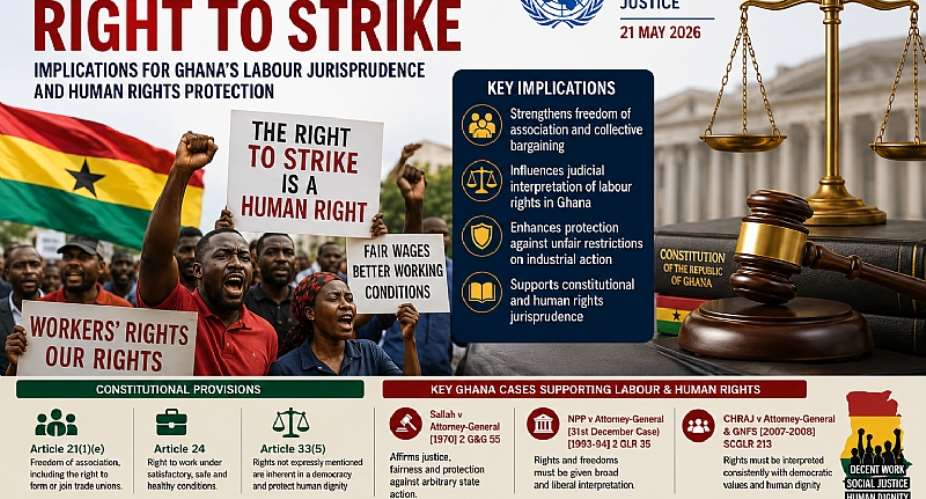
The 1992 Constitution of Ghana guarantees fundamental human rights and freedoms, including labour rights. Article 24 of the Constitution provides that every person has the right to work under satisfactory, safe, and healthy conditions and shall receive equal pay for equal work without discrimination.
More importantly, Article 21(1)(e) guarantees freedom of association, including the freedom to form or join trade unions for the protection of one’s economic and social interests. This constitutional protection aligns directly with ILO Convention No. 87, which Ghana has ratified.
Article 33(5) of the Constitution further expands the scope of rights by recognizing that rights specifically mentioned in the Constitution do not exclude other rights considered inherent in a democracy and intended to secure the freedom and dignity of mankind. This provision allows Ghanaian courts to incorporate evolving international human rights standards into domestic constitutional interpretation.
The Labour Act, 2003 (Act 651) also regulates strikes and industrial actions in Ghana. Sections 159–170 establish procedures for lawful strikes, including negotiation, mediation, and arbitration requirements. While the law permits strikes, it also imposes restrictions, especially within essential services.
The ICJ advisory opinion is therefore likely to influence how Ghanaian courts interpret these constitutional and statutory provisions concerning workers’ rights.
The Impact of the ICJ Ruling on Ghana
1. Strengthening the Constitutional Right to Strike
Although the Ghanaian Constitution does not expressly mention the “right to strike,” the ICJ ruling reinforces the argument that the right is implied within freedom of association and collective bargaining rights.
Ghanaian courts may increasingly interpret Articles 21 and 24 broadly to recognize strikes as an essential democratic labour tool rather than merely a statutory privilege granted by Parliament.
This development could strengthen labour unions such as the Trades Union Congress (TUC), Ghana Medical Association (GMA), and Ghana Registered Nurses and Midwives Association (GRNMA) when challenging excessive restrictions on industrial action.
2. Influence on Judicial Interpretation
Ghanaian courts have historically embraced purposive constitutional interpretation, particularly where human rights are involved.
In New Patriotic Party v Attorney-General (31st December Case) [1993-94] 2 GLR 35, the Supreme Court held that constitutional provisions concerning rights and freedoms must receive a broad and liberal interpretation.
Similarly, in Sallah v Attorney-General [1970] 2 G&G 55, the court emphasized constitutional justice, fairness, and protection against arbitrary state action. Although the case primarily concerned wrongful dismissal from public office, it remains significant for protecting employment rights and due process under constitutional governance.
The ICJ ruling may therefore encourage Ghanaian courts to rely more heavily on international labour standards when deciding labour disputes and constitutional cases involving workers’ rights.
3. Increased Protection Against Unfair Labour Restrictions
The ruling may pressure Ghana to review laws and administrative practices that excessively limit industrial action.
For instance, public sector workers in sectors classified as “essential services” often face substantial restrictions on strikes. The ICJ opinion may encourage courts and policymakers to balance public interest with workers’ constitutional freedoms.
This aligns with Article 23 of the Constitution, which requires administrative bodies and public officials to act fairly, reasonably, and in accordance with due process.
4. Enhancement of Human Rights Jurisprudence
The ICJ ruling reinforces the connection between labour rights and broader human rights principles.
In CHRAJ v Attorney-General & Ghana National Fire Service [2007-2008] SCGLR 213, the Supreme Court affirmed that constitutional rights must be interpreted in a manner consistent with democratic values and human dignity.
Likewise, in Republic v High Court; Ex Parte CHRAJ (Richard Anane Case) [2007-2008] SCGLR 213, the courts emphasized accountability and constitutional governance.
The recognition of strike action as a human rights issue may therefore elevate labour disputes from ordinary industrial disagreements to constitutional matters involving dignity, participation, and democratic governance.
5. International Influence on Domestic Labour Reforms
Ghana is a dualist state; therefore, international treaties do not automatically become domestic law unless incorporated by Parliament. Nevertheless, Ghanaian courts frequently rely on international legal principles for constitutional interpretation.
The ICJ advisory opinion could influence future amendments to the Labour Act and strengthen collective bargaining mechanisms. It may also encourage Parliament to clarify the constitutional status of strike actions and reduce ambiguities surrounding lawful industrial action.
Challenges and Limitations
Despite the significance of the ICJ ruling, several challenges remain.
First, the advisory opinion is non-binding. Ghana is not legally compelled to amend its laws solely because of the ruling. Its practical effect depends largely on domestic courts, Parliament, labour institutions, and government policy.
Second, Ghana’s economy and public sector structure require continuity in essential services such as healthcare, electricity, water supply, and security. Courts may therefore continue to uphold reasonable restrictions on strikes where national interest and public safety are threatened.
Third, labour disputes in Ghana are often politicized, especially within the public sector. Political considerations may affect the implementation of stronger labour protections.
Conclusion
The ICJ’s advisory opinion affirming the right to strike under international labour law marks a historic advancement in global labour rights. For Ghana, the decision reinforces constitutional guarantees of freedom of association, dignity, fair labour practices, and democratic participation.
Although the ruling is not legally binding, it is likely to shape judicial interpretation, strengthen labour activism, and influence future reforms within Ghana’s labour law framework. Ghanaian courts, guided by constitutional principles and persuasive international authority, may increasingly treat the right to strike as an inseparable aspect of human rights and democratic governance.
Ultimately, the ruling presents Ghana with an opportunity to modernize labour relations while balancing workers’ freedoms with national development and public interest.
By Emmanuel Twum Barimah
Senior Admin Manager (Ghana Health Service)
BA, MBA in Health Services Management
Faculty of Law, Pentecost University
References
- Constitution of the Republic of Ghana, 1992.
- Labour Act, 2003 (Act 651).
- International Labour Organization Convention No. 87 (1948).
- Sallah v Attorney-General [1970] 2 G&G 55.
- New Patriotic Party v Attorney-General (31st December Case) [1993-94] 2 GLR 35.
- CHRAJ v Attorney-General & Ghana National Fire Service [2007-2008] SCGLR 213.
- Republic v High Court; Ex Parte CHRAJ (Richard Anane Case) [2007-2008] SCGLR 213.
- Reuters News Report, “UN Top Court Says Workers Have Right to Strike Under International Law,” May 21, 2026.

 August 6: Cedi sells at GHS12.35 on forex market, GHS11.75 on BoG interbank
 Students are being influenced by social media and hard drugs – Deputy Education ...
 'You've done worse before so what's the demo for?' — Solomon Owusu question's NP...
 Government holds national inter-faith memorial service to mark one year since Au...
 NDC sets October 20 to open nominations for national executive elections
 Police intercept 866 parcels of suspected cocaine hidden in Gari at Tema Port; a...
 GES condemns assault on Obuasi SHTS headmaster, vows sanctions against students
 Ghana spent over GH¢52bn on diesel and petrol imports in 2025 as fuel dependence...
 I don’t feel safe because I talk; I feel that my mouth will put me into trouble ...
 NPP supporters gather at Supreme Court for 'Democracy Under Attack' protest

