




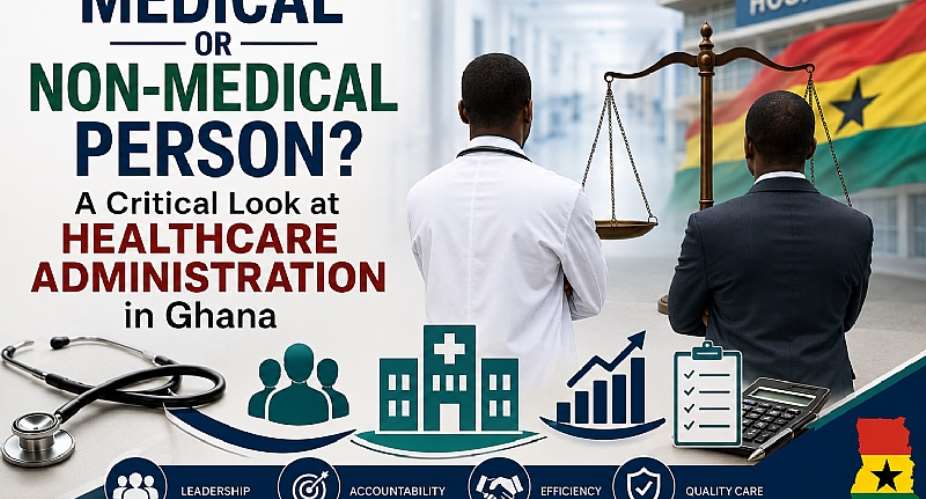
Healthcare administration in Ghana has become one of the most discussed issues in recent years. Many people continue to debate whether leadership positions in hospitals and health institutions should be occupied mainly by medical professionals or by non-medical administrators. This discussion raises important legal, ethical, and constitutional questions about competence, accountability, and the future of healthcare delivery in Ghana.
Healthcare administration involves planning, organizing, supervising, and managing health institutions to ensure effective healthcare delivery. In Ghana, leadership positions such as Chief Executive Officers, Hospital Administrators, Directors, and Managers are occupied by both medical and non-medical professionals. The major question remains: who is better suited to manage healthcare institutions effectively?
Supporters of medical professionals argue that doctors, pharmacists, nurses, and other clinicians understand healthcare delivery better because they work directly with patients. They believe medical professionals understand emergencies, medical ethics, staff shortages, and patient care more than non-medical administrators. According to this view, a medically trained leader is more likely to make decisions that improve patient care and protect lives.
This argument became stronger during the COVID-19 pandemic when healthcare systems around the world relied heavily on medical experts for leadership and decision-making. In Ghana, healthcare professionals played major roles in disease control, public education, and emergency response. This increased public trust in medically trained administrators.
On the other hand, many people believe healthcare administration is mainly about leadership and management rather than clinical practice. Hospitals are large institutions that require budgeting, procurement, human resource management, auditing, strategic planning, and policy implementation. Therefore, individuals trained in business administration, finance, law, economics, and public administration may also perform effectively in managing healthcare institutions.
The debate can also be examined from a constitutional perspective. The 1992 Constitution of Ghana guarantees equality and freedom from discrimination under Article 17. This means public appointments should not unfairly exclude people solely because they are non-medical professionals, unless specific medical qualifications are necessary for the position. In addition, Article 36(1) of the Constitution requires the state to ensure efficient healthcare systems and proper national development. Healthcare leadership should therefore focus on competence, professionalism, and efficiency rather than professional rivalry.
Furthermore, Article 34(2) of the Constitution explains that the Directive Principles of State Policy are meant to guide all institutions and individuals in promoting national development and public welfare. Healthcare administrators must therefore place public interest above personal or professional competition.
In Ghana, disagreements have sometimes emerged over whether hospital Chief Executive Officers should necessarily be medical doctors. Some professional groups argue that non-medical administrators may not fully understand clinical priorities, while administrative professionals insist that leadership and management skills can be learned independently of medical practice.
Another challenge within Ghana’s healthcare administration is financial and procurement management. Reports by the Ghana Health Service and the Auditor-General have occasionally identified procurement irregularities, misuse of resources, and poor management practices within some health institutions. These challenges show that effective healthcare administration requires strong management skills, transparency, accountability, and ethical leadership regardless of professional background.
Article 41(f) of the Constitution also places a duty on every citizen to protect public property and fight against misuse of public funds. Healthcare administrators therefore have both constitutional and moral responsibilities to manage public resources honestly and efficiently.
The issue should not be seen as a competition between medical and non-medical professionals. Modern healthcare systems require cooperation between clinicians and administrators. A successful hospital needs both medical expertise and sound administrative leadership. Medical professionals contribute clinical knowledge while administrators contribute management, financial, and organizational skills.
In my opinion, Ghana should move beyond professional divisions and focus on competence, integrity, experience, and specialized training in healthcare administration. A doctor without management skills may struggle to run a large institution effectively, just as a non-medical administrator without understanding healthcare operations may also face difficulties. What matters most is the ability to provide efficient leadership, accountability, and quality healthcare delivery.
To improve healthcare administration in Ghana, government and health institutions should invest more in professional training in healthcare management and leadership. Appointment processes should be transparent and based on qualification, competence, and performance rather than political influence or professional bias. Collaboration between medical and non-medical professionals should also be encouraged to improve healthcare delivery.
In conclusion, the debate over whether healthcare institutions in Ghana should be led by medical or non-medical persons is important but should not divide the healthcare sector. Ghana’s healthcare system needs competent, ethical, and visionary leaders who are committed to public service and national development. The Constitution of Ghana emphasizes fairness, accountability, efficiency, and protection of public welfare, and these principles must guide healthcare administration in the country.
By Emmanuel Twum Barimah
Senior Administrator at Ghana Health Service
BA, MBA in Health Service Management
Faculty of Law, Pentecost University
References
- The 1992 Constitution of the Republic of Ghana.
- Ghana Health Service Act, 1996 (Act 525).
- Auditor-General’s Reports on Public Institutions in Ghana.
- World Health Organization (WHO), Health Systems Governance Report.
- Ministry of Health, Ghana – Health Sector Policies and Reforms.
- Agyepong, I. A. et al. (2018). “The Ghanaian Health System: Structure and Challenges.”
- Republic of Ghana, Public Financial Management Act, 2016 (Act 921).
- Ocloo, J. & Fulop, N. (2021). Leadership and Management in Healthcare Systems.

 August 6: Cedi sells at GHS12.35 on forex market, GHS11.75 on BoG interbank
 Students are being influenced by social media and hard drugs – Deputy Education ...
 'You've done worse before so what's the demo for?' — Solomon Owusu question's NP...
 Government holds national inter-faith memorial service to mark one year since Au...
 NDC sets October 20 to open nominations for national executive elections
 Police intercept 866 parcels of suspected cocaine hidden in Gari at Tema Port; a...
 GES condemns assault on Obuasi SHTS headmaster, vows sanctions against students
 Ghana spent over GH¢52bn on diesel and petrol imports in 2025 as fuel dependence...
 I don’t feel safe because I talk; I feel that my mouth will put me into trouble ...
 NPP supporters gather at Supreme Court for 'Democracy Under Attack' protest

