




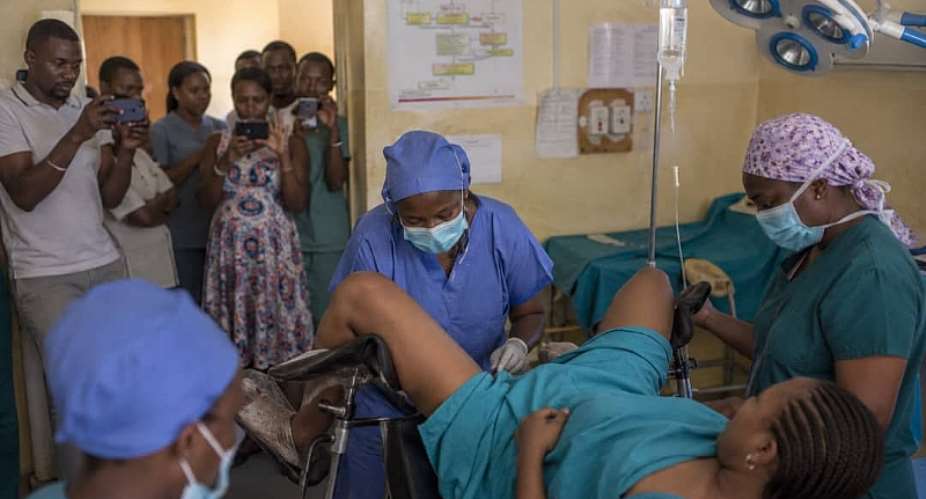
Today, some of the most secure and confidential areas in our health facilities - such as the labour ward and operating theatre are gradually finding their way onto social media, sometimes to the extent of exposing clients under our care.
As a health worker, are you aware of the consequences of taking a photograph of your patient and posting it on social media without the client’s written consent?
Do you know what privacy and confidentiality mean in healthcare?
Do you know the law’s perspective on the above issue?
This piece of writing addresses the above questions within the Ghanaian context.
To start with, there is the need to define these two terms which are often used interchangeably: “client” and “patient.” According to Elizabeth C. Arnold (2011), a health care client is defined as “any individual, family, group, or community with an identified health care need requiring nursing intervention.” On the other hand, a patient is a narrower term used in healthcare to refer to “a person with a specific disease or condition who receives treatment from a health care provider” (NHS England, 2026). In this write-up, both terms are used interchangeably to refer to a person who seeks the services of a hospital or healthcare professional in relation to their health needs.
INFORMED CONSENT IN HEALTHCARE
World Health Organization (WHO), defines informed consent as a process by which a patient voluntarily confirms willingness to undergo a particular medical intervention, after having been informed of all the risks, benefits, alternatives, and consequences associated with it.
Types of consent include implied, verbal, and written. A valid informed consent must include the following key elements:
Disclosure - the healthcare provider explains the condition, nature and purpose of treatment or procedure, benefits, risks and possible complications and alternatives.
Understanding - the patient must understand the information provided.
Voluntariness - the decision must be made freely without force, pressure, or manipulation.
Competence - the patient must be mentally capable and legally competent to make decision.
Consent – the patient gives permission verbally, writing or implied depending on the situation.
PRIVACY AND CONFIDENTIALITY IN HEALTHCARE
Privacy in healthcare implies that a patient has the right to control access to their body, personal information, medical records, and photographs. A patient has the right to decide who can see, use, or share their information.
Confidentiality on the other side means that healthcare workers have a legal and ethical duty to protect patient information from unauthorized disclosure. Any information obtained during treatment, including photographs, videos, diagnoses, medical records, or conversations, must not be shared with others without the patient’s informed consent.
Additionally, taking a patient’s photograph and posting it on social media without written consent breaches both privacy and confidentiality because:
The patient did not authorize the use of their image.
The purpose of the photograph was not explained.
The patient did not voluntarily agree in writing.
To avoid the above situation, healthcare professionals are expected to maintain trust, dignity, respect, and professionalism at all times.
THE LAW’S PERSPECTIVE IN GHANA
Under the laws of Ghana, a healthcare worker may be sued, disciplined, or sanctioned for taking and sharing a patient’s photograph without proper consent. This is because the unauthorized disclosure of patient information constitutes a violation of the patient’s constitutional, statutory, and ethical rights to privacy and confidentiality.
To begin with, Article 18 of the 1992 Constitution guarantees the right to privacy of every individual. Consequently, a patient has a constitutional right to dignity, privacy, confidentiality, and protection from public exposure without permission.
Furthermore, Article 33 of the Constitution provides that a person whose fundamental human rights and freedoms have been violated, are being violated, or are likely to be violated may apply to the High Court for redress. Therefore, where a healthcare worker takes or shares a patient’s photograph without authorization, the affected patient may institute an action before the court for the enforcement of his or her constitutional rights.
In addition to the constitutional protection, the Data Protection Act, 2012 (Act 843) protects personal and sensitive information, including medical information and patient images. Under the Act, health information is classified as special personal data. As a result, such information cannot be processed, shared, or published without the consent of the data subject except as permitted by law.
Similarly, the Public Health Act, 2012 (Act 851) recognizes the patient’s right to privacy during treatment and also protects the confidentiality of medical information. More importantly, the Act requires consent before patient information may be used for teaching, conferences, or related purposes.
Therefore, if consent is legally required even for academic presentations and professional discussions, then posting patient images on platforms such as TikTok, Facebook, Snapchat, Instagram, or WhatsApp without authorization constitutes a serious professional and legal violation.
Moreover, the Patient’s Charter further reinforces these protections by expressly safeguarding the privacy and confidentiality rights of patients. The Charter provides that a patient has the right to privacy during consultation, examination, and treatment. It further states that patient information must not be disclosed to a third party without the patient’s consent, except where disclosure is required by law or is in the public interest.
Apart from the constitutional and statutory obligations, healthcare professionals are also bound by ethical duties under the Professional Code of Ethics of the Nursing and Midwifery Council of Ghana. Under the Code, nurses and midwives are required to maintain patient confidentiality, respect patient dignity, and avoid actions that may damage public trust in the profession.
Although Ghana has limited publicly reported court decisions specifically on healthcare workers posting patient photographs online, a reference can be made to a case of consent - Anthony v Cape Coast University College (1973), where the college displayed the picture of a religious married woman without her consent. The courts found for Mrs. Anthony.
In 2025, at one of Ghana's teaching hospitals, a nurse secretly took photographs of a patient while she was recovering after surgery in the children’s ward. Without consent, the nurse later posted the images on TikTok and Facebook to showcase her work as a health professional. The photos quickly spread online, and the patient was recognized by people who knew her. This caused the patient emotional distress, embarrassment, and invasion of privacy. The patient filed a complaint against both the nurse and the hospital.
The incident was considered unlawful under Ghanaian law because the patient did not give written informed consent, her medical information and image were disclosed publicly, and her right to privacy and confidentiality were violated.
Following the complaint, the hospital suspended the Nurse pending investigation, while the Data Protection Commission became involved due to the unauthorized disclosure of sensitive patient information.
Disclosure of patients' information without their consent may constitute a breach of confidentiality, a violation of privacy rights, and or professional misconduct.
Accordingly, a nurse or midwife who posts patient photographs online without consent may face disciplinary action, suspension, revocation or loss of licence, dismissal from work, or litigation before the courts. This is in line with examples seen globally, where healthcare workers have lost their employment and licenses and faced lawsuits for unauthorized patient recordings and social media exposure.
LEGAL AND PRACTICAL IMPORTANCE OF WRITTEN CONSENT
Consent must be formal, informed, and properly documented because a patient may later:
deny ever giving consent;
claim that he or she was not in the right frame of mind at the time consent was given;
state that the consent was obtained under duress or coercion; or
argue that he or she did not fully understand how the photograph or information would be used.
For this reason, written informed consent serves as a legal and professional safeguard for:
the patient;
the healthcare worker; and
The health institution.
Accordingly, before taking or using a patient’s photograph, a healthcare worker must clearly explain:
Why the photograph is being taken;
how it will be used;
where and to whom it may be shared; and
Obtain the patient’s written informed consent before any use or disclosure.
If the above protocols are not followed, posting patient photographs on social media is a violation of privacy, confidentiality, professional ethics, and Ghanaian law.
In conclusion, posting a patient’s photograph on social media without proper authorization constitutes a violation of the patient’s right to privacy and confidentiality. It may also amount to professional misconduct, a breach of ethical obligations, and a violation of the laws of Ghana.
By Gloria Boateng
(PMO, NURSE MANAGER, RESIDENT MID.GCNM WELL WOMAN CARE)
Arnold, E. C. (2011). Developing therapeutic communication skills. Interpersonal relationships: Professional communication skills for nurses (6th ed.), USA: Elsevier, 175-196.
Nurses and Midwifery Council. (2018). The code: Professional standards of practice and behaviour for nurses, midwives and nursing associates.
American Medical Association. (2024). Informed consent.code-medical-ethics.ama-assn.org
World Health Organization. (2021). Information for researchers concerning informed decision making: What is an informed consent form?

 Ghana lost 1.1 million ounces of gold to smuggling in 2023 – GHEITI report
 Stranded Ghanaian fishermen narrate how they ate fresh fish, drunk sea water to ...
 How notorious armed robber died on the way whiles leading police to arrest accom...
 'We must continuously improve cargo handling, coordination among port operators'...
 GPHA honours industry players, former leaders and staff at 40th anniversary awar...
 Nii Lante Vanderpuye confident of winning NDC national chairmanship despite Gold...
 Agalga dismisses critics, assures Builsa North of progress on Sandema–Wiaga Road
 NDC Lawra constituency polls: We are not going to disappoint you – Chairman Bati...
 Ghana's President Mahama calls for new West African security accord, stronger AU...


