




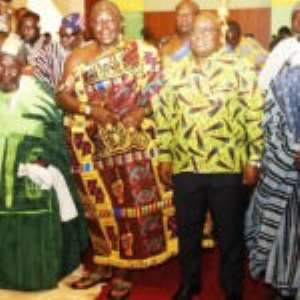
On March 27, 2002, then Chief of Staff, Mr. Jake Otanka Obetsebi-Lamptey, announced to a bewildered nation that Ya-Na Yakubu Andani II, the Overlord of the Dagbon Traditional Area, had been killed in a civil conflict at his palace. Thirty members of his courtiers were also killed, together with other members of his household. It followed three days of mayhem during which the Gbewaa Palace came under heavy machine gun and artillery fire.
First reports spoke of 30 households razed to the ground in the worst chieftaincy-related conflict in the history of traditional leadership in the country. Unconfirmed reports said about 50 foreign mercenaries were involved in the conflict, and that sounds of heavy gun-fire permeated the air.
Dagombas in the country, and in all parts of the world, took sides in the conflict. A number of government appointees resigned their positions to pave way for investigations into the conflict.
With the attack on the Gbewaa Palace blamed on the Abudu faction in the dispute, who generally owe allegiance to the then ruling New Patriotic Party (NPP), the government of President John Agyekum Kufuor had to thread a fine line so as not to be labeled as siding with the aggressors.
The opposition National Democratic Congress (NDC) made big political capital out of the conflict, accusing the government of complicity in the royal murder. The NDC made a manifesto pledge of hunting down the perpetrators and dealing with them according to the laws of this country. The fact that nobody has been jailed 16 years after the mayhem, tells a lot about the complex nature of the conflict.
Former junta head Jerry John Rawlings shouted from the roof-tops claiming that he had evidence which pointed to the hand of then President Agyekum Kufuor and his administration. After shadow boxing around the issue all this while, Mr. Rawlings has not been able to produce a single fact to buttress his claim.
Mr. Alex Segbefia, one-time Deputy Chief of Staff, was another loose talker on the issue. He said the NPP and its administration were to blame for the assassination of the Ya-Na, and for the escalation of the conflict between the two royal gates.
President Agyekum Kufuor responded to accusations of complicity against his administration by appointing a three-member Commission of Enquiry to investigate the circumstances leading to the conflict, and make recommendations on the way forward.
The commission was chaired by Mr. Justice I.N.K. Wuaku, a retired justice of the Supreme Court. The two other members were Prof. Kwesi Yankah of the University of Ghana, and Mrs. Florence Brew, who was listed as an Educationist.
The was tasked “to make a full, faithful and impartial inquiry into the circumstances of, and establish the facts leading to the events and resultants deaths and injuries in Yendi in the Dagbon Traditional Area of the Northern Region, between 25th March and 27thMarch, 2002.
(b) “To identify those responsible for the events and resultant deaths and injuries of persons and to recommend appropriate sanctions or actions against any person found to have caused, been responsible for, or been involved in the violence and the resultants deaths and injuries.
(c ) To inquire into any matter which the commission considers incidental or reasonably related to the events and the resultant deaths and injuries; and
(d) “To submit within one month its report to the President, giving reasons for its findings and recommendations.
After asking for a extension of time, the commission finally submitted its report to the President on November 6, 2002.
Describing the disturbances as the 'three-day war', the Wuaku Commission said: “The remote cause of the conflict in Yendi is the long-standing chieftaincy dispute between the Andani and the Abudu Gates, including the non-observance of the funeral of the late Mahamadu Abdulai IV.”
The commission said the immediate cause of the three-day disturbance was “an attack on Ziblim Abdulai by Abusu youth in the morning of 25th March 2002, which infuriated some Andani youth, who armed themselves and fired shots in the direction of the Abudus. Indeed, the first casualty in the exchanges was an Abudu – Adbulai Issahaku a.k.a. “Who Born You. He was shot by an unidentified companion of Mutaru.
The commission established that what ensued on the fateful three days in March 2002 “was a criminal act of war fought between two Gates, for which individuals from both Gates are blamable.”
The report indicted three state appointees -the then Regional Minister, Prince Imoro Andani, the Yendi District Chief Executive, Mohamed Habib Tijani as well as a number of state security officials. The report exonerated the Minister for the Interior then, Alhaji Malik Yakubu Alhassan, who had previously taken a swipe from the Andani group and the NDC. National Security Adviser Lt.-Gen. Joshua Hamidu, Major Suleimana Abubakar, and Alhaji Mohamed Aminu Amada and a few others were also exonerated from complicity in the events leading to the conflict.
The committee recommended that two persons -Yidana Sugri and Iddrisu Gyamfo- who were seen openly displaying body parts of the slain Ya-Na in Yendi on March 27, 2002, should be prosecuted together with a number of people implicated in the conflict.
The government accepted the report and indicated that the Attorney General had already been instructed to take measures to ensure that those to be prosecuted were put before court.
In its White Paper on the report, the government said it had taken note of the commission's recommendations that it “should, as a matter of urgency, vigorously implement regulations governing the importation, use and manufacture of firearms in Dagbon area should be launched.”
The complexity of the nature of the problem meant that the Kufuor regime had to call on the experiences of three eminent chiefs to cajole both sides to the negotiating table, while applying the stick and carrot approach to get to the bottom of the matter.
The appointment of the three eminent chiefs – Otumfuo Osei Tutu II, the Asantehene, Nayiri Naa Bohogu Abdulai Mahami Sheriga and Yabonwura Yuntumba Boresa Sulemana Jakpa I – was envisaged as the key to unlock the padlock. But it took nearly a decade of careful negotiations before a deal could be struck.
The Andani Royal household relentlessly resisted overtures to get them to agree for the funeral of late Ya-Na Mahamadu Abdulai IV, arguing that the former overlord died a private man and ought not be given a royal farewell.
On Friday, April 3, 2015, the 103 children of the late Ya-Na Yakubu Andani II embarked a protest march in Tamale, reiterating their incessant calls for justice. They were joined by the widows of the departed chief.
They accused the Kufuor administration, which was the government of the day, of deliberately white-washing the monumental crime of the assassination of the Ya-Na.
A petition sent to government, and read by Abdulai Yakubu Andani, son of the slain traditional leader, said: “The government of the day embarked on a deliberate attempt at white-washing this monumental crime with the setting up of the Wuaku Commission. In the process of manipulating investigations, the commission preferred charges which do not exist in our statutes books.
The accusation followed the acquittal of suspects arraigned before court charged with the murder of the Overlord, and for their role in the events leading to the murder of Ya-Na Yakubu Andani II. All suspects were freed for lack of evidence in court.
The Abudus, on the other hand, threatened and actually boycotted the sitting of the three eminent chiefs on a number of occasions. They contend that the eminent chiefs had failed to call the Andani group to order, following their consistent refusal to allow the Abudus access to the Gbewa Palace to organise the final funeral rites for the Ya-Na.
“Their most recent promise on December 5, that Abudu…will take occupation of the Gbewa Palace to perform the funeral rites of Ya-Na Mahamadu Abdulai VI, between January 8 and 15, 2016, has not been fulfilled.
After nearly a decade of conflict resolution, the three eminent chiefs presented their road-map to peace to President Addo Dankwa Akufo-Addo. The main thrust of the report is the burial arrangements for the two departed kings of Dagbon, and the enskinment of a new Overlord for the traditional area.
According to the arrangement, the Abudus are required to be granted right of occupancy to organise the funeral of Ya-Na Mahamadu Abdulai IV, from December 14 to 28. After that they are required to leave the Gbewa Palace to pave the way for the funeral of Ya-Na Yakubu Andani, from January 4-18, next year. After the two funerals, the way would be clear for the installation of a new Ya-Na.
Before the launch of the road-map, the government had made considerable in-roads into both camps, cajoling them to accept the long road to peace. 'The Dagbon Peace and Progress Now' is the brain-child of Northern Regional Co-ordinating Council.
At the official launch of the new project, the Regional Minister, Salifu Saeed, called for collective responsibility to sustain the project. Already, signs of reconciliation are beginning to emerge in the areas. Just before Otumfuo Osei Tutu II presented the road-map for peace to the President Addo Dankwa Akufo-Addo at Jubilee House in Accra, hundreds of Dagbon youth hit the streets of Yendi and Tamale in a peace march, calling for the implementation of the first phase of the eminent chiefs' recommendation that was already known.
Dubbed 'Diwumti,'a Dagomba word meaning we are tired, apparently of the conflict, the peace seekers marched through the principal streets of the traditional headquarters and the regional capital, escorted by heavily armed security personnel, drawn from the police and military.
The leadership of the Dagbon Zungo Network, in collaboration with other stakeholders for peace in the region, brokered supervised the march. Those on the march comprised both Andani and Abudu youth. For me, as a social commentator, the march for peace represents a major break-through in the 16-year search for peace, since the unfortunate three-day events in March 2002.
I will like to believe that the litmus test to the peace deal will manifest itself when the two funerals for the late Mahamadu Abdulai and Ya-Na Yakubu Andani respectively, are observed in December and January. If there is no major conflict in the next two months, then we are in for a treat.
It has been a long walk to peace in Dagbon. If the peace holds, it would represent a major investment in the socio-economic development of this country – So much by way of national resources have been invested into ensuring that the conflict does not escalate. These are resources that would normally have gone into improving the living standards of the people generally, and the people of Northern Ghana, in particular.
Though the migration of the youth from the northern parts of Ghana to the South has been a phenomenon over the years, the escalation of the conflict in 2002 brought more Dagomba youth to Accra, Kumasi, Takoradi and other southern cities and towns. Ending the conflict means the revival of northern rice farms and general boost to agriculture and industry in the north.
On such an auspicious occasion as the launch of the road map to peace, I will like to pat the shoulders of the leadership of both the Andani Royal Gate and the Abudu Royal Gate for their co-operation, which has enabled various governments, since the conflict, to pursue peace in Dagbon to its conclusion.
I will like to congratulate Otumfuo Osei Tutu II and his two other eminent chiefs – Nayiri Naa Bohogu Abdula Mahama Sheriga and Yabonwura Boresa Sulemana Jakpa I – for dedicating their lives and working very hard to resolve one of the most endearing conflicts in the traditional history of this nation.
I will like to believe that the government and people of Ghana deserve to heave a sigh of relief after the successful resolution of this conflict. Never again should the Dagbon conflict rear its ugly head.
The sad part of the whole drama is that both the Andanis and the Abudus are the same people with the same ancestry, and, ultimately, the same destiny.
 Flooding is now a festival in Ghana, we have it every year – Kamal-Deen Abdulai
 Head coach of Uganda Laryea Kingston finally opens up on beating Ghana at U-17 A...
 I cannot be like Abedi Pelé – Jordan Ayew admits
 Focus on sakawa, not porn IDs – Kofi Bentil tells Sam George
 KATH CEO suspended for breaching Mahama’s directive
 Romance Scam: US Justice Department shares Abu Trica case update
 Mother, son arrested over alleged murder of husband at Nsawam-Adoagyiri
 KATH doctors signal possible strike over suspension of CEO
 Ghana considers legal action against South Africa for compensation over xenophob...
 Bawku Naba urges Nayiri to enforce customary peace rites to end conflict


