




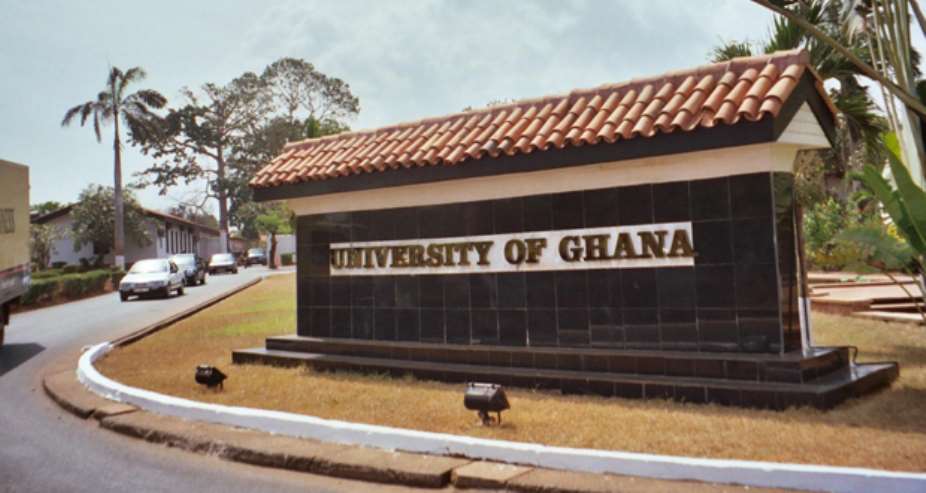
TOMORROW, the 1st of August 2018, will be a distinctive day in the history of the University of Ghana, Legon.
For the University's topmost position – that of Chancellor – will be held for the first time by a woman.
If gender prejudice is one of the hidden failings in our society, then I cannot bestow enough praise on those charged with making the appointment, for rising above it in such a spectacular manner. The members of the University Council in particular [under the leadership of the extremely enlightened Professor Yaw Twumasi] can hold their heads high for thus propelling the University into the 21st century.
I am told the names proposed for installing a new Chancellor to replace the redoubtable Mr Kofi Annan, were all individuals of considerable weight, and that it was quite a feat for a woman to beat such a stiff competition. It goes without saying that the woman in question must be truly exceptional.
She is Mrs Mary Chinnery-Hesse, a woman whose curriculum vitae is quite stunning. Appointments she has held [locally[ include chair of the Zenith Bank; Vice-Chair of the National Development Planning Commission; member of the Board of the Centre for Policy Analysis; member of the Public Utilities Regulatory Commission and Chief Advisor to the President of the Republic in the Government of former President John Agyekum Kufuor.
In addition, she has served as: Vice-Chairperson of the National Development Planning Commission and member of the Board of the Centre for Policy Analysis. As a precursor to the appointment she takes up tomorrow, she served as a Member of the Council of the University of Ghana from 2006 to 2009.
Her international appointments are no less impressive: Resident Coordinator of UN Systems in New York; then Resident Representative of the United Nations Development Programme(UNDP) in Sierra Leone, Tanzania, the Seychelles and Uganda.
Next, she was garlanded with another “first”: the first-ever woman Deputy Director-General of the International Labour Organization (ILO). This was a position with the rank of Under Secretary-General of the UN. That was another first” for her: namely, the first African woman to attain the rank of Under-Secretary-General in the history of the United Nations! Her status was further enhanced when she was asked to take the chair of the UN’s Consultative Committee on Programme and Operational Question. She has also served as an Advisor to the World Bank.
Other significant appointments she has held include membership of the Eminent Persons’ Advisory Panel of the Organisation of African Unity (OAU) which crafted the strategy to convert the OAU to the African Union (AU). Her has also held the Chair of a High-Level Panel to Review Progress in Implementing the Programme for the Least Developed Countries. And she's been a Member of the Zedillo Commission of Eminent Persons on Financing for Development.
Additionally, she has served on the UN Blue Ribbon Panel of 16 Wise World leaders on Threats, Challenges and Change. (This was a Panel tasked to rewrite the global security architecture, and make proposals for the reform of the United Nations, especially the Security Council.)
Mary has, as well, been a Member on the Board of the prestigious Global Humanitarian Forum in Geneva, Switzerland. She was on that board in the company of several Nobel Peace Prize Laureates. And for many years, she was the chair of the Board of Trustees of the Voluntary Fund for Technical Cooperation of the UN High Commissioner for Human Rights in Geneva.
Her advice continues to be actively sought and valued by many Governments and International Organisations on a variety of themes. She is, as a result, very busy in retirement. She is the Chair of the Goodwill Ambassadors of the Kofi Annan International Peace-Keeping Training Centre, and she is also the Chair of the Board of the Centre for Regional Integration in Africa.
Outside the UN ambit, Mary Chinery-Hesse was the Chairperson of the Commonwealth Expert Group of Eminent Persons on Structural Adjustment and Women. This Group produced a landmark Report entitled “Engendering Adjustment”.
But her best contribution to progress and peace in Africa takes the form of a role she has been playing on a body set up by the African Union, whose activities are seldom publicised. This is the African Union's “Friend on the African Union Panel of the Wise” and on the “Pan-African Network of the Wise (Panwise). These various “Panels of The Wise” are usually made up of retired African heads of state, and their main task is to “short-circuit” peace-threatening political developments in African countries, before they blow up into full crisis. Their modus operandi is to conduct delicate behind-the-scenes negotiations between antagonistic factions, in order to prevent armed conflict from breaking out – especially after disputed elections, or other coup-prong situations.
Such interventions often take members of the panel into situations of great tension and potential danger. But Mary has never refused to go to a crisis zone, and her discreet role as a warm mother figure and a person with contacts and cosmopolitan exposure, has enabled her to win such respect that in very high circles in Africa, her nickname is “Wise Mary”.
Mary Chinery-Hesse was educated at the Wesley Girls High School. After obtaining her Cambridge School School Certificate from that all-girls institution, she had the unusual experience of pursuing sixth form studies at a famous “all-boys” school – Mfantsipim. She went to Mfantsipim with 24 other “Wehege” girls because “there was no Sixth Form in any Girls School in Ghana at the time, to absorb us!”
Mary goes on: “ I attended Mfantsipim School in 1957 and 1958, passing out with the Cambridge Higher School Certificate (with Distinction, and Exemption from Matriculation). I read Latin, English, Geography and History. Being such a few girls among pubescent young boys had its challenges, – some aggravating, but mostly hilarious – especially when viewed with the wisdom of hindsight. The truth, however, is that we made lasting and supportive friendships from among the boys, and we feel privileged to have been associated with such a great and prestigious School. For example, I met Kofi Annan there, and we have been there for each other ever since.
“In fact, Mfantsipim School honoured me in 2001 with an 'Excellence Award', when the School celebrated its 125th Anniversary. I graduated in 1962 [Honours in Economics and Sociology], and met and married my husband Barrister Chinery-Hesse in March 1963, after a whirlwind, short, intensive courtship. We remain happily married after 55 years. I am the mother of a son and a daughter, with several grandchildren.”
In terms of personal interests, Mary says “I am still too busy with different substantive assignments – especially international ones – to have much leisure time. I love to dance, though, especially High Life.”
In 1991, Mary Chinery Hesse was awardedan Honorary Doctor of Laws degree (honoriscausa) by her Alma Mater, the University of Ghana. So when she is installed as Chancellor tomorrow, she would have “returned home” – full circle!
Please join me in congratulating her.

 Flooding is now a festival in Ghana, we have it every year – Kamal-Deen Abdulai
 Head coach of Uganda Laryea Kingston finally opens up on beating Ghana at U-17 A...
 I cannot be like Abedi Pelé – Jordan Ayew admits
 Focus on sakawa, not porn IDs – Kofi Bentil tells Sam George
 KATH CEO suspended for breaching Mahama’s directive
 Romance Scam: US Justice Department shares Abu Trica case update
 Mother, son arrested over alleged murder of husband at Nsawam-Adoagyiri
 KATH doctors signal possible strike over suspension of CEO
 Ghana considers legal action against South Africa for compensation over xenophob...
 Bawku Naba urges Nayiri to enforce customary peace rites to end conflict


