




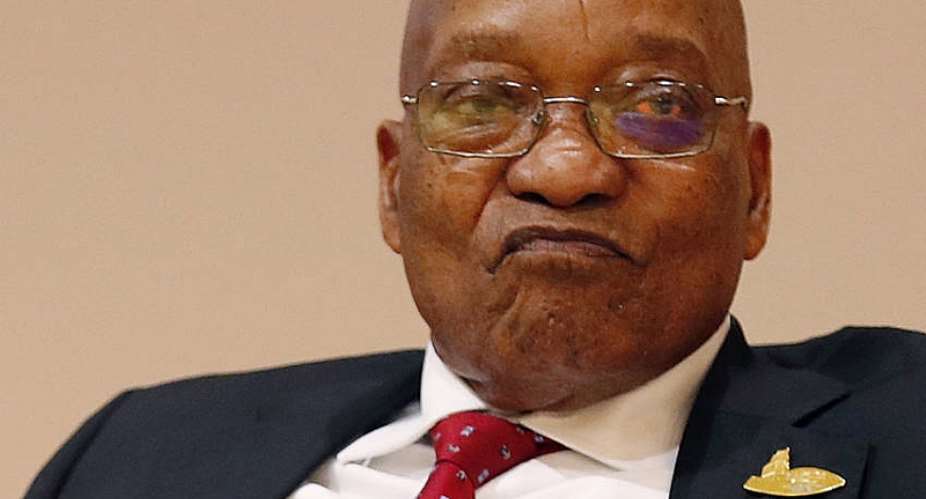
The ousted South African President, Mr Jacob Zuma, was brought down by a sheer lack of comprehension of the political realities in his country in 2017-18.
He had been the ANC's chief of intelligence during the struggle against apartheid. But when he became President – after the far more brilliant Thabo Mbeki had been recalled through being undermined by rivals in the ANC (some suspect this was Zuma-inspired) – Zuma performed so badly that some clever South Africans began to describe him as a man of “ex-intelligence” [i.e. lapsed intelligence]!
When he was accused of sleeping with a woman who had HIV, he said he wasn't worried about it because he'd had “a shower” immediately afterwards and that if one did this after bedding such a woman, the disease couldn't infect one.
His response to many accusations, including one for rape, was to joke about it and sing a sentimental song entitled “Bring Me My Machine Gun”.
Uneasy South Africans smiled with embarrassment at these foibles at the top of their governmental machinery, but others dismissed them as “eccentricities” that could be tolerated from a man who had contributed so much to the arrival of democracy in their country.
Many couldn't bring themselves to believe that Zuma's apparent dimness of wit was not a put-on act, but the real thing. How coud a man who had worked with Nelson Mandela as Deputy President of the ANC be lacking in common sense to such an extent?
The reason why they cut him so much slack was that he proved himself a genuine hero when he managed to use his Zulu connections to short-circuit a most diabolical plan, conceived by the apartheid intelligence apparatchiks when the apartheid regime was on its last legs, to derail South Africa's march towards freedom, whilst giving the apperanace that the regime was in favour of the process.
The plan was to incite the Zulus to attack the Xhosas, in the deliberately-promoted belief that the ANC, which is mainly Xhosa, was trying to carry out a "conquest" of the Zulus that the Xhosas had never been able to achive in history. The plan was to cause gruesome "black-on-black" massacres in Johannesburg and elsewhere.
Trains bringing African workers to the great industrial city were regularly attacked by gun-wielding thugs who would kill people who spoke Xhosa or Zulu, depending on the language most largely spoken by the passengers in a targeted railway carriage, or workers' hostel.
It didn't make sense for either ethnic group to be indiscriminately attacking the other's members on a train, nor in crowded workers' hostels, for the physical apeareance of each group was not that much different from that of members of the other! Besides, many Zulu speakers can speak and understand Xhosa, and vice versa.
It later emerged, not only through the South African Truth and Reconciliation Commission but also, through confessions voluntarily made by ex-members of the apartheid intelligence corps, that the plan had been to prove to the outside world -- especially the Western countries that were wavering in heir support for the apartheid regime -- that South Africa would descend into chaos, marked by "inter-tribal warfare", if power was ever taken from the hands of the white minority.
A Zulu party, the Inkatha Freedom Party, was financed secretly by the apartheid-mongers, to be a covertly-armedcounterpoise to the ANC. Although the Inkatha leader, Chief Mangosutho Buthelezi, protested that Inkatha was a genuine people's movement with no links to the apartheid machine, information was leaked from his party to the ANC, and when Nelson Mandela heard this, he was so furious that he bitterly attacked President F W De Klerk publicly for duplicity. He just didn't believe that De Klerk knew nothing of the wicked plan to set the ANC and the Inkatha Freedom Movement at each other's throats. The talks between the ANC and the De Klerk Government then became dangerously stalled.
But the saboteurs in the apartheid regime had reckoned without the influence of Jacob Zuma, then Deputy President of the ANC. He adroitly used his contacts in the Zulu traditional administrative structure to erode the influence of Buthelezi to an extent that obliged Buthelezi to accept an offer of a job as a Minister (of Home Affairs) in Mandela's first Cabinet, as the price for a ceasefire. And thus, South Africa's path to freedom was secured.
Did this achievement go to Zuma's head? That's quite possible, for the mistakes he made when he became State President made him out to be a person who thought he could get away with everything. He allowed members of his family, especially his son Dunduza, to be openly associated with private companies that benefited from Government contracts. And he used public money to build for himself, a luxurious home at a place called Nkandla.
Because he got away with such lapses in judgement, he became even more careless, and allowed his son to become closely linked with a family of Indian businessmencalled the Gupta.Their idea of doing business in a foreign country was to capture almost its entire industry through takeovers and mergers financed largely by sleight of hand.
The Guptas' activities were so numerous and tainted with suspicion that South African media practitioners began to refer to their manoeuvres as constituting "state capture." Eventually, Zuma could not prevent these activities from becoming the subject of investigations by an official enquiry.
But what laid the soft underbelly of the Zuma-Guptaconnection bare for sharp-knifing was the leakage, by whistle-blowers, of an enormous trove of emails, which exposedthemethods by which the Guptas had secured dominance with regard to Cabinet appointments (for instance); contracts by state-owned enterprises; strategies for taking over privately-owned companies, etcetera etcetera.
Once the email cat was out of the bag, it was only a matter of time before the Zuma-Gupta connection would become the pieces of cardboard on which the Zuma "house of cards" was constructed.
So Zuma has gone and Cyril Ramaphosa has taken his place. This does not necessarily guarantee that the business dealings of South African Governmententerprises will be clean henceforth. For Cyril Ramaphosa has moved from the status of a fairly radical trade union leader to a position which favours the activities of such companies as Lonmin (formerly known as Lonrho) a company once described by the then British Prime Minister, Edward Heath, as "the unacceptable face of capitalism".
Ramaphosa also damned himself in the eyes of the public when, in trying to protect Lonmin, he equivocated over whether the police in SouthAfrica had acted brutally and unlawfully when members of the force had shot at unarmed back miners at Marikana, in an incident that recalled the police brutalities of yesteryears, especially Sharpeville (1960) and Soweto (1976).
Cyril Ramaphosa's defenders say he has made enough money already in the private sector, and so cannot be temptedto be corrupt. He also knows the ways by which private companies eat into the public moneys that should be used for bringing educational, health and other social amenities to the black populace that's in dire need of governmental support; those who have to be rescued from the squalor in which the apartheid economy left them. And quickly.
If Ramaphosa is able to deliver such social benefits, his association with the likes of Lonmin will be largely forgiven. But if he fails, South Africa will continue to seethe with discontent, and Africa's most powerful economy will be in danger of tottering, in the hands of political dwarfs.
So we must suspend judgement until Cyril Ramaphosa has been at the helm for some time.
All those who wish South Africa well, will however be hoping that Ramaphosa will prove equal to the task that Nelson Mandela could not complete, namely, enabling South Africa to attain its full potential, in the world's economic and political tables of power.

 GJA Applauds Ghana’s Sharp Rise in Global Press Freedom Rankings
 US Embassy Cautions Against Censorship in Fight Against Misinformation
 Interior Minister Blames Weak Enforcement by Assemblies After Avenor Building Co...
 Gov’t Warns Against Rising Misinformation, Calls for Stronger Journalistic Stand...
 Ramaphosa Warns Against Vigilante Crackdowns on Foreign Nationals
 Global InfoAnalytics Boss Rejects Claims Polls Are Destabilising NDC
 Bawumia to Propose Policy Alternative as Cocoa Sector Tensions Deepen
 ECG Announces Scheduled Outages and Technical Fault Affecting Multiple Regions o...
 Investigation committee uncover GH¢19.5m loss at Bolgatanga Technical University...
 Afenyo-Markin calls for protection of journalists, warns against suppression of ...


