




Love him or loathe him, John Dramani Mahama commands a rare blend of respect, affection, and admiration — the kind of warmth reserved for only a handful of figures in Ghana’s socio‑political history. Osagyefo Kwame Nkrumah had it in abundance. To some extent, so did Ignatius Kutu Acheampong. And of course, Jerry John Rawlings inspired a level of public devotion that was impossible to ignore.
The cheers and chants that greeted President Mahama at the Dominion Centre during the aptly named Town Hall Meeting were proof of this enduring appeal. What unfolded was not staged enthusiasm; it was genuine affection on a massive scale. And Mahama, as expected, did not disappoint. He is the kind of politician whose mere presence ignites excitement and positive emotion.
In short, the Town Hall Meeting — organised under the auspices of the Ghana High Commission — was a resounding success. And it wasn’t only Mahama who electrified the audience. Mr. Goosie Tanoh, chief architect of the 24‑hour economy project, and the ever‑popular “Ato Is Forcing” also received long, enthusiastic applause.
That was Sunday, 31 May 2026.
The following day, Monday, 1 June, the caravan moved from North London to a more business‑oriented and affluent part of the capital. After attending an investment event, President Mahama made a quick dash to Chatham House for a quieter, more reflective conversation on Africa’s direction of travel in today’s geopolitical landscape.
The meeting lasted just an hour. Unlike the energetic atmosphere at the Dominion Centre, Chatham House offered calm — a space for thoughtful listening. It gave me, Mansa Musa, the opportunity to ask Ghana’s President a question in the heart of Central London.
When the microphone reached me, after a little fumbling and circling around the point, I finally asked whether he believed — as many Africans do — that the African Union project is effectively dead.
The President also circled around the question before offering an answer which, in my view, was unconvincing: that the AU remains alive, active, and strong. Really? Ayoooo.
I doubt many Africans in the diaspora were persuaded.
The African Union, founded on the vision of uniting independent African nations into a bloc capable of competing globally while promoting peace, cooperation, and development, has fallen far short of the expectations of its founding fathers. Of course, one cannot expect the President of Ghana to publicly admit that. But those of us on the periphery can call a spade a spade.
Since the overthrow of Nkrumah and the passing of that generation of African giants, the continent has endured crisis after crisis in which the AU — or its predecessor, the OAU — appeared ineffective, absent, or simply overwhelmed:
- The Congo crisis involving Patrice Lumumba and Mobutu Sese Seko.
- The expulsion of Nigerians from Ghana, followed by Nigeria’s retaliation in 1983.
- The struggle against apartheid in South Africa.
- The Angolan Civil War.
- Civil wars in Côte d’Ivoire, Liberia, Sierra Leone, Rwanda, Sudan, and now renewed instability in the DRC.
- Rising anti‑migrant sentiment in South Africa directed at fellow Africans.
- African governments evacuating their citizens from conflict zones in other African countries — while the world watches, and the AU watches too.
Seriously, beyond high‑level gatherings and endless talking shops, what tangible impact has the AU had on the everyday lives of Africans over the past sixty years?
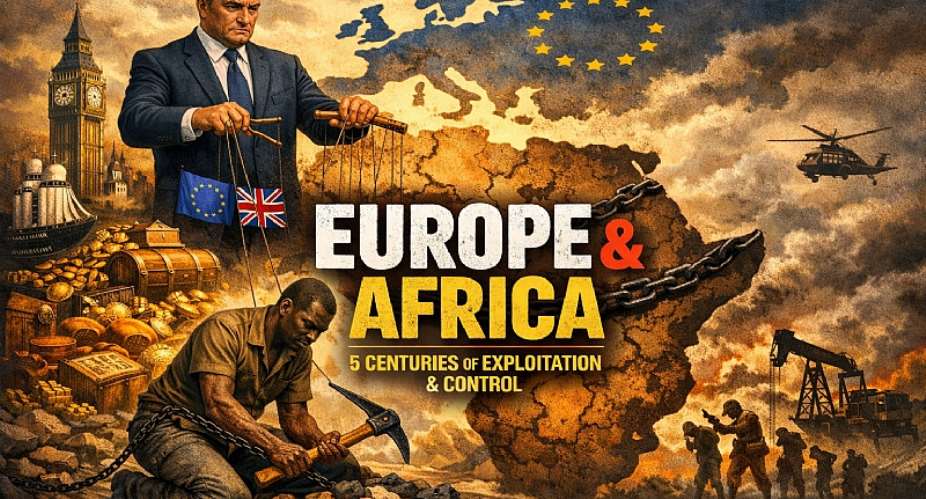
Despite presiding over a continent endowed with natural resources worth trillions, African leaders often appear to seek approval from former colonial powers before taking decisive action. Even when African leaders attempt independent initiatives, European leaders somehow find their way into the room. At a recent summit in Kenya, President Emmanuel Macron was present. And now, as Africans gather in Accra to discuss reparations for the horrors of the transatlantic slave trade, Macron — whose country abstained during a UN vote on reparations — has once again inserted himself into the conversation. Whether we like it or not, he will be part of the discussion.
Decades after independence, Black Africans should have realised that while we may need Europe, Europe needs Africa far more than we admit.
The immense wealth displayed in Central London, Paris, Monaco, New York, Madrid, Lisbon, The Hague, and Amsterdam was built — at least in part — on the labour, exploitation, and resources extracted from Africa and enslaved Africans. The uncomfortable truth is that many of these societies continue to benefit from systems established during that era.
Yet Africans remain largely unaware of the leverage we possess.
We sit on trillions in natural wealth, yet often have little say in how that wealth is used. We rarely control the terms of engagement. More troubling still, we seem content with this arrangement.
For more than five centuries, Europeans have shown us their true colours.
Yet we Africans remain colour‑blind.
What a shame.
What a shame.


 Mahama wants Ghanaian football talents retained longer to revive premier league
 No businessman will sponsor NPP again because of its ‘evil and greedy nature’ – ...
 Failure to jail corrupt NPP officials will haunt NDC in election 2028 – Hopson A...
 Mamprugu Youth calls for crackdown on fake Facebook accounts over alleged false ...
 Mahama appoints Dr Abdul-Baasit Aziz-Bamba as Acting Director-General of Value f...
 2024 teacher recruits’ salary arrears processed — GES
 NPP's failure to continue E-blocks projects worsened SHS placement crisis — Tank...
 "Fix SHS placement bottlenecks for BECE graduates" — Patricia Appiagyei tells go...
 Dr Ayew Afriye secures police enquiry bail for Efya Royal
 UK stranded Barosky to receive psychological, financial support after his repatr...

