




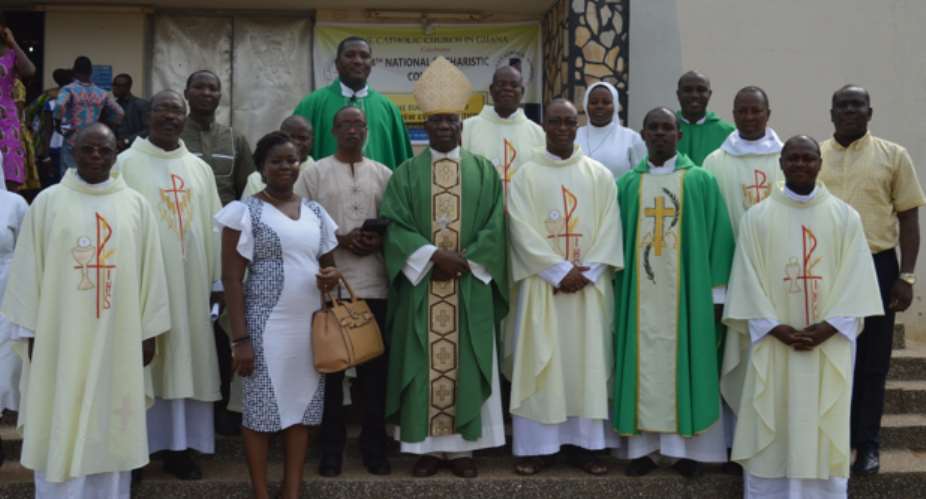
The Jasikan Diocese in the Accra Ecclesiastical Province, will be the host to the Fourth National Eucharistic Congress from Monday August 7 to Sunday, August 13, this year under the theme: The Eucharist and the New Evangelisation.
Scheduled to coincide with the 60th Independence Anniversary of Ghana, the Congress will officially be launched by the National Planning Committee at Jasikan and simultaneously at all the Dioceses in Ghana on February 26.
The year 2017 is a monumental year in the life of Ghana and a celebration of the Eucharistic Congress by the Church will be a fitting way of marking the nation’s 60th Independence Anniversary as well as using the Eucharist to help consolidate the peace, unity and development of our country.
Catholics in the 20 Diocese in the country have been asked to support, participate and pray for the success of this Congress.
In its 2016 Communique issued after its Plenary Assembly at Tamale, the Ghana Catholic Bishops’ Conference, hinted that “We intend to hold a National Eucharistic Congress in 2017 to rededicate, through prayer and reflection, our dear Motherland to our Lord and Saviour, Jesus Christ.”
Over 10,000 Catholics from all over Ghana are expected participate in the upcoming Fourth Eucharistic Congress to be held in Jasikan from August 7 to 13, 2017 on the theme: The Eucharist and the New Evangelization.
Ghana, since 1951 has organised three Congresses in Kumasi, from February 19-26, 1951; Tamale, from January 5 – 11, 1998; and again in Kumasi, from November 18 – 21, 2005.
Launching the Congress on behalf of the Ghana Catholic Bishops’ Conference at the St. Peter Claver Cathedral in Jasikan on February 26, Most Rev. Gabriel A. A. Mante, the host Bishop, said the participants will take part in a series of catechism sessions, that focus on different dimensions of the Eucharist, daily celebration and adoration of the Blessed Sacrament, the Sacrament of the Reconciliation, Eucharistic Processions and Durbars.
He noted that event would also have a Study-session for 250 National Delegates, made up of Priests, Religious, youth, men and women, from all the 20 Dioceses which are expected to sponsor ten persons for the study session.
Topics for the Study Session include: The Eucharist and our Care of the Environment, The Eucharist and the Social Media, The Eucharist and the Church’s Dialogue with the Youth, The Eucharist and the Church’s Dialogue with the Poor, the Sick and the Suffering, The Eucharist and the Family, The Eucharist makes the Church, and the Church makes the Eucharist.
Bishop Mante said “while we wait with interior preparation and in great expectation for the national event, the various Dioceses will organise events locally to mark, celebrate and raise awareness on the 4th National Eucharistic Congress.”
He stated that the primary object of the Congress was to take advantage of the context of the 60th Independence Anniversary of Ghana and to use the Congress to rededicate the Republic of Ghana and her citizens to the Eucharistic Love of Jesus Christ.
“The wish of the Bishops is that the Congress will support a deeper understanding of the meaningful celebration of the Mass; Extend the worship and adoration of the Blessed Sacrament outside the Mass itself,” he added.
The Bishop said it was also to help all delegates, pilgrims and participants of the Congress reflect the social implications of the Eucharist so that the influence and the fruit of our celebration and adoration will permeate our entire personal and social life.
He explained that a Eucharistic Congress is a celebration of the Catholic Church which brings the people of God together specifically to raise an awareness of the central place of the Eucharist in the life and mission of the Catholic Church.
It is also to pray and adore the Lord Jesus Christ in the Eucharist, help and improve our understanding of the celebration of the Eucharist, draw attention to the social dimension of the Eucharist; and use the centrality of the Eucharist to effect integral transformation.
Bishop Mante thanked the Priests and Religious, the lay men, women and the youth of the Diocese for accepting the onerous task to host the Congress and acknowledged the tremendous efforts of the Local Organizing Committee so far.
He added that “As host, my Dear Catholics of Jasikan, you will prepare the ground for our brothers and sisters who are coming to pray and study with us. You will make your homes and other facilities to them and express your generosity to them. We trust you will do very well in these endeavours.”
The Bishop thanked the Steering and the Local Organising Committees for their steadfastness and prayed that their efforts would manifest into a successful Congress.
Earlier, the committee held a meeting and visited the Congress grounds.
National Steering Committee members at the launching were Rev. Fr. Wisdom Larweh, Acting Chairman; Very Rev. Fr. Christopher Vordzogbe, Co-ordinator of the National Liturgical Commission; Rev. Fr. Michael Awuah-Ansah, Executive Secretary Department of Pastoral Ministry; Rev. Fr. Dieu Donne Davor, Executive Secretary, Department of Social Communications, all at the national catholic Secretariat.
Others were Rev. Peter Abel representing the Cape Coast Province; Rev. Fr. Samuel Atinga, representing the Tamale Province, Rev. Frs. Frank Offin-Sekyere and Patrick Worlanya Tettey, representing the Jasikan Diocese and Dr. Mrs. Anita Appiah, Co-ordinator of Community and Institutional Care of the Directorate of Health at the National Catholic Secretariat.
The sub-themes to be discussed during the Congress include “The Word of God, Jesus Christ and the Eucharist: Christian Hope in a Secularising World”, “The Eucharistic Celebration and the New Social Media”, “The Eucharist: The Source of Unity Peace and Development in Contemporary Ghana”, among others.
The daily celebration of the Eucharist will be at the heart of the Congress but its wider programme will include various liturgical celebrations, cultural events, catecheses, testimonies, workshops, processions during the week of the Congress.
What is Eucharistic Congress? : A Eucharistic Congress is a gathering of the Church, Family of God which aims to promote an awareness of the central place of the Eucharist in the life and mission of the Church; help renew and improve the People of God’s understanding and celebration of the liturgy; draw attention to the social dimension of the Eucharist; and use the central place of the Eucharist to effect transformation in the lives of individuals, societies and nations.
It is also the gathering of Priests, Religious , and laity to bear witness to the Real Presence of Jesus in the Eucharist and brings together people from a wide area, and typically involve large open-air Masses , Eucharistic adoration to the Blessed Sacrament , and other devotional ceremonies held over several days.
Previous Congresses in Ghana:
The First Congress took place in Kumasi from February 19 to 26, 1951 during which the Catholic Church in Ghana prayed to the Eucharistic Lord, the Prince of Peace, to bring down many blessings upon the then Gold Coast. Indeed, through that maiden Congress, God heard the prayers of the Church when Ghana gained Independence on March 6, 1957, virtually without violence.
According to an article by Joe K. des Bordes in the December 28, 1997 edition of The Standard, the 1951 Congress was “summoned by the newly- erected hierarchy of the Gold Coast as a means of giving the public thanks to God for the blessings so unstintingly lavished on the country and of celebrating the erection of the hierarchy.”
The Second Congress was held from January 5 to 11, 1998 in Tamale against the backdrop of the Nanumba-Konkomba conflict. This Congress is credited with helping to bring an end to the war. It was on the theme: One Bread One Body, One Lord for All: The Eucharist and the Universal Kingship of Christ and was attended by about 8,000 people including official delegates from all the Dioceses of Ghana and Observers from outside Ghana.
Former President Jerry John Rawlings, who was the Special Guest of Honour at the climax, said a true Catholic or any other Christian was one who lives by his or her faith and the Commandments of God both in word and action. He called on the Church and other Religious Bodies to continue to complement government’s efforts in building the country in the moral, spiritual and physical realms.
The Third Congress was again held in Kumasi from November 18 to 21, 2005 on the theme: The Eucharist: Source and Summit of the Life of the Church As a Family of God in Ghana, coinciding with the 125th Anniversary of the Catholic Evangelisation in Ghana in 1880 and the 25th Anniversary of Pope St. John Paul’s visit to Ghana in 1980. The Papal legate to the Congress was His Eminence Anthony Cardinal Olubunmi Okogie, Emeritus Archbishop of Lagos, Nigeria.
During that Congress, Cardinal Okogie, urged Ghanaians to worship Jesus in the Holy Eucharist on a 24-hour basis, saying that by “doing so will bring us face to face with Christ the King and we shall be able to place our needs before them.”
International Congress:
International Eucharistic Congresses (IECs) take place normally every four years. In Ghana, however, such duration has never been fixed and so the three previous National Eucharistic Congresses (NECs) had taken place intermittently; the first one in 1951 in Kumasi, the second in 1998 in Tamale and the third in 2005 again in Kumasi.
Origin of Eucharistic Congresses:
The celebration of International Eucharistic Congresses can traced to as far back as 1881 when the work of the IEC began in France as a fruit of the Eucharistic Apostolate of St. Peter-Julian Eymard, “The Apostle of the Eucharist” and of other outstanding figures such as Blessed Antoine Chevier, Leon Dupont and Emelie Tamisier.
Blessed Antoine Chevier was a French Priest of the 19th century and the Founder of the work of the Prado, a Clerical School. Leon Dupont who is known as “The Holy Man of Tours” or the “Apostle of the Holy Face,” helped spread various Catholic devotions such as that of the Holy face of Jesus and the nightly Eucharistic adoration. He was declared venerable by Pope Pius XII and currently awaits beatification while Emilie Tamisier first proposed the idea of rendering homage and veneration to the Blessed Sacrament under the form and name of the International Eucharistic Congress.
History of International Eucharistic Congresses:
Since 1881, the Catholic Church has celebrated 51 International Eucharistic Congresses, the first one taking place in Lille, France in 1881 and the last one, the 51st edition, which took place in Cebu City in the Philippines from January 24 to 31, 2016, under the theme: “Christ in you, the Hope of Glory” (Col. 1:27). It attracted millions of Catholic worldwide who participated in the programmes of the Congress which included Morning Prayers, Masses, Catecheses, Testimonies, Processions, among others.
Meanwhile, the Church in Hungary would host the 52nd International Eucharistic Congress in 2020. The Congress will be held 30 years after Hungary held its first democratic elections since World War Two. Those elections meant the end of decades of Communist rule, when many church leaders and other believers faced persecution.

 ‘I never said I’ll declare a state of emergency to end galamsey’ – Mahama
 Education minister to meet teacher unions on Monday over strike
 Multiple fibre cuts disrupt voice, data services across the North – NCA
 134 former NPP MMDCEs of Akufo-Addo administration demand terminal benefits
 V/R: One dead, two injured as grader knocks down pedestrians at Dzodze
 At least 16 people killed as Russia and Ukraine trade deadly air strikes
 Gov’t directs release of 50,000 bags of grain to settle Ghana's obligation to EC...
 'Stay away from Volta Region' — Togbe Afede warns Illegal miners
 ‘Common sense wasn’t working’ – Kumadoe takes on EOCO, MP standoff
 ‘Those saying they are beginning to regret coming home If that is the thank you ...


