




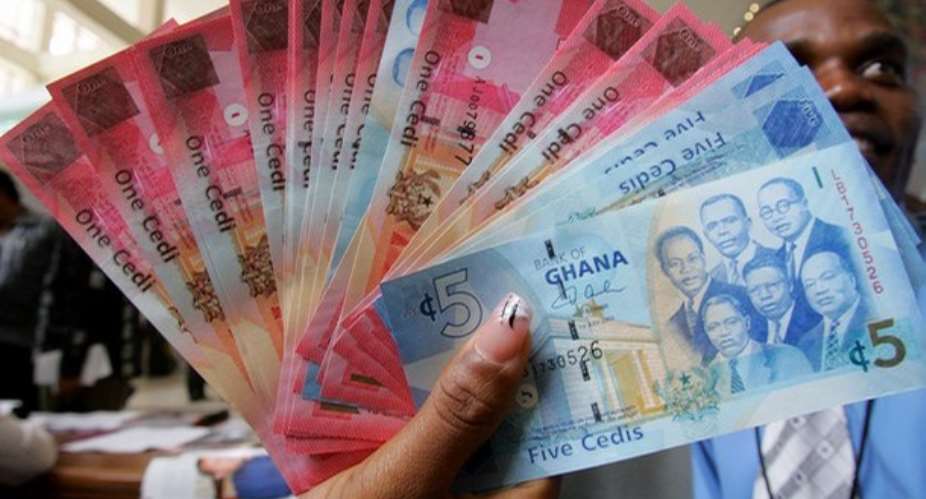
Since the beginning of the fourth republic, various governments have lost the battle to stabilize the cedi, and Ghanaians have taken a heavy toll, as they face the dreadful effects of a rapid depreciation of their currency.
In January 2009, the dollar traded for 1.27 Ghana cedis. As of December 7, 2016, when Ghanaians went to the polls to choose their next president, the same dollar trades for over 4.00 cedis, a depreciation of over 70 percent.
What made matters worse for Ghanaians from January 2009 to December 2016 is that the Mahama administration often claimed that the cedi depreciation benefited Ghanaians.
For example, the government claimed that cedi depreciation helped Ghanaians export more. This claim lacked merit because Ghana’s key exports – cocoa, gold, and crude oil – are priced in dollars; therefore, depreciation of cedi did not help in terms of increasing exports.
Currency depreciation is a loss of purchasing power, so a 50% depreciation means prices have doubled.
For example, a company importing rice from Asia converts cedis to dollars. Instead of paying 1.27 cedis for one dollar, as in January 2009, the company pays 4.0 cedis for a dollar today. This means that, traders’ cost of goods have tripled.
Obviously, importers passed this triple jump in cost to the average Ghanaian family. Hence the hardships we saw as December 7 2016, elections drew near.
Interestingly, the hardships due to price increases affected Ghanaians differently, depending on their job.
Civil servants and some sectors received pay increases to mitigate this triple jump in prices of some goods and services, but farmers faced the direct effects of skyrocketing prices.
Cocoa prices are a good example when compared from 2010 - 2011 to 2016 – 2017: the government increased prices from 200 to 205 cedis and from 425 to 475 cedis, respectively.
So using the prevailing 1.39 cedis to a dollar in 2010 - 2011 versus 4.0 cedis to a dollar in 2016 - 2017, the government of Ghana, through the Cocoa Board, paid cocoa farmers $147 dollars per bag in 2010-2011 versus $118 in 2016.
However, on the international cocoa exchanges the price of cocoa in October 2010 versus October 2016 was about the same.
If a cocoa farmer bought and used imported fertilizer and pesticides and prices of these essential items have tripled, we can see that cocoa farmers lost money in 2016.
The bottom line is that Ghanaians are being encouraged to engage in agriculture; however, unless the rapid depreciation of the cedi is arrested, farmers are simply being encouraged to enter an unprofitable business.
If agriculture is a business, then the bottom line is profits. In 2016, cocoa farmers lost money.
Kofi Amoabin is the CEO of SSA Farm Technologies Inc, a provider of innovative solutions to agriculture, mining and energy sectors.


 ‘Too arrogant, too sure of itself’ France confronts its legacy in Africa
 Nigeria's unwritten power-sharing rule looms over presidential race
 Several killed, dozens wounded in Jordan church shooting
 ‘I killed lots of terrorists, but it didn’t make me feel better’: The trauma hau...
 Casualties feared as multi-storey building collapses in Nairobi
 Cabinet approves bill to regulate public relations practice – Shamima Muslim
 Bawumia was right; NDC's economy is only on paper, not in people's pockets – Kwa...
 NDC should credit Bawumia for introducing gold-for-reserves policy – Kwadwo Poku
 Obuasi SHTS sex scandal: Gender Ministry deploys team to support affected studen...
 Adwoa Safo's Dome-Kwabenya comeback bid must push Elikplim Akurugu to deliver mo...



Comments
How many people not even the governor of BOG will agree with what you're saying but it's the FACT. There's no human with intelligence within the NDC party and I believe they won't be voted back to power any time soon. Mahama just left us with $120 billion in debt within the last 5 years.