




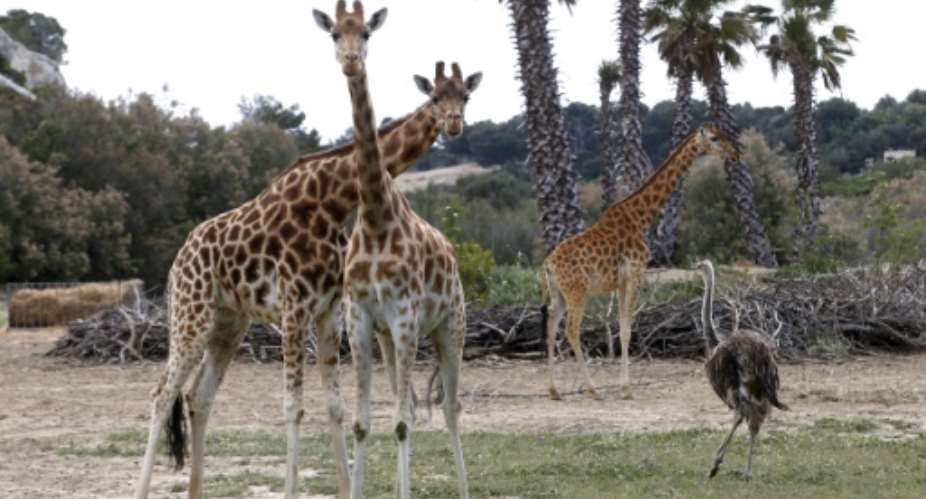
Nairobi (AFP) - One of the most under-studied large mammals in Africa, research has shown the giraffe has silently been going extinct, with numbers dropping 40 percent in the past three decades.
Here are some unusual facts about one of the most distinctive-looking creatures on the continent.
Neck
The giraffe's best-known feature can be longer than most people are tall. However, like humans it still only has seven vertebrae. Each is about 25 centimetres (10 inches) long.
It is used to reach high up into trees for food but too short to reach the ground, so the animals have to splay their legs or kneel down to drink water. Luckily they only drink every few days and get most of their hydration from plants.
The neck is also used in an elaborate ritual fight known as "necking" in which giraffes swing at each other to establish dominance.
Markings
With its spotted pattern and long legs and neck, the giraffe was given the Latin name "camelopardalis", meaning "camel marked like a leopard".
But the spots are not only for camouflage.
According to the Giraffe Conservation Foundation (GCF), each patch is surrounded by a sophisticated system of blood vessels which act as thermal windows to release body heat.
A thermal scan of a giraffe shows the intensity of heat in its body matching the pattern of the spots.
Like the human fingerprint, each giraffe has its own unique pattern.
Big tongue, big heart
It's not just the neck and legs which are outsized on a giraffe.
Its tongue can measure up to 50 centimetres to give the animal even more leverage in nibbling from the top of its favoured tree, the acacia.
The tongue's blue-black colour is believed to shield the organ from sun exposure and it is widely accepted that a giraffe's sticky saliva has antiseptic properties to protect it from spiky thorns on the acacia.
A giraffe's heart weights up to 11 kilograms -- to power blood up a neck of nearly two metres -- and beats up to 170 times per minute, double the speed of a human heart.
Breeding
Giraffes have one of the longest gestation periods, at 15 months. They give birth standing up, which means their calves drop just under two metres to the ground.
This startling introduction to life gets them up and running around in less than an hour. A newborn calf is bigger than the average adult.
In the wild, giraffes can live up to 25 years, while in captivity they can survive over 35 years.
Genetics
Giraffes evolved from an antelope-like animal of about three metres tall that roamed the forests of Asia and Europe 30 to 50 million years ago. Its closest living relative is the okapi.
In September scientists revealed there were in fact four distinct giraffe species and not one, as initially thought.
 S.african Police Probe Killing Of Foreigner In Xenophobic Unrest
 Tension at Bantama NPP office as chairman accuses Asenso Boakye of political mac...
 Korle Bu succesfully performs first two off-pump heart bypass surgeries
 Disability Act lacks teeth, must be strengthened — Annoh-Dompreh
 Mental health, drug tests now mandatory for firearm licences — Interior Minister
 GoldBod directs licensed buyers to report gold purchases within five minutes
 Action will be taken on viral video showing SHS student assaulting a junior — Dr...
 NDC promised to ease cost of living yet increasing utility tariff — Kofi Tonto
 NDC is a useless govt – Miracles Aboagye fumes
 Govt eyes 1,012km rail corridor to boost trade, transform cargo transport from T...


