




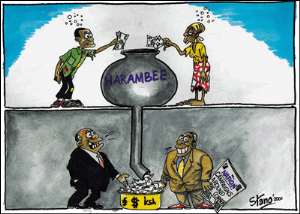
I could easily have predicted the news report alleging Mr. Fedilis Matthew Oppong-Mensah, the recently dismissed headmaster of the Opoku-Ware School (OWASS), to have collected nearly GHC 3 million from two classes of graduating students with the promise of supplying them with custom-tailored school blazers, dress suits, vests and track-suits which were reportedly never supplied (See "Sacked Owass Headmaster To Cough Up GHC 2,649,000" Chronicle / Ghanaweb.com 8/5/15). As of this writing, Mr. Oppong-Mensah was reported to have instructed the parents of the students to contact the school's bookstore for the aforementioned items.
We are not, however, told why these supplies could not be delivered on time. Here in the United States, such default in supply schedule would have attracted some penalties, with the scammed buyers being afforded the option of monetary refund, or having the said items sold at heavily discounted prices. In Ghana, Mr. Oppong-Mensah would probably get away with such sloppy business transaction. I have no idea why the Opoku-Ware headmaster was fired, but I am tempted to infer that it likely had somethig to do with him flouting some school-fee regulations stipulated by both the Director-General of the Ghana Education Service (GES) as well as the Naana Opoku-Agyeman-headed Ministry of Education.
It wouldn't surprise me the least bit, if it should turn out that my guess is right on the money. Between 1982 and 1984 while I attended sixth-form at Prempeh College, the then-headmaster, the late Mr. M. K. Atiemo - I hope I have his initials right - and the extant Opoku-Ware headmaster, Mr. Owusu-Donkor, were the most notorious headmasters in Ghana. And their notoriety primarily verged on their easy ways with, or rather soft spot for, naked bribery and corruption. The parents of nearly every student who gained admission into these two leading high schools in the Asante Region had to pay some kickback in one form or another. These two headmasters were also known to be the best-suited of their kind, and the only ones among their peers who owned and drove Mercedes Benzes in the country.
Today, such narrative may come off as embarrassingly pedestrian; but in those days, it was quite a story. Most University of Ghana professors, and here I make a strict distinction between "professors" and "lecturers," could barely afford a Volkswagen Golf Sedan or Beetle Model automobile. And, mind you, quite a remarkable percentage of these professors sported a Ph.D. from a reputable Western-European or Eastern-European university. Indeed, I would not be the least bit surprised should it turn out that the culture of rank corruption among our high school administrators was invented by Messrs. Atiemo (alias "Atia") and Owusu-Donkor.
I never met Mr. Owusu-Donkor personally, although I visited the Opoku-Ware campus many times to have tutorial sessions on Religious Studies (Christian Religious Studies, that is) with the now-late Mr. Hooper (aka M'Agya Hooper/Nanabanyin), a most generous gentleman of a rare kind. But it was commonplace to hear it said that Messrs. Atiemo and Owusu-Donkor walked in lockstep. Both Prempeh College and Opoku-Ware School, named after two of the most significant Asante Kings, were also notorious for being tragically blighted by a teaching staff that preferred to devote most of their teachings only to students whose parents could afford to pay extra-tuition fees in addition to those stipulated by the Ghana Education Service.
At Opoku-Ware, legend even had it that there was a teacher who routinely spent his regular class hours working on his backyard garden. Actually, it was his front-yard garden, right by the side of the road in-between the Suame Rounabout and the Santansi Roundabout. So much for Operation Feed Yourself! I believe he taught Economics and Geography. Students also had to purchase his self-published, largely plagiarized and cyclostyled, books as a prerequisite for attending his classes, irrespective of whether one paid the extra-tuition fees or not. He was probably called Mr. Sarkodie, or some such name, I cannot readily remember.
What I also wanted to highlight is the fact that it was the old-boys' network that likely established and fostered this carcinogenic regime of bribery and corruption. Legend also had it that it was the Prempeh College's Old Boys' Association that got rid of the last non-Prempeh College alumnus headmaster, Mr. T. N. Osae, a quite notable and respectable historian, and brought in Mr. Atiemo, then the headmaster of Sunyani Secondary School. Their gripe was that Mr. Osae had jampacked Prempeh College with too many Accra boys whose academic mediocrity had precipitously brought down the quality and ranking of Asanteman's oldest and flagship secondary academy. Eventually, in time, the exact same complaints would be made against Mr. Atiemo; to wit, that he had packed Prempeh College with too many intellectually dull Krachi boys.
Interestingly, when the Prempeh College Old Boys' Association demanded the removal of one of their pioneering school prefects, Mr. Atiemo was widely rumored to have angrily retorted that he owed absolutely no allegiance to any old boys' network; and that it was purely his own sterling academic achievements and professional qualifications that had secured him the enviable post of Prempeh College Headmaster.

 'I couldn’t have refused an order' – Major Adjei-Ampofo explains why he took par...
 'Some NDC members are working with NPP to get your GoldBod job' – Kevin Taylor w...
 'It is too early for you to take this political heat' – Kevin Taylor cautions Ay...
 NPP knows GoldBod is our strength, that is why they want to bring it down – Suhu...
 Stop using radio airtime for greetings, talk about Mahama’s economy – Suhuyini t...
 IEA proposes binding long term national development plan to stop successive gove...
 Health Minister moves to prevent stockouts of HIV, TB and Malaria commodities
 IEA wants MPs, ministers barred from serving on State-Owned Enterprise boards
 Constitutional review: IEA warns against changes that could turn judiciary into ...
 Eastern Regional Minister orders temporary closure of two SHSs after violent stu...


Comments
The article by Kwame Okoampa-Ahoofe regarding Mr Owusu Donkor,a former headmaster at Opoku Ware School,leaves much to be desired! Having read this article,my former school mates and i are astounded! Not by the fallacy of this article,but by its conjecture that it was common knowledge that Owusu Donkor was corrupt! Until today, none of us were privy to this alleged conduct by our former headmaster. If it were true,we would have heard about it during our time at Owass and later in life. We knew Ow...