




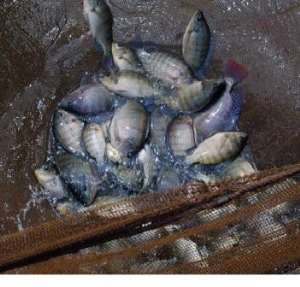
The Ghana National Aquaculture Development Plan (GNADP) has been launched, as the country's first blueprint to guide the sustainable development of the aquaculture value chain.
Implementation of the plan will cover a five year period at a cost of US$85 million.
With financial and technical support from the Food and Agriculture Organisation (FAO), the Plan is aimed at enhancing and improving the practice, management and development of aquaculture as a viable business.
Aquaculture is fast gaining pace as an alternative source of animal protein as Ghana's marine and freshwater fishery production decline.
The country's fish demand for 2012 was estimated at 968,000 metric tons while the country's fish production for that year was 486,000 metric tons, representing about 50.2 per cent of requirement.
Dr. Emmanuel Anokye Frimpong, who is involved in the training of Ghanaian fish farmers under the USAID Aquaculture and Fisheries Collaborative Research Support Program, notes that the practicality of aquaculture must be understood if it is benefit people as a business.
'Aquaculture is a hands-on activity; it is also a business that involves doing', he explained, adding that some people struggle in the business 'primarily because it is difficult for them to just get their feet wet and their hands dirty'.
With the new intervention, aquaculture production is expected to increase by 360 percent from the current 27,750 metric tons to 130,000 metric tons while generating an estimated 220, 000 jobs across the value chain.
The capacity of aquaculture associations to improve the knowledge, skills and management capabilities of indigenous fish farmers will be prioritized, according to Nayon Bilijo, Minister for Fisheries and Aquaculture Development.
To achieve this, Dr. Anokye Frimpong believes access to information on new developments in fish farming via radio, television and mobile phones would empower fish farmers to maximize opportunities in the sector.
In 2012, Ghana's Water Research Institute (WTI), in partnership with WorldFish, came out with the 'Akosombo' strain of Nile Tilapia, which grows 30 percent faster than non-improved tilapia.
The improved variety is to increase aquaculture productivity and food security in West Africa.
For local consumption, an increase in productivity can result in greater availability of fish in the market, reducing the price of the product and making it more accessible to poor consumers.
Story by Kofi Adu Domfeh

 We will remove Affi Agbenyo from EC if NPP returns to power – Kamal-Deen
 Ghana’s economic activity grows 7.4% in July 2026, services lead
 Five remand prisoners remain at large after escape from Konongo police cells
 Burkina Faso bans beauty pageants
 We must praises NDC for stabilising Ghana's economy – Stephen Amoah
 Chairman Wontumi returned to Nsawam as court adjourns bail ruling to November 4
 NDC can retain power in 2028 on Mahama’s records – Kwame Anthony
 October 15: Cedi sells at GHS12.30 on forex market, GHS11.68 on BoG interbank
 Court to rule on Wontumi’s bail pending appeal on November 4
 Police arrest eight in crackdown on suspected drug trade at Okaishie Drug Lane


