




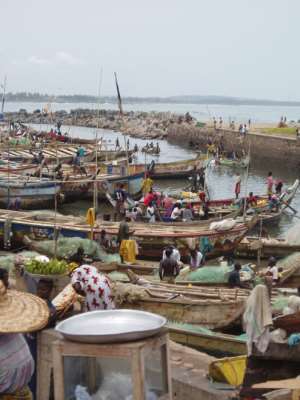
Fish blood splashed as women slashed huge fishes into smaller pieces with machetes for expectant customers. Money stained in fish blood and fish scales exchanged hands briskly.
Shouts of Eban (herring), Sukuei (thread fish), Epaei (Horse mackerel), Nkanfona (long-finned herring), Eduei (Barracuda), Wowoyan (Ribbon fish), Sesew (Shrimps) and Mpatoa (tilapia) filled the atmosphere. These are fante names for the fishes.
The shouts became louder, confusing the already messy environment in the fish port at Elmina in the Central region of Ghana.
The fishermen at Elmina have had a good day at sea on a beautiful but drizzly Wednesday morning and there could not have been a brighter day at the port despite the rains.
The bubbling atmosphere made useless of the drizzles. They could not be bothered by the rains.
Fishy-smelling women sat under sheds in the fish market, relying on how loud they could possibly shout to get the attention of the customers. The shouts of the names of fishes (in fante) have served them well as effective advertisements over the years.
Large basins with inscriptions on them were another major form of advertisement and helped customers locate their best deals.
There were no weighing scales. But there was serious bargaining and negotiations taking place. Big business was ongoing. What you got depended on the quantity and the type of fish you wanted, the octopus arguably being the most expensive.
I had squeezed myself into the crowded market after paying 20 pesewas as entry fee to the fish port.
Calculating each step cautiously, careful not to step on another or be stepped on.
However, in the midst of the seeming disorder was concealed sanity.
A careful look indicated that the women knew the exact spots they had to sell and surprisingly, the prizes were almost the same for the specific quantity around the market. No huge differences.
There was a system operating in the midst of all the noise and squalor.
I observed that the fishermen sold their catches to specific women groups.
Many of the women who belonged to these groups bought the fishes in huge quantities and in turn sold them to individuals of even other market women.
Specific women groups bought fish from specific fishermen. They knew their customers and the system provided ready markets for the fishermen.
Some individuals also thronged the port to buy fish for personal use.
Many of the fish sellers were mostly women but some men also sold. These men usually were not stationery but moved round with fish in buckets, looking for buyers around the port. Young men and even boys could be seen with a few fish in their hands seeking buyers.
The women fish sellers had very apt marketing skills and it was not surprising that I bought GH¢ 5 worth of shrimps on impulse. A few others were rather cheeky not ready for bargains.
The activities of all the fish sellers were co-ordinated by selected queens called “kokoahemaa” and they ensure that there was order in the place.
A lot more economic activities went on in the port.
Elmina, the ancient city which lies to the west of Cape Coast in the Central region of Ghana is known for its role in the infamous slave trade and to host the largest slave castle in Ghana.
But the trade, which has held the people together and sustained majority of the people in the area for over a century, has not received much notice.
Fishing provides livelihood for majority of the people in the area. They and their dependents depend on fishing. Indeed, many families depend on the sea in many ways.
Hundreds of young men in canoes leave the town for fishing every other day from Elmina.
And come in hopefully in canoes loaded with fishes on a good day.
They came into the port from behind the Elmina Castle under the fast deteriorating bridge into the port unload the catch for the buyers before mooring at the other side, the Esuekyir side of the port.
I trekked to the other side.
This was the landing bay. Here, brightly painted canoes, big and small, old and new anchored on the silted Benya lagoon. Wherever one stood, it gave you a pleasant beach view.
Almost all the canoes had one flag or an inscription or another. The flags included flags of countries, football clubs, political parties and even television stations. One canoe had the flag of GTV (Ghana Television,) while another had the flag of the Arsenal Football Club.
Other inscriptions on the canoes depicted the faith of the owners in God. One read “Aseda Nka Nyame” literally meaning “Thanks Be To God” while another read “Trust God.”
It was calmer here than at the fish port. Here, men mended nets, others scooped water from the canoes, some sat behind coal pots roasting fish. Women, some with crying babies behind their backs bargained for few basins of fish.
However, in the entire muddle was an unexplained pleasantness. It was obvious; the people loved what they do.
Nana Ackonu is the Chief Fishermen of Elmina and this means he is traditionally the head of all fishermen and fishmongers at Elmina and oversees all fishing related activities.
He explained in an interview that the Benya lagoon, the sea and the people of Elmina did not have only an economic relationship, but said the relationship extended even to the spiritual.
He explained that the founder of the Elmina state, Nana Kwa Amankwaa was said to have walked from nearby Eguafo in search of water and had found the Benya lagoon. He said Kwa Amankwaa was said to have shouted “Menya” literally meaning “I have got it.”
He said the name of the lagoon was “Menya” but had been corrupted as Benya over the years.
“It holds the soul of the people,” he said.
The Nana Benya Shrine, which stands in the yard of the landing site and to which the people pay homage during their annual festivals, confirmed his statement.
He said rituals are performed for the god of the lagoon, Nana Benya for bumper seasons.
“The lagoon has served us well and the fishing here has brought many people to this land” he said proudly.
He indicated that over 600 large canoes and 800 smaller ones from other fishing communities including those from Cape Coast, Komenda ,Otuam, Dego, Sekondi and across the country throng there each season to ply their trade.
King Solomon, a fisherman for 30 years, said he cannot imagine a world without fishermen. His 21- year- old son is also into fishing.
Solomon wore a red stripped cap over T shirt eating kenkey and fish with pepper sauce under a shed. He quickly washed his hands for the interview.
“I have taken care of a family of eight with my income from fishing. But that is virtually it. I don't even have a canoe after 30 years. Certainly the fishing industry could be far better and fishermen better off than we are now” he said. “We could have been far richer if effective systems were put in place for us fishermen. But sadly, this has not been the case.”
He noted that the fishermen were exploited when there was bumper harvest because they were not enough cold stores to store the fishes.
“We need the cold stores here. It is very important,” he added.
He said there was also the need for the regular supply of the premix fuel used for the outboard motors on the canoes.
“Today you have the fuel, tomorrow it is not available, and we cannot achieve much with this kind of system.”
The outboard motors also remain another problem. “The outboard motors are too expensive. It is over GH¢ 8000 and you cannot easily get started with the kind of prices,” he stated wearing a rather serious expression on his face.
The assertions of Solomon were collaborated by Nana Ackonu, who said fishing inputs should be highly subsidised to make the industry attractive to the young ones. He stated that though young people wanted to venture into fishing, industry these challenges usually put them off.
He also stated that there was the need for education for fishermen on effective fishing methods and technical know- how “between the people who sit in the offices and the university and those who go to sea” to improve on the industry.
But in the midst of the seemingly plenty was scarcity.
Afua Bosumtwi buys and retails fish at Elmina. When I met her, she carried three large empty basins stuck in each other.
Though Afua is married to a fisherman, she dealt with a different group of fishermen and today, despite the fact that many boats had come back with fish, her suppliers came back empty.
She said it had been like that for a few years now. She said the inconsistencies in the catch rates were becoming more frequent. For her, it was a bad day.
The story behind the unpredictable catches at sea is much more complex than just the worried look on Afua's face.
Dr Maame Enstua Mensah, Director General of the Centre for Scientific and Industrial Research said most of the nation's fish species had depleted drastically and were currently at a warning level.
She noted that pair trawling and other negative fishing practices including the use of unapproved fishing nets and dynamite fishing had significantly affected the fish levels in our seas.
“Some fishermen are even using mosquito nets to fish,” she stated.
This, she stated, had led to high levels of depletion of various fish species.
She called for the effective implementation of the Fisheries Act 625 to ensure the right and acceptable fishing practices by fishermen.
Dr Enstua-Mensah emphasized that it was crucial to educate the fishermen and all interested on fishing to ensure that they operated more professional to help protect and preserve the nation's fish industry for posterity.
Luckily for the nation, the University of Cape Coast has taken on the responsibility of ensuring that the fishing industry has the right people manning it.
The immediate past Vice Chancellor, Professor Naana Jane Opoku Agyeman, said the establishment of the Fisheries College at Anomabo was long over-due.
She noted that agriculture in the country had suffered setbacks due to over concentration on crops and livestock.
Fish provide about 60 per cent of the protein needs of Ghanaians and the industry must not be neglected.
The number of fishermen are, however, said to be dwindling, leaving the industry in the hands of old feeble men.
Prof. Agyeman said the first batch of students for the Fisheries Colleges were expected to be admitted for the 2013 academic year, adding that she was optimistic the status and productivity of fisher folks and the fishing industry would be raised by this noble move.
Afua said she was hoping for better catch days ahead to continue the trade that had kept her family going for years.
“There is joy in the home and even in the community when the basins are filled with fishes, then life is easier for us all,” she said.
 NACOC raids Central University, arrests 5 students in possession of wee-infused ...
 Ireland deports 42 South Africans
 Chief Justice Baffoe-Bonnie's Canada trip self-funded — Judicial Service
 Ghana summit charts path from 'recognition to action' on slavery reparations
 Boakye Agyarko is best suited to lead NPP as National Chairman – Kpandai MP
 African Union condemns deadly Niamey airport attack, pledges support to Niger
 Don’t see Ken’s comment as war but opportunity for reconciliation — Kwasi Kwarte...
 Kennedy Agyapong’s claim Defence Committee was stopped from visiting Afari Milit...
 'We only corrected a miscommunication' — Agric Minister dismisses rift with Fina...
 Ghana invests too little in early childhood despite 80% poverty rate among under...


