




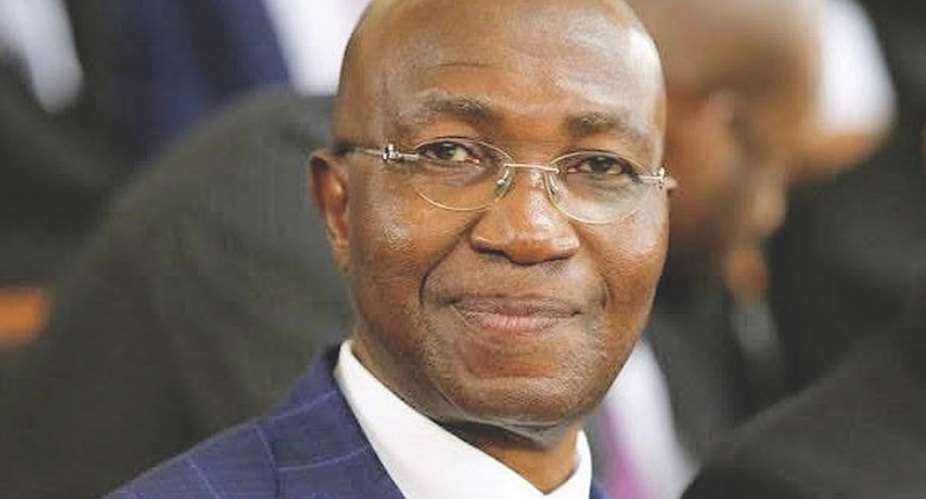
Those who watched last week Thursday’s live television broadcast marking the 75th birthday of Chief Wole Olanipekun would agree that it was a worthwhile break from normal programming. The event had real value in presenting the newly-minted Grand Commander of the Order of the Niger (GCON) as a man of substance and a recognized historic persona.
President Bola Ahmed Tinubu lightened the mood with banter about Olanipekun, a Senior Advocate of Nigeria (SAN), being “already booked” for any court challenge arising from the forthcoming presidential election. The assembled audience loved the joke, greeting it with resounding applause. Of course, much truth is often spoken in jest, and this was a classic example. Tinubu topped it off by conferring the GCON on the celebrant - an honour even the most ardent cynic cannot deny is richly deserved.
He represents a throwback to a more edifying past. That period recalls an era, which feels like a distant epoch now, when Nigeria maintained the highest internationally competitive standards. Nigerian jurists and lawyers were deeply respected and shone like stars when they appeared before the Judicial Committee of the Privy Council in Britain, which served as the country’s highest court until appeals to it were abolished in 1963.
Nigerian barristers were highly sought after across Africa. One notable example occurred in 1952, when Chief H.O. Davies joined the defence team for Jomo Kenyatta and fellow Mau Mau freedom fighters in Kenya, deploying forensic skills that remain legendary. Decades later, in 2013, the British government reached a £19.9 million out-of-court settlement with surviving elderly Kenyan victims of the colonial crackdown. The efforts of the late legal luminary, who later became a Queen’s Counsel (QC), continue to resonate.
Olanipekun earned his awards because he has remained faithful to the original spirit that stretches all the way back to Nigeria’s first indigenous lawyer, Christopher Alexander Sapara Williams. He is famously remembered for insisting that the legal practitioner lives for the direction of his people and the advancement of his country’s cause, a principle centred on the upliftment of society.
The elder-statesman is an embodiment of these virtues. His practice of the law through landmark cases has focused largely on helping to build a better, more equitable nation. He exemplifies both deep jurisprudential learning and the practical, technical skills needed to win the argument.
In this marriage of theory and practice, a rare skill in itself, the septuagenarian stands alongside legal giants such as the brilliant British advocate Sir Edward Marshall Hall, whose courtroom brilliance spanned the early decades of the twentieth century into the 1920s. Around that same era, Nigeria produced a towering counterpart in E.J. Alex Taylor, fondly revered as “The Cock of the Bar” and hailed in Yoruba as “Akọ níwájú Adájọ́.”
Wole Ogunsemi, a retired Army Colonel and one of Olanipekun’s long-term friends, recalled watching the bar leader rise from a brilliant young barrister in 1970s Ilorin to Nigerian Bar Association (NBA) President. To Ogunsemi, the presidential honour is a fitting recognition of a distinguished lawyer whose scholarships and civic projects - building courts, schools and churches - have uplifted many lives.
At a time of lowered expectations and standards, it is vital that the achievements of a figure like Olanipekun be brought to the fore. The example of such legal role models should be placed in the limelight from secondary school through university law faculties. Their careers and conduct should be studied as reference points for high ethical standards at the Law School. This matters deeply, for as far as public record shows, there has never been even a whiff of impropriety about Chief Wole Olanipekun, GCON, CFR, OFR, SAN. Such legacies help guard and guide successive generations against the erosion of standards and the unethical practices that have sadly become all too commonplace. It will show that genuine success can be attained without cutting corners or stooping to the unacceptable.
This matters because, as one of the founders of History, Herodotus, famously observed, “A person who does not know anything about the events which occurred before he or she was born will remain forever a child.” That is why we applaud the conferment of Nigeria’s second-highest national award on him. It should help redress the balance and show those still in their decisive formative years that lasting achievement comes from emulating the discipline and integrity of figures like the veteran advocate.
May the Lamb of God, who takes away the sin of the world, grant us peace in Nigeria!
Email: [email protected].
Mobile: 08033614419 SMS only.

 Bank of Ghana's New Heritage Notes: A National Embarrassment That Demands Accoun...
 Consumer Protection Agency CEO Kofi Kapito dies
 Mahama, Mottley reclaim King Cuffee's Legacy with historic monument unveiling
 Kenyan starvation cult leader guilty of 123 manslaughter deaths
 December 4 declared public holiday for 2026 Farmers’ Day celebration
 GRA flags 29 shops at A&C and Marina malls over tax infractions
 Cashew farmers demand suspension of export ban until local processors can absorb...
 Upper West Regional Police only invited me, not arrest — Nadowli-Kaleo NPP chair...
 Osahen Afenyo-Markin questions EOCO unlawful transfers of funds in frozen accoun...
 Paris court orders Depardieu to stand trial over alleged 2018 rape of actress


