




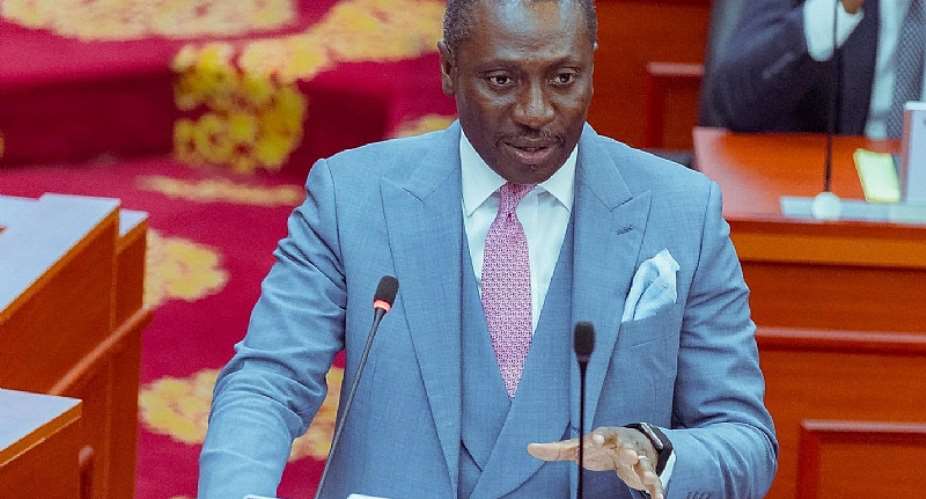
Minority Leader Osahen Alexander Afenyo-Markin has raised concerns over the handling of frozen bank accounts by the Economic and Organised Crime Office (EOCO), accusing the agency of moving customers' funds without filing charges and potentially violating constitutional provisions governing the exercise of discretionary powers.
He warned that the practice could undermine businesses, cost jobs, discourage investment and expose the country to judgment debts.
The Effutu MP made the allegations during his concluding remarks on the 2027 Budget debate in Parliament on Thursday, November 26, arguing that EOCO and the Financial Intelligence Centre (FIC) were acting contrary to Article 296 of the 1992 Constitution, which regulates the exercise of discretionary powers by public authorities.
He said Benjamin Boakye of the Africa Centre for Energy Policy (ACEP) had raised similar concerns and urged Finance Minister Dr Cassiel Ato Forson to pay attention to the matter because the FIC falls under his ministerial oversight.
Osahen Afenyo-Markin questioned the justification for EOCO seeking court approval to transfer funds from frozen accounts into accounts controlled by the agency while investigations remained inconclusive and no charges had been brought against the affected account holders.
He demanded to know the reasons for such transfers and the benefits they served.
The Minority Leader also challenged commercial banks that allegedly transfer customers' frozen deposits to EOCO solely on the agency's instructions without obtaining court orders.
He questioned where the transferred funds were kept and who benefited from the interest accumulated while the money remained outside the customers' control.
“Businesses are being crippled, jobs are being lost, unemployment is being aggravated,” he told Parliament.
He warned that actions he considered to be in clear violation of Article 296 could drive away investors and expose the state to costly legal claims.
Baffour Awuah's case features in EOCO criticism
To support his concerns, Osahen Afenyo-Markin referred to the case involving Manhyia South MP Nana Agyei Baffour Awuah, accusing EOCO of arresting the legislator without sufficient justification and demanding financial records covering a 10-year period.
Mr Baffour Awuah pleaded not guilty before the Accra High Court on October 3 to charges involving money laundering and causing financial loss.
However, EOCO had earlier secured an arrest and search warrant from the High Court on September 30 after informing the court that the MP had failed to honour 2 invitations issued in February as part of investigations into the SIC Life Savings and Loans matter.
That account of events has been disputed by Mr Baffour Awuah.
Osahen Afenyo-Markin welcomed a directive by Attorney-General Dr Dominic Ayine cautioning law enforcement agencies against improper arrest and detention practices.
He, however, accused the Attorney-General of having previously made public comments that could also be considered prejudicial.
As of Thursday night, EOCO had not published any response to the allegations raised by the Minority Leader in Parliament.
Responding on behalf of the government, Majority Leader James Agalga rejected claims of state-sponsored harassment and challenged Mr Afenyo-Markin to seek legal redress if he believed the agency had breached the law.
Mr Agalga, who had described EOCO's initial attempt to arrest Mr Baffour Awuah in September as “unprofessional”, insisted that the government would not tolerate the victimisation of individuals by state institutions.
“If EOCO is in breach of the law … you are a lawyer, you know what to do,” he said.
He further pointed to the availability of the human rights courts as an avenue for addressing alleged violations.
“If they are unlawful, the human rights court is there,” he added.
Afenyo-Markin questions economic gains highlighted in 2027 Budget
Beyond the concerns over EOCO, the Minority Leader used his concluding remarks to challenge the government's presentation of the country's economic performance, arguing that improvements in official statistics had not translated into meaningful relief for ordinary Ghanaians.
He contrasted the government's macroeconomic achievements with the financial pressures facing households and businesses, insisting that economic progress must be measured by its impact on people's everyday lives.
“On paper, everything looks beautiful, but a market woman cannot eat paper,” he said.
Addressing the Finance Minister directly, he added: “We are not interested in your paper economy.”
Osahen Afenyo-Markin also criticised the reduction in cocoa producer prices announced in February, delays in posting recruited teachers and nurses, and what he described as a shift in the government's policy messaging from the 24-Hour Economy programme to the New Economy agenda.
His concerns echoed questions raised by Damongo MP Samuel Abu Jinapor during Tuesday's debate on the 2027 Budget.
However, Mr Agalga defended the government's economic programme, describing the November 12 Budget Statement as a practical policy document focused on the needs of ordinary citizens rather than political slogans.
He said the budget was designed around the realities of Ghanaians and maintained that it introduced no new taxes while making provision for major infrastructure projects, including the Accra-Kumasi Expressway and Western Corridor Railway, without resorting to additional borrowing.
The Majority Leader described the fiscal plan as “a budget of restraint with purpose”, arguing that the government had demonstrated its ability to undertake development projects without transferring excessive debt burdens to future generations.
In support of the government's economic record, the Builsa North MP cited October 2026 inflation of 5.5 per cent, compared with 8 per cent during the same period a year earlier.
He also put the country's debt at GH¢759.3 billion at the end of October, equivalent to 47.5 per cent of Gross Domestic Product (GDP).
Mr Agalga rejected criticisms of the debt figures previously raised by former Finance Minister and Karaga MP Mohammed Amin Adam.
He further disclosed that Ghana's gross international reserves had reached US$12.7 billion by the end of September, representing approximately 4.5 months of import cover.
He contrasted the position with what he described as the three weeks of import cover inherited from the previous New Patriotic Party administration.
“A promise made is a promise kept,” he said.
 Stop using media to pressure NACOC if cocaine case not going your way in court –...
 Cashew farmers demand suspension of export ban until local processors can absorb...
 Upper West Regional Police only invited me, not arrest — Nadowli-Kaleo NPP chair...
 Osahen Afenyo-Markin questions EOCO unlawful transfers of funds in frozen accoun...
 Paris court orders Depardieu to stand trial over alleged 2018 rape of actress
 November 27: Cedi sells at GHS12.55 on forex market, GHS11.84 on BoG interbank
 Government has no power to destool chiefs – Justice Dennis Adjei
 Mahama arrives in Barbados for five-day state visit
 Galamsey threatens food security, public health and national security – Zanetor
 Ministries, state agencies risk sanctions for data privacy breaches – Sam George


