




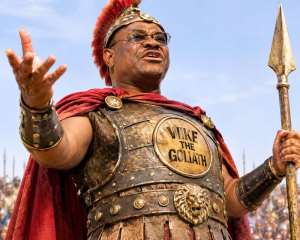
There is something particularly amusing about politicians who mistake political influence for political ownership, and political ambition for an extraordinary ability to command the will of the electorate. Such politicians sometimes become so carried away by their own self-importance that they begin to speak as though entire states, their voters and their electoral fortunes are personal possessions waiting to be allocated.
The Minister of the Federal Capital Territory (FCT), Nyesom Wike, appears to be flirting with this rather embarrassing political disposition.
His recent declaration that he was done with Rivers State and the FCT, and therefore wanted President Bola Tinubu and the leadership of the All Progressives Congress (APC) Presidential Campaign Council to assign him Imo and Kwara states to deliver in the 2027 presidential election, has provided yet another opportunity to examine his increasingly conspicuous political swagger.
Indeed, Wike's request would probably have been less amusing if it had been presented as an ordinary expression of willingness to undertake additional campaign responsibilities. Unfortunately, the manner in which he presented it carried the unmistakable flavour of a political strongman who believes that electoral victories are commodities he can personally manufacture, package and deliver at will.
In biblical literature, there is a character whose disposition offers an interesting parallel to this kind of exaggerated self-confidence. His name is Goliath.
As recorded in 1 Samuel 17, Goliath was a Philistine warrior who became notorious for his intimidating appearance, loud boasts and persistent challenges to the army of Israel. He was so confident in his physical strength and military reputation that he openly mocked the Israelites, daring them to produce a man who could defeat him.
For forty days, he continued his theatrical display of arrogance, apparently convinced that nobody could challenge his superiority. He was, in his own estimation, an unbeatable champion.
But Goliath's greatest weakness was that he mistook intimidation for invincibility. He had become so impressed with his own reputation that he underestimated the possibility of an unexpected challenge.
Then came David, a young shepherd who refused to be intimidated by the giant's intimidating stature and noisy boasts. Armed with a sling and a stone, David brought Goliath down, demonstrating that the loudest voice in the battlefield does not necessarily belong to the eventual victor.
That biblical episode offers a useful lesson for Wike and other Nigerian politicians who sometimes speak as though electoral outcomes are determined by their personal declarations rather than the collective decisions of voters.
To be clear, Wike is not Goliath, and Imo and Kwara are certainly not battlefields on which their citizens must surrender their democratic rights to a political strongman. However, the resemblance between Goliath's boastful disposition and the minister's latest political exhibition is difficult to ignore.
One would have thought that a politician who understands the intricacies of Nigerian politics would appreciate that winning elections requires more than political theatrics, declarations of strength and the confidence to ask for additional territories to conquer.
What exactly does Wike mean by delivering Imo and Kwara? Delivering them to whom, and through what democratic process? Does he imagine that the citizens of these states are electoral parcels that can be collected from one political warehouse and deposited in another?
Perhaps the minister should be reminded that the people of Imo and Kwara are not political appendages of the FCT Ministry, nor are their votes part of any political inventory that can be transferred to him by presidential permission.
Imo has its political leadership, just as Kwara has its own. Both states have governors, political structures, party loyalists, competing interests and, most importantly, millions of citizens whose constitutional right to vote cannot be appropriated by any politician, however influential he considers himself.
Wike's request is particularly curious because he reportedly based his interest in Imo on information that the state was experiencing political problems, while his assessment of divisions in Kwara was, by his own admission, drawn from what he had read on social media and had not independently confirmed.
Yet, on the strength of such information, he was already volunteering to take over the political mobilisation in both states. This is a rather remarkable demonstration of confidence, if not political overconfidence.
There is also a question of political propriety. Imo Governor Hope Uzodimma chairs the Progressive Governors Forum, while Kwara Governor AbdulRahman AbdulRazaq chairs the Nigeria Governors' Forum. Does Wike's unsolicited offer not suggest that he considers himself better positioned to deliver their respective states than the elected governors who currently administer them?
If that is the implication, it raises questions about the minister's understanding of political collaboration and the sensitivities involved in managing relationships within a ruling political establishment.
More importantly, Wike should understand that political mobilisation is not the same thing as electoral ownership. A politician may assemble a formidable campaign structure, persuade influential individuals to support a candidate and mobilise enthusiastic crowds. None of these guarantees that voters will ultimately cast their ballots as instructed.
The ballot belongs to the voter, not the campaign coordinator.
This is where the Goliath analogy becomes even more instructive. Goliath's mistake was not simply that he boasted. It was that he became so consumed by his own perceived superiority that he failed to recognise the vulnerability inherent in his position.
Wike should therefore be careful not to mistake his current political relevance for permanent political invincibility. Nigerian politics is notoriously unpredictable. Yesterday's political kingmakers have become tomorrow's political footnotes, while politicians who once appeared electorally indispensable have discovered that the electorate can move in unexpected directions.
Besides, there is a difference between being politically influential and being universally acceptable. The former may help a politician negotiate responsibilities and influence political calculations. The latter, however, cannot be commanded or manufactured.
If Wike genuinely believes that he has successfully put the necessary machinery in place to secure Rivers State and the FCT for President Tinubu, he should allow the eventual electoral process to establish the credibility of that claim. There is no need to sound as though he has already received a certificate of electoral ownership over two additional states.
And if he is eventually assigned Imo and Kwara, he should remember that the people of those states are not Goliath's defeated soldiers waiting to surrender to another political champion. They are citizens entitled to make independent democratic choices.
Perhaps the minister should revisit the biblical account of David and Goliath. It is a story about the danger of excessive confidence, the limits of intimidation and the unpredictability of victory. It also reminds us that size, noise and reputation do not always determine the outcome of a contest.
For now, Wike may continue to boast about Rivers and the FCT while volunteering to take charge of Imo and Kwara. But he should not confuse a request for campaign assignments with a divine endorsement of electoral victory.
After all, even Goliath had an impressive reputation before he met David.
In a democracy, the ultimate David is the electorate. And unlike political appointees, voters do not need anybody's permission to decide who wins or loses an election.
At this juncture, it is germane to recall that Wike's request was made at a Rainbow Coalition town hall meeting in Gokana, Rivers State. He also acknowledged that his information about divisions in Kwara had not been independently confirmed.

 Kenyan starvation cult leader guilty of 123 manslaughter deaths
 December 4 declared public holiday for 2026 Farmers’ Day celebration
 GRA flags 29 shops at A&C and Marina malls over tax infractions
 Stop using media to pressure NACOC if cocaine case not going your way in court –...
 Cashew farmers demand suspension of export ban until local processors can absorb...
 Upper West Regional Police only invited me, not arrest — Nadowli-Kaleo NPP chair...
 Osahen Afenyo-Markin questions EOCO unlawful transfers of funds in frozen accoun...
 Paris court orders Depardieu to stand trial over alleged 2018 rape of actress
 Mahama arrives in Barbados for five-day state visit
 Galamsey threatens food security, public health and national security – Zanetor


