




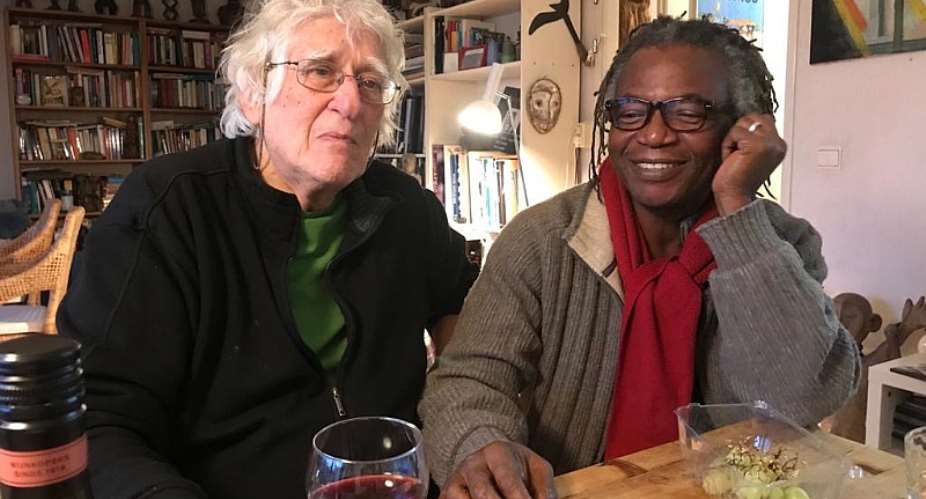
Some people one meets leave an indelible impression. Many are seldom famous; they rarely hold power, and their names are unlikely to adorn the history books. Yet they possess something that is growing increasingly scarce in our viciously violent and quarrelsome world: an instinctive, irrepressible recognition of the humanity of other people.
I have been blessed to meet and interview two such men, both Dutch, both committed to struggles that were not, strictly speaking, their own.
I interviewed Leo Klatser for my magazine, The African in the 1990s, and, some seven years ago, Klaas de Jonge for New African magazine.
Their political lives belonged to different eras, yet I found the same quality in each. Humanism oozed out of them.
I don’t like labels, and I don't use the word lightly. Humanism has little to do with party cards or the fashionable vocabulary of pretentious human rights activists.
Both Klatser and de Jonge seemed to have internalized a simple but profound proposition: a human being's dignity is not negotiable, and injustice does not become tolerable because its victims happen to live somewhere else or have a different skin color.
I consider both men complete Human Beings whose lives carry a lesson for an age intent on dividing humanity into rival racial, religious, national, and geopolitical camps.
Leo Klatser: The Fight Against Fascism
Born in Amsterdam in 1916, Klatser was a communist, journalist, writer, and photographer. At an early age, he went to Spain in 1937 to help defend the Republic against Franco's Fascist rebellion. At a tender age, Klatser already understood that far more than Spain's future was at stake. Hitler had consolidated his dictatorship in Nazi Germany, Mussolini was pursuing his imperial ambitions in Italy, and Spain had become another front in the struggle between authoritarianism and democratic resistance.
Klatser served there as a photographer with the Republican forces and returned to the Netherlands in 1939, after the Republic fell.
Unfortunately, Fascism had not finished with him. Under the Nazi occupation, he joined the resistance, was arrested and imprisoned, and in December 1943 was transported to Buchenwald. He survived and was liberated in April 1945.
Let’s try to consider what a man like Klatser saw: the destruction of the Spanish Republic, the horror of Nazi imprisonment, an age in which the most elementary principles of human dignity were assaulted as a matter of policy.
A lesser man would have emerged consumed by hatred of humanity, but he did not.
Klatser’s later life had a complexity worth admitting and admiring. He had the intellectual integrity to question his own ideological beliefs. He quarreled with the Dutch Communist Party and argued for de-Stalinisation.
Our genuine respect for him does not require us to pretend that Klatser’s life was free of contradiction. Like every great person, his life was full of contradictions.
What endures is that a young Dutchman placed himself in the path of an evil that threatened people far beyond his own borders.
Klaas de Jonge: The Struggle Against Apartheid
Like Klatser, Klaas de Jonge carried the same universal understanding of dignity into another struggle.
An anthropologist and academic, he was not content to study racial oppression from the comfortable distance of a university while its victims endured it daily. He joined the African National Congress and its armed wing, Umkhonto we Sizwe, and from 1981 to 1985 worked in a special operations unit, doing reconnaissance and bringing arms and explosives into South Africa.
In 1985, the apartheid security police arrested him. During a police tour of Pretoria, he broke away, still in restraints, and ran into the Dutch embassy, only to be dragged out again by officers who had followed him in. Under heavy Dutch pressure, they returned him to the embassy, sparking a diplomatic crisis. He remained there for twenty-six months, until September 1987, when he was freed in an intricate prisoner exchange involving South Africa and Angola.
We should all try to reflect on what that commitment meant. A Dutchman risked his freedom and his life to help liberate black South Africans from a system of institutionalized racial domination supported by his own government.
The moral lesson: Klaas de Jonge had neither an African ancestry to defend nor a family stake in the struggle's outcome. He had no economic inducement or prospect of a post-struggle reward. What moved him was the conviction that apartheid was an intolerable assault on human dignity. He compared the armed struggle against apartheid with Dutch resistance to the Nazi occupation. He saw no moral difference between resisting one form of racial and political oppression and resisting another.
Klaas de Jonge continued working in Africa, including on transitional justice in Rwanda, and died on 5 May 2023, fittingly, on the Netherlands' Liberation Day.
I eulogized him here: https://femiakogun.substack.com/p/in-memory-of-klaas-de-jonge?r=3wwyw&utm_campaign=post&utm_medium=web.
Why return to these men? Because we underestimate the human qualities that make international solidarity possible. We have grown used to discussing the world in the cold vocabulary of national interest, geopolitical intrigues, strategic partnership and economic advantage.
Of course, we do not deny that these things matter, and that governments owe duties to their own citizens.
But is that all there is to humanity? Must a Palestinian child, a Congolese miner, a Sudanese refugee, or a victim of apartheid first prove some economic or strategic usefulness before we acknowledge a right of every human being to live in dignity?
Klatser and De Jonge refute that impoverished view. To them, solidarity can and must transcend nationality, race, religion, and geography.
Which brings me to Ubuntu: I am because we are. Ubuntu is not a mere cultural slogan but a profound account of how human existence interlocks. Recognizing the humanity of others does not diminish our humanity; it enlarges it.
My Yoruba people have a lovely saying: Ọjú Ọ̀run tó gbogbo ẹyẹ láti fò, láì fara gbá ara wọn / The sky is vast enough for all birds to fly without touching wings.
There is room for everyone on Mother Earth.
We need not destroy one another to secure our own existence, nor humiliate other people to establish our dignity.
It’s the same instinct that draws me to the Chinese idea of a Shared Future for Humanity. Whatever one thinks of any government's conduct, the proposition that common challenges demand people-to-people cooperation deserves serious consideration.
There can be no sustainable international order when it’s built on permanent confrontation, racial superiority and the exploitation of the weak by the strong who maintain that might is right. Nobody can credibly speak of a shared future while accepting a world in which some lives count for less than others.
There is an uncomfortable lesson here for those who loudly (hypocritically) proclaim human rights while practicing selective morality.
Europe has a long line of courageous people who fought fascism, colonialism, and racial oppression to which Klatser and De Jonge belong.
As we have enumerated in several articles on this blog, Europe also has a long bloody history of dastardly conquest, colonial plunder, genocide, and racial domination, which the first can’t erase.
We should honor people like Klatser and de Jonge without using them to excuse their societies' crimes.
Africans should learn from them. We must recognize genuine solidarity wherever it comes from, and cultivate it ourselves: our commitment to African liberation should never require us to deny the dignity of other peoples.
The world has no shortage of people who can recite the language of universal rights while remaining indifferent to injustice beyond their own circle.
The world needs more complete human beings like Klatser and de Jonge.
I count myself lucky to have interviewed both men. I cannot claim to have known every dimension of their lives, nor do I suggest that either man was free of contradiction.
But they both left me with an enduring impression of men whose humanity was not confined by the accidents of birth, nationality, or race. Both stood up for people whose struggles they chose to make their own.
That, to me, is the essence of humanism.
Perhaps that is what we should teach our children: that the measure of a person is not how fiercely he defends the interests of his own tribe, nation, or race, but whether he can recognize the humanity of someone beyond them.
We did not choose where we were born, or the color of our skin, or the language of our ancestors. But we can choose the kind of human beings we become.
The sky is big enough for all the birds to fly without touching wings. The world is big enough for all its peoples to live in dignity, peace, and mutual respect. Leo Klatser and Klaas de Jonge understood this, and lived it.
I am glad to have met them.
©️ Ọ̀dọ̀fin Fẹ́mi Akọ́mọláfẹ́ (1st Dan, Ọ̀dọ̀fin I of Kasoa)


 Kenyan starvation cult leader guilty of 123 manslaughter deaths
 December 4 declared public holiday for 2026 Farmers’ Day celebration
 GRA flags 29 shops at A&C and Marina malls over tax infractions
 Stop using media to pressure NACOC if cocaine case not going your way in court –...
 Cashew farmers demand suspension of export ban until local processors can absorb...
 Upper West Regional Police only invited me, not arrest — Nadowli-Kaleo NPP chair...
 Osahen Afenyo-Markin questions EOCO unlawful transfers of funds in frozen accoun...
 Paris court orders Depardieu to stand trial over alleged 2018 rape of actress
 Mahama arrives in Barbados for five-day state visit
 Galamsey threatens food security, public health and national security – Zanetor


