




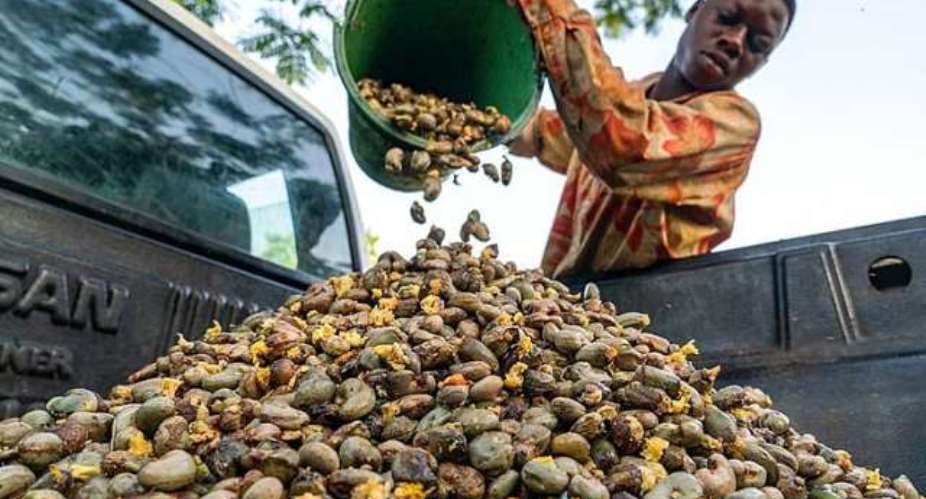
The Ghana Cooperative Cashew Farmers and Marketing Association (GCCFMA) has called on President John Dramani Mahama to put the proposed three-month restriction on raw cashew exports on hold, warning that implementing the policy under the current processing capacity could plunge more than 200,000 farmers into financial difficulties.
The association argues that the government must first ensure that local processing companies have the capacity to purchase at least 75 per cent of Ghana's annual cashew production before restricting exports.
Its Secretary, Sah Kofi Eric, made the appeal on Thursday during a press briefing at Wenchi Jubilee Park in the Bono Region, where he cautioned that an immediate ban would leave farmers across 7 regions struggling to find buyers for their produce.
President Mahama announced the proposed restriction on Monday, November 16, as part of measures to encourage local processing and increase value addition in the cashew industry. Under the policy, exports of raw cashew nuts would be prohibited for 3 months during each season, alongside the introduction of an export tax.
The President announced the policy at Tuobodom in the Techiman North District during the commissioning of the Nadkansco cashew processing factory, a 30,000-tonne facility financed by the Ghana EXIM Bank.
Although the farmers welcomed the commissioning of the factory and acknowledged the government's efforts to strengthen domestic processing, they questioned whether existing factories could accommodate the volume of nuts produced annually.
At the Wenchi engagement, which was attended by association executives, including Vice-President Daniel Tachie, and traditional leaders, the farmers maintained that the production and processing figures presented at the factory commissioning did not justify an immediate restriction on exports.
Ghana produces approximately 262,000 metric tonnes of raw cashew nuts annually, but existing local factories process only about 17,000 metric tonnes, representing less than 10 per cent of total production.
Even with the addition of Nadkansco's annual processing capacity of between 30,000 and 33,000 metric tonnes, the association said the country's total domestic capacity would remain below 25 per cent of annual output.
Farmers fear market collapse and mounting financial pressure
The GCCFMA warned that enforcing the restriction during the first 3 months of the peak harvesting season could drive traders, aggregators and exporters out of the farm-gate market.
It said the withdrawal of these buyers would leave farmers with large quantities of unsold cashew nuts, creating an immediate oversupply situation and depriving smallholders of the cash they depend on to meet production costs.
According to the association, farmers rely on timely sales to finance land preparation, harvesting, transportation and drying activities. A disruption in the buying chain could therefore affect their ability to sustain farming operations.
The association also raised concerns about the limited storage facilities available to smallholder farmers, many of whom lack proper warehouses and standard jute sacks to preserve their produce.
It warned that prolonged storage under unsuitable conditions could expose the nuts to moisture damage, reduce kernel out-turn and ultimately attract significant price reductions when the produce is eventually sold on the international market.
To avoid these challenges, the farmers have proposed that the government suspend the three-month export restriction until domestic processing capacity can absorb at least 75 per cent of the country's annual raw cashew production.
They are also calling for urgent consultations involving farmers, aggregators, processors and exporters to ensure that the policy reflects the realities of the entire value chain.
Additionally, the association wants the government to establish a guaranteed buffer-buying mechanism or alternative off-take arrangement to purchase surplus nuts that local factories cannot accommodate.
It has also proposed targeted assistance for farmers, including access to affordable jute sacks, shared warehouse facilities and financing to support the purchase of farm inputs.
Processors back export restriction
The farmers' position differs from that of the Association of Cashew Processors Ghana (ACPG), which has endorsed the proposed export restriction.
The President of the processors' association, Antonio Manuel Caramelo Raposo, welcomed the government's decision on November 17, particularly the planned three-month export ban and a one-year waiver of import duties on machinery for cashew processing.
Regulatory framework for raw cashew exports
The proposed restriction comes against the background of an existing regulatory framework governing the export of unprocessed cashew and other tree crops.
When President Mahama announced the policy on November 16, the Presidency did not provide a specific commencement date, the proposed export tax rate or details of a new legal instrument to enforce the restriction.
The policy also follows an earlier government commitment of US$200 million to support the development of tree crops and strengthen the cashew industry.
Under Section 27 of the Tree Crops Development Authority Act, 2019 (Act 1010), and Regulations 50 and 51 of the Tree Crops Regulations, 2023 (L.I. 2471), the Tree Crops Development Authority (TCDA) administers a mandatory written permit system for exporters of unprocessed cashew, rubber and shea.
Since May 2, 2025, licensed exporters have been required to obtain written permits from the TCDA and provide evidence of payment of a levy of GH¢44.86 per tonne before securing phytosanitary certificates for shipment.
Regulation 29(2) of L.I. 2471 also restricts farm-gate and district-level purchasing activities to licensed Ghanaian citizens.
Meanwhile, Cashew Council Ghana, the umbrella body representing stakeholders in the industry, disclosed in a statement on November 19 that it was engaging the Presidency and the TCDA to obtain details of the proposed policy framework ahead of the official opening of the new cashew season in December.
Local processors had earlier called for urgent and coordinated interventions across the value chain to expand domestic processing capacity.
The GCCFMA says it expects Cashew Council Ghana to formally present its concerns and proposals to the sector minister and President Mahama for consideration.
As of Thursday evening, neither the Presidency, the Ministry of Food and Agriculture nor the Tree Crops Development Authority had publicly responded to the farmers' request for a suspension of the proposed export restriction.

 Stop using media to pressure NACOC if cocaine case not going your way in court –...
 Cashew farmers demand suspension of export ban until local processors can absorb...
 Upper West Regional Police only invited me, not arrest — Nadowli-Kaleo NPP chair...
 Osahen Afenyo-Markin questions EOCO unlawful transfers of funds in frozen accoun...
 Paris court orders Depardieu to stand trial over alleged 2018 rape of actress
 November 27: Cedi sells at GHS12.55 on forex market, GHS11.84 on BoG interbank
 Government has no power to destool chiefs – Justice Dennis Adjei
 Mahama arrives in Barbados for five-day state visit
 Galamsey threatens food security, public health and national security – Zanetor
 Ministries, state agencies risk sanctions for data privacy breaches – Sam George


