




"We are not there yet," German Chancellor Friedrich Merz told reporters afterwards, though he had "not given up hope" for a deal when leaders meet again on December 17.
Failure would mean the tense negotiations spilling into a year of elections across Europe -- most crucially in France -- whose president has raised the stakes by threatening to walk away if that happens.
Leaders have spent nearly all of 2026 butting heads over the size of the long-term budget after the European Commission proposed a two-trillion-euro spending plan, which most capitals disapproved.
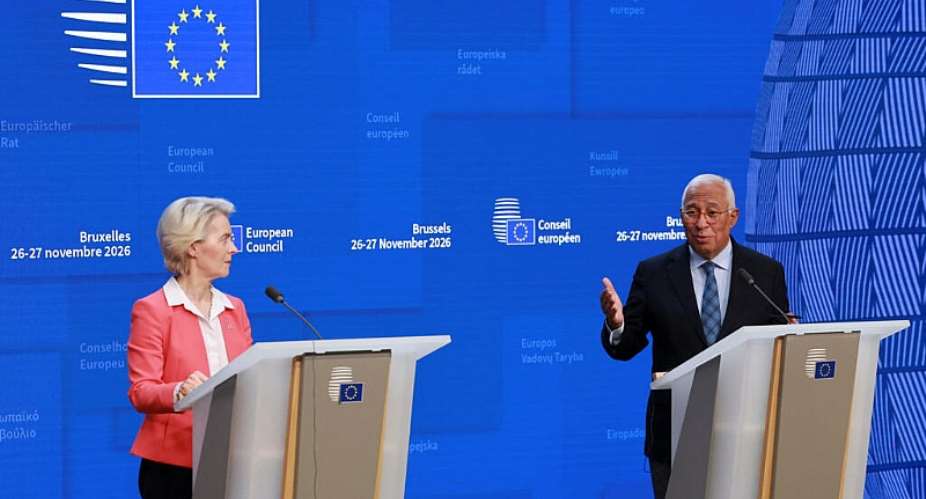
The latest proposal by European Council head Antonio Costa sought to bridge divisions by slashing the budget by €204 billion and proposing a tax on digital companies.
Costa urged leaders to "compromise" heading into the talks -- but they failed to produce a breakthrough.
"Sensible seven"
On one side, a group of net contributor countries, nicknaming themselves the "Sensible Seven" -- the Netherlands, Austria, Sweden, Finland, Denmark, and Belgium-- are pushing for a smaller spending pot.
Briefing reporters afterwards, Merz said Germany would keep pressing for cuts -- and several likeminded countries sat out the final summit meetings to signal dissatisfaction with the process so far.
Digital tax and farm aid at stake as EU budget talks resume
Meanwhile, 17 southern, central and eastern European nations in the "Friends of Cohesion" group still wanted greater funding to support agriculture and regional development -- as hundreds of farmers demonstrated outside the summit.
But Costa played down the summit divisions at a press conference afterwards, calling it "a necessary step" in the negotiation process.
"Everyone had to show they did not agree -- and stage a bit of political theatre," echoed one EU diplomat.
The call for cuts has raised hackles from France, which wants more money for farmers and insists Europe needs larger funding to match its rising challenges.
Addressing the media, Macron said slashing the budget was a "strategic error" that risked hobbling the bloc's efforts to invest on a par with economic rivals China and the United States.
EU unveils plan to cut dependence on US and Asian technology
The upcoming French vote loomed large over the talks.
"The prospect of a potential Le Pen victory -- and its consequences -- is always in the back of everyone's mind," one EU diplomat said.
But several leaders pushed back at that idea, with Austrian Chancellor Christian Stocker saying he was "certainly not afraid of an election in France".
Italian Prime Minister Giorgia Meloni similarly said she saw "no hard deadline" to reach a deal.
Ukraine link
An already-fraught dealmaking process was complicated further after Merz linked any resolution to an agreement on Ukraine funding by all 27 EU countries.
Member states are being asked to back an extra €45 billion loan to help keep Ukraine funded through 2027, but Prague, Budapest and Bratislava want an opt-out.
The trio, which opted out of a similar giant loan last year, are normally net recipients of European money.
But Merz reiterated that he considered this a non-starter, warning: "I stand by my position that aid for Ukraine must be borne by the entire European Union."
(With newswires)


 2027 Budget shifts focus to growth, jobs after economic stabilisation – Seth Ter...
 Ministries, state agencies risk sanctions for data privacy breaches – Sam George
 True definition of NDC's 'New Economy' is buying luxury jet amid high cost of li...
 Ghanaians don't eat paper, yet NDC keep touting paper-based economic gains – Osa...
 Akufo-Addo's NPP administration failed to retool security agencies – Agalga
 New presidential jet was not procured for luxury, but necessity – Agalga
 ‘Everything is possible’ – Speaker Bagbin inspires Zenith Law students with cour...
 Zenith University Law students observe parliamentary proceedings to deepen under...
 Mahama changes galamsey approach, summons top officials and security chiefs
 'Your record stinks’ – Agalga fires back at Minority over cocaine debate


