




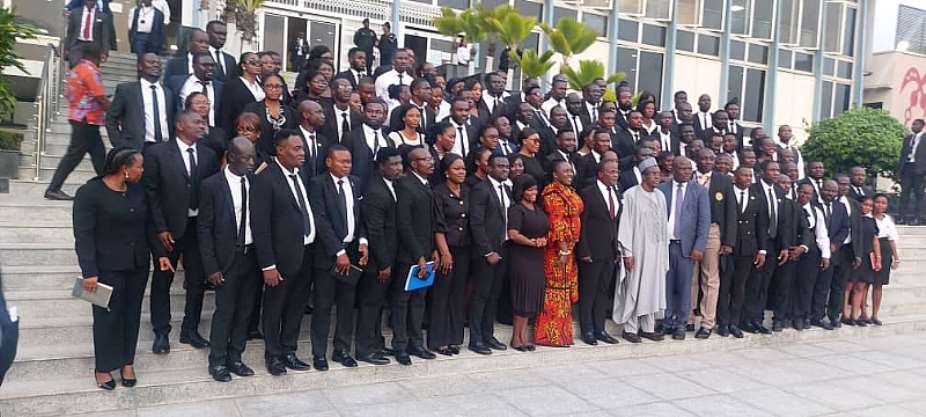
A delegation of Level 200 law students from Zenith University has visited Parliament of Ghana to gain first-hand insight into the legislative process and the constitutional responsibilities of the legislature.
The visit was aimed at bridging the gap between classroom learning and practical parliamentary proceedings, particularly in the application of the principle of separation of powers.
Speaking during the engagement, the Constitutional Law lecturer, Dr. David Dodjie Olaga, explained that the visit was informed by the need to expose students to the practical workings of Parliament.
He said the principle of separation of powers, propounded by French political philosopher Montesquieu, provides for the existence of three arms of government: the legislature, the executive and the judiciary.
According to him, the principle is intended to promote good governance through checks and balances, ensuring that power is not concentrated in one institution.
Dr. Olaga said Parliament, under the 1992 Constitution, is responsible for making laws, while the Executive, led by the President, plays a constitutional role in the legislative process through presidential assent.
He explained that the process demonstrates how law-making responsibilities are shared between institutions, preventing Parliament from exercising absolute authority over legislation.
The lecturer noted that although students had studied parliamentary procedures and constitutional provisions in the classroom, observing proceedings in the chamber would provide a clearer understanding of how those principles operate in practice.
He said the visit would enable students to witness parliamentary debates, the Speaker's role in regulating proceedings, and the interactions between the Majority and Minority sides of the House.
Mr Olaga emphasised that the engagement was intended to make constitutional law more practical and relatable to students, rather than leaving their understanding confined to theoretical lessons.
The delegation comprised approximately 110 Level 200 students, alongside other students taught by the lecturer at different academic levels.
Mr Olaga, who teaches three courses at the university, said the parliamentary visit offered an important opportunity for students to familiarise themselves with the institution and its role in Ghana's democratic governance.
 ‘Everything is possible’ – Speaker Bagbin inspires Zenith Law students with cour...
 Zenith University Law students observe proceedings to deepen parliamentary proce...
 Mahama changes galamsey approach, summons top officials and security chiefs
 This is only the beginning of my demand for accountability – Gumah after confron...
 'Your record stinks’ – Agalga fires back at Minority over cocaine debate
 GNFS to receive first batch of 40 new fire tenders by December – Muntaka
 Okaikwei North MCE suspends PA for one week after slapping Assembly staff member
 Let Ghanaians feel the economic change in their pockets and not on paper — Afeny...
 CLOGSAG demands police probe into alleged assault on Okaikwei North Assembly sta...
 Gov't pays GHS4.9 billion to DDEP bondholders, retires 44.1% of programme


