




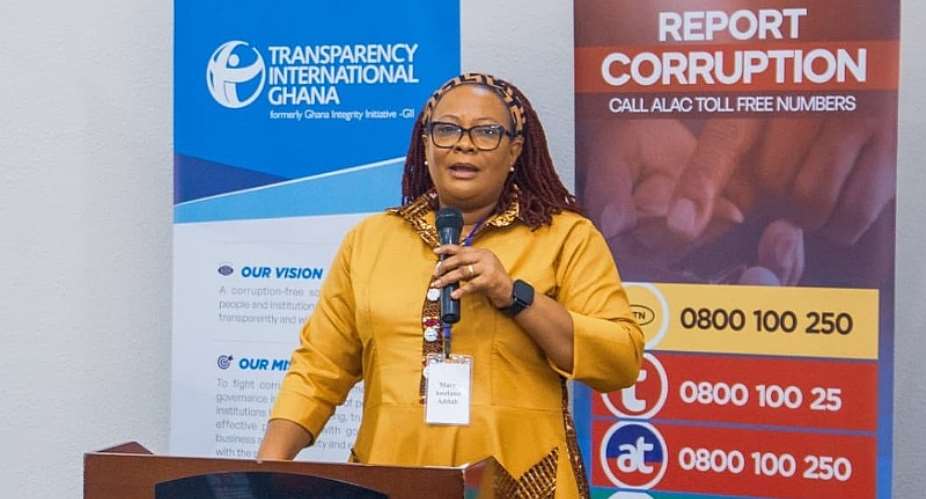
Ghana's efforts to tackle corruption have been weakened over the years not by the absence of accountability institutions, but by their failure to work together effectively.
In a renewed effort to address the problem, some of the country's key anti-corruption and accountability agencies are being brought together twice a year to strengthen cooperation, improve information-sharing and eliminate duplication of responsibilities.
The initiative, being spearheaded by Transparency International Ghana (TI Ghana), the Ghana Center for Democratic Development (CDD-Ghana) and the Ghana Anti-Corruption Coalition (GACC), will take the form of bi-annual forums involving selected public accountability institutions.
The organisers believe the engagements will help address longstanding gaps in Ghana's anti-corruption framework by moving agencies beyond isolated operations towards a more coordinated approach to investigations, oversight and enforcement.
The forums form part of a project titled “Strengthening Accountability, Rule of Law, and Institutional Responsiveness in Ghana,” funded by the European Union.
The project seeks to place citizens, particularly women and young people, at the centre of accountability efforts while encouraging public institutions to become more transparent, responsive and effective in carrying out their mandates.
Executive Director of TI Ghana, Mrs Mary Awelana Addah, said Ghana's performance in governance and corruption-related assessments underscored the urgency of strengthening institutional collaboration.
She disclosed that the country recorded an average score of 48.2 per cent in Government Effectiveness between 2010 and 2019, while its average score on Transparency International's Corruption Perceptions Index over the past decade stood at 42.
She further cited findings from the 2022 Afrobarometer Survey and the 2022 Corruption in Ghana Survey conducted by the Ghana Statistical Service and the Commission on Human Rights and Administrative Justice (CHRAJ), which indicated that more than 75 per cent of Ghanaians believed corruption had increased.
“That is not just a statistic. It is a crisis of confidence in the very institutions created to protect the public purse,” Mrs Addah emphasised.
According to her, Ghana has several institutions mandated to fight corruption and promote accountability, including CHRAJ, the Office of the Special Prosecutor (OSP), the Economic and Organised Crime Office (EOCO), the Ghana Audit Service (GAS), the Financial Intelligence Centre (FIC), the Internal Audit Agency (IAA) and the Public Procurement Authority (PPA).
However, she observed that their collective effectiveness had been undermined by overlapping responsibilities, inadequate information-sharing, resource limitations and weak follow-up on audit findings and corruption cases.
She explained that CHRAJ's Key Accountability Institutions (KAI) Platform was established to address some of these coordination challenges, adding that the new bi-annual forums would build on that foundation by providing a more structured and sustained mechanism for cooperation.
Rather than serving as routine discussion platforms, the forums are expected to produce practical outcomes, including specific institutional commitments, documented lessons and a validated collaborative framework and work plan.
The proposed framework will outline the responsibilities of participating agencies, establish timelines for implementation and provide guidance on how information will be exchanged.
The programme is expected to feature opening remarks by the CHRAJ Commissioner on the importance of institutional collaboration, alongside an address by the Special Prosecutor on the practical challenges of implementing anti-corruption measures.
A panel discussion involving representatives of CHRAJ, EOCO, OSP, GAS, IAA and FIC will also examine lessons and best practices, before participants move into a working session to develop the proposed collaboration framework.
Beyond strengthening investigations and prosecutions, the initiative seeks to place greater emphasis on preventing corruption before public resources are lost.
This approach will involve improving procurement oversight, strengthening audit processes and internal controls, facilitating intelligence-sharing and expanding civic education.
The participation of the National Commission for Civic Education (NCCE), the Ghana Police Service's Criminal Investigations Department (CID) and civil society organisations is also expected to broaden the scope of the discussions beyond investigative, prosecutorial and regulatory institutions.
The organisers maintain that their broader strategy, which focuses on encouraging citizens to use reporting channels, supporting investigative journalism and advocating legislative and policy reforms, will require sustained cooperation between public institutions and the citizenry.
For many Ghanaians concerned about audit recommendations that remain unimplemented and high-profile corruption cases that make little progress, the success of the initiative will ultimately depend on measurable action after the meetings.
The critical questions will be whether audit findings receive timely attention, whether intelligence is shared early enough to prevent procurement-related abuses and whether institutions can overcome jurisdictional tensions to support one another's work.
The bi-annual forums are expected to provide a regular platform for tracking commitments, strengthening cooperation and holding participating agencies accountable for agreed actions.
If effectively implemented, the initiative could help Ghana move beyond a system of multiple anti-corruption institutions operating independently towards a more coordinated national accountability framework.
For a country where more than 75 per cent of citizens surveyed believe corruption is increasing, such a shift could represent an important step towards restoring public confidence in the institutions responsible for protecting the public purse.








 2027 Budget shifts focus to growth, jobs after economic stabilisation – Seth Ter...
 Ministries, state agencies risk sanctions for data privacy breaches – Sam George
 True definition of NDC's 'New Economy' is buying luxury jet amid high cost of li...
 Ghanaians don't eat paper, yet NDC keep touting paper-based economic gains – Osa...
 Akufo-Addo's NPP administration failed to retool security agencies – Agalga
 New presidential jet was not procured for luxury, but necessity – Agalga
 ‘Everything is possible’ – Speaker Bagbin inspires Zenith Law students with cour...
 Zenith University Law students observe parliamentary proceedings to deepen under...
 Mahama changes galamsey approach, summons top officials and security chiefs
 'Your record stinks’ – Agalga fires back at Minority over cocaine debate


