




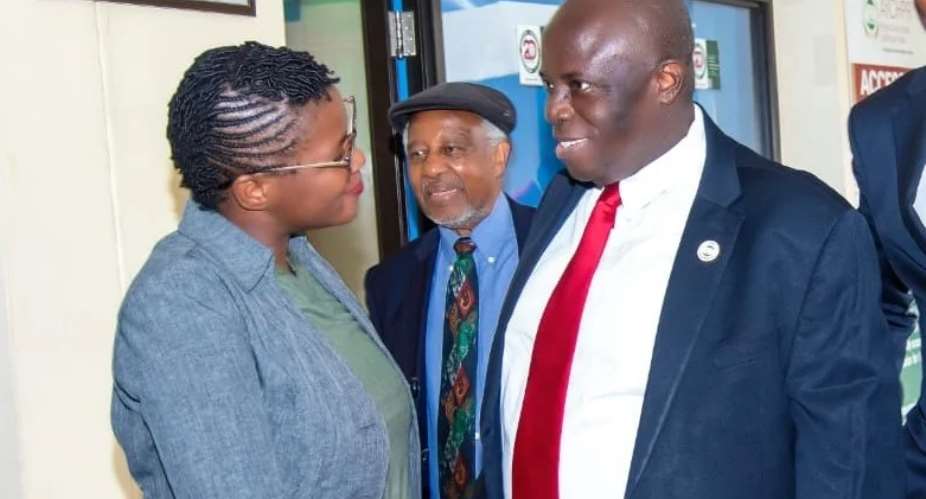
A judge of the African Court on Human and Peoples’ Rights, Justice Sir Dennis Domonic Adjei, has asserted that the chieftaincy institution in Ghana is sacred, constitutionally protected, and indispensable to national unity, but it operates within clear legal boundaries.
Justice Adjei, who is also a Justice of the Supreme Court of Ghana, made the observation when he delivered a public lecture on "Chieftaincy and Stakeholders in Ghana Law: Resolution and Traditional Authority" in Accra on Wednesday.
Tracing the institution from pre-colonial Africa through European monarchies to modern constitutional monarchies, Justice Adjei argued that while many monarchies in Europe and Africa had been abolished or stripped of power, Ghana had deliberately chosen to entrench chieftaincy in its constitution.
He said Ghana was among 14 African countries that expressly guarantee chieftaincy in their constitutions, alongside Botswana, Eswatini, Kenya, Lesotho, Malawi, Mozambique, Namibia, Nigeria, Sierra Leone, South Africa, Uganda, Zambia, and Zimbabwe.
In contrast, he noted, leaders such as Julius Nyerere of Tanzania abolished chieftaincy in 1963, and Sekou Toure did the same in Guinea in 1957, while Rwanda abolished monarchy and chiefs after the 1959 revolution.
In Ghana, he said, the Constitution does not merely recognize chiefs; it protects the institution, its hierarchy, and its customary processes.
That hierarchy, he explained, ranges from the Asantehene and Paramount Chiefs through Divisional Chiefs, Sub-divisional Chiefs, and Adikrofo to other persons recognized by the National House of Chiefs.
Justice Adjei, a Fellow of the Ghana Academy of Arts and Sciences (FGA), stressed that not every royal is entitled to become a chief, particularly a person convicted of high treason, treason, high crime, offenses involving state security, fraud, dishonesty, or moral turpitude.
He also drew a distinction between customary status and statutory recognition. A chief who follows customary procedure exercises only customary functions, he said, until his name is entered in the National Register of Chiefs and gazetted.
Honorary chiefs, he added, who do not hail from the appropriate family and lineage, do not have their names in the Register unless recognized by the National House of Chiefs.
Like the constitutional monarchs of the United Kingdom, Spain, Belgium, Denmark, the Netherlands, Norway, and Sweden, who reign but do not rule and remain above politics, Ghanaian chiefs must be symbols of unity, Justice Adjei said.
That is why, he explained, the Constitution bars chiefs from active party politics.
In disputes, he was emphatic: the government cannot destool a chief. Only the chieftaincy tribunals have the sole prerogative to determine causes or matters affecting chieftaincy, with appeals lying from the Traditional Council to the Regional House, the National House of Chiefs, and the Supreme Court.
The ordinary courts, he said, can only intervene through supervisory jurisdiction where there is excess of jurisdiction, breach of natural justice, or a patent error on the face of the record.
Justice Adjei, who is a Senior Fellow of the Center for International Mediators and Arbitrators England and Wales, concluded that chiefs remain custodians of the majority of lands in Ghana, promoters of development, custodians of culture and memory, and key actors in dispute resolution through customary arbitration and mediation.
For those reasons, he said, chieftaincy had helped keep Ghana as one nation, one people, and one destiny and must be promoted to perform its traditional role.







 ‘Everything is possible’ – Speaker Bagbin inspires Zenith Law students with cour...
 Zenith University Law students observe proceedings to deepen parliamentary proce...
 Mahama changes galamsey approach, summons top officials and security chiefs
 This is only the beginning of my demand for accountability – Gumah after confron...
 'Your record stinks’ – Agalga fires back at Minority over cocaine debate
 GNFS to receive first batch of 40 new fire tenders by December – Muntaka
 Okaikwei North MCE suspends PA for one week after slapping Assembly staff member
 Let Ghanaians feel the economic change in their pockets and not on paper — Afeny...
 CLOGSAG demands police probe into alleged assault on Okaikwei North Assembly sta...
 Gov't pays GHS4.9 billion to DDEP bondholders, retires 44.1% of programme


