




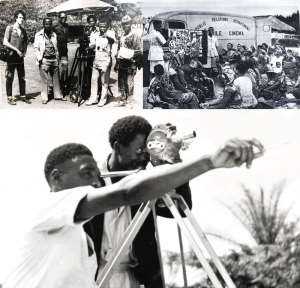
Ghana's cinematic history survived a coup, crossed international borders and escaped destruction. Yet decades later, the country was still struggling to protect the very images that tell its story.
There is something deeply troubling about a country having to look beyond its borders to find evidence of its own history.
Ghana once possessed the ambition, infrastructure and political will to build a film industry capable of documenting its people, culture and national development. Under Dr Kwame Nkrumah, filmmaking was not simply entertainment; it was an instrument of education, cultural identity and national storytelling. Cameras followed the country's transformation, captured important political moments and documented a young nation finding its place in the world.
Then came the coup of February 1966.
Following Nkrumah's overthrow, accounts from people who worked within the country's film establishment describe orders to destroy films associated with his administration. Some materials were burnt. Others survived because courageous film workers resisted the orders, hiding prints and negatives rather than surrendering an entire chapter of the country's history.
Among those who helped preserve this visual legacy was Reverend Dr Chris Hesse, Nkrumah's personal cinematographer. His determination to protect historical footage would become one of the most remarkable preservation stories in Ghana's film history.
Some of the original film materials had been processed and stored in Britain, where they escaped the destruction that affected materials in Ghana. What began as a technical arrangement for film processing and storage would eventually become an unexpected lifeline for Ghana's historical records.
But escaping destruction was only the beginning of the struggle.
Years later, Ghana's own film institutions would face another crisis. Following the divestiture of the Ghana Film Industry Corporation in 1996, its old film collection was reportedly left without the institutional protection it deserved. In 2002, film materials were found dumped in the company's parking area. Chris Hesse and filmmaker Kwaw Ansah intervened, helping transfer the collection to the Information Services Department's Central Film Library.
Even that refuge failed to provide lasting protection. Poor storage conditions, deterioration and years of neglect eventually took their toll. By 2022, the remaining celluloid materials at the Central Film Library had been disposed of following concerns about their condition and potential health hazards.
It is a painful reminder that a nation's heritage can be lost not only through political hostility, but also through administrative indifference.
Yet the story is not entirely one of loss.
Hesse's decades-long efforts to preserve more than 1,000 reels of historical footage have brought renewed attention to Ghana's cinematic memory. The documentary The Eyes of Ghana, directed by Ben Proudfoot, has helped introduce this remarkable archive and its preservation struggle to a wider audience.
That achievement deserves recognition. But recognition alone is not preservation.
Ghana must now answer some difficult questions. Where exactly are the surviving original reels? How many have been restored and digitised? Who holds legal custody of them? Can researchers, filmmakers, students and ordinary Ghanaians access them? And what guarantees exist that these materials will not disappear into another cycle of institutional neglect?
The government, the film industry and our cultural institutions must move beyond announcements and establish a transparent, properly funded national audiovisual archive. Every surviving reel must be inventoried, professionally preserved, digitised and backed up. Access arrangements must be clear, and the original materials must remain protected under responsible Ghanaian custodianship.
This should not be treated as a project belonging to one political administration. Ghana's history does not belong to one government, one president or one generation.
The footage of Nkrumah, the independence movement, the country's early filmmakers and the ordinary people who shaped the nation belongs to all Ghanaians.
We cannot continue to celebrate our history while neglecting the evidence that documents it.
A country that loses its films loses more than entertainment. It loses faces, voices, places, memories and perspectives that future generations may never recover.
Ghana must not wait for another filmmaker, another foreign archive or another generation to remind us of what we once had. Our history has survived long enough. It is time we learned how to protect it.

 Tullow Oil, govt reach agreement to settle $387m tax disputes
 Prof. Agyemang Calls for Targeted PhD Regulation, Research Funding
 Tenants Union opposes proposal to increase rent advance limit from six to 12 mon...
 Mahama urges Germany, EU to sustain support for Sahel states amid terrorism thre...
 Ablakwa gives domestic worker assaulted by boss in Iraq GH¢50,000; considers rec...
 Mahama urges Oti chiefs to identify lands for agriculture under US$10bn New Econ...
 Remove your 'bomb' SRC President, that 'unfit' boy is in bed with university man...
 Power Has Moved North. What Next?
 Five ministers to face 41 parliamentary questions as House races to pass 2027 bu...


