




“I would not at present spend upon the Northern Territories a single penny more than is absolutely necessary for their suitable administration and the encouragement of the transit trade.”
Those were the words of Sir Frederic Hodgson, Governor of the Gold Coast, towards the close of the nineteenth century. They were not merely an expression of colonial indifference. They were a Freudian slip- a declaration of an entire philosophy of governance: a North to be administered cheaply, exploited conveniently, and developed reluctantly. For much of the colonial era, that philosophy remained the operating manual of British policy. History, however, has a rather mischievous way of rewriting its own scripts.
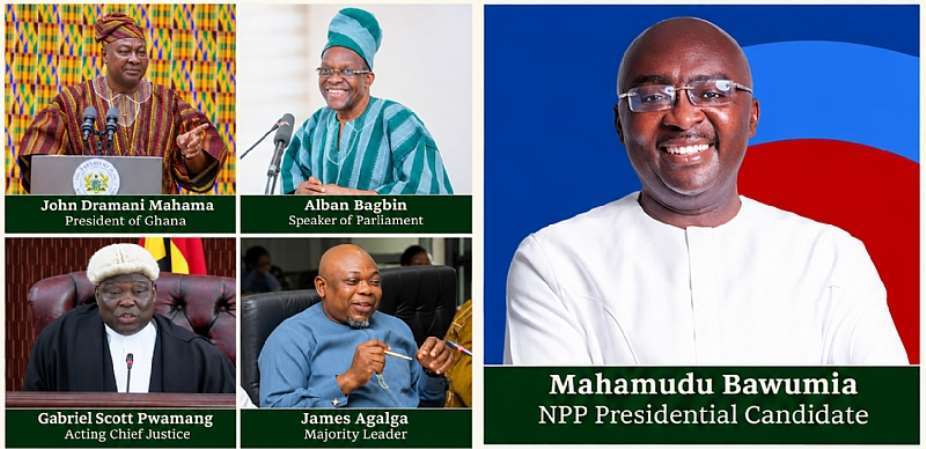
Today, Justice Gabriel Scott Pwamang, a son of the Upper East region, a Kasem-speaking Nankanise from Nayagnia in Navrongo, is poised to succeed Paul Baffoe-Bonnie as Chief Justice upon the latter’s retirement on 26 December. And then comes the remarkable political arithmetic. For the first time in our history, as far as I can recall, the President of the Republic (Savanna Region), the Speaker of Parliament Upper West), the Chief Justice Upper East), and the leader of the largest opposition party, the New Patriotic Party, Dr. Mahamudu Bawumia, will all hail from the five northern regions.
Pause for a moment and consider the symbolism.
A territory once deemed unworthy of serious investment now finds its sons occupying the commanding heights of every branch of the Ghanaian state. The North, once peripheral to the colonial imagination, has moved into the very centre of national power.
As someone from Navrongo, I share in that pride. It is a moment worth celebrating.
But let us not confuse our people's arrival in high office with the arrival of development in our communities. Power has moved north. But has prosperity followed? That is the question. And it is a question that deserves considerably more than celebratory speeches, political congratulations, and the familiar choreography of partisan self-congratulation.
Even if political power remains concentrated in the North for the next decade, what assurance is there that the region will fare any better than it did during the preceding seventy years of southern political dominance? The answer will depend not on the geographical origins of those occupying office, but on what the North does with this historic opportunity.
THE NORTH’S ALLIANCE WITH ASANTE: A HISTORY OF STRATEGIC SURVIVAL
To understand the present, we must first revisit the anxieties that shaped the North’s entry into national politics. Colonial administration had reduced the Northern Territories largely to a reservoir of labour for the mines and cocoa farms of the South. Educational opportunities were deliberately restricted, leaving the North severely disadvantaged as self-government approached in the early 1950s. While the South had cultivated an educated political elite over generations, the North was entering the constitutional conversation with comparatively few educated representatives.
It was against this unequal backdrop that J. A. Braimah, S. D. Dombo, Yakubu Tali and Mumuni Bawumia, father of the current NPP flagbearer, established the Northern People’s Party in April 1954.
Their concern was neither imaginary nor misplaced. In a unitary state dominated by Nkrumah's Convention People’s Party, a politically and educationally disadvantaged North risked being outvoted, out-manoeuvred and consigned to the margins of national decision-making. The alliance with the Asante-based National Liberation Movement in March 1955, in pursuit of federalism, was therefore a calculated political strategy. It was an alliance born of necessity, not sentiment.
The Northern People’s Party won 15 seats in the 1956 elections, outperforming the National Liberation Movement’s 12. Yet, when opposition parties merged to form the United Party in 1957, Dombo, Bawumia and their colleagues accepted Kofi Busia as leader.
And therein lies an enduring feature of Northern political history: the North has frequently supplied the numbers, the loyalty and the political muscle, while others have occupied the commanding position. It has often been a partnership in which Northern political capital was invested in coalitions whose ultimate leadership lay elsewhere.
There is, however, another fascinating irony in this history.
Free, or more appropriately, subsidized schooling for the North was introduced under colonial rule as a belated response to years of neglect. The expansion of educational opportunities followed negotiations during the final months before independence.
In December 1956, the Northern People’s Party, together with the National Liberation Movement and the Asanteman Council, petitioned London for separate independence for the Northern Territories and Ashanti.
According to collective memory in the North, Nkrumah responded to the threat by guaranteeing scholarships for Northern students, thereby encouraging the North to join an independent Ghana rather than pursue a separate political destiny. If that recollection is accurate, the historical lesson is profound.
The North’s greatest educational breakthrough may not have come from political accommodation or the generosity of allies. It may have come when the region demonstrated that it possessed an alternative, and that its continued participation in the emerging Ghanaian state could not simply
be taken for granted. There is a lesson here for contemporary Northern leadership: political goodwill is valuable, but political leverage is indispensable.
REPRESENTATION WITHOUT DEVELOPMENT: THE GREAT PARADOX
Seventy years later, the original anxiety about political exclusion has, at least at the level of official representation, been substantially addressed. Northerners are no longer merely knocking on the doors of national power. They are occupying the rooms. Yet the uncomfortable truth is that representation has not translated into development in anything like the proportion one might reasonably expect.
Consider the President’s own hometown.
President Mahama has served approximately six and a half years across two terms: July 2012 to January 2017, and again from January 2025. In November 2025, he initiated the reconstruction of the Wenchi–Bole–Sawla–Wa highway, a project scheduled for completion within 24 months and incorporating a dual carriageway through Bole. Construction on the Bole Township and inner roads officially commenced on 5 October 2026. These are welcome developments. But their timing invites an uncomfortable comparison. Nearly two years into his second presidency, roads in the President’s own hometown are only beginning to take shape. They are not approaching completion.
Now consider Kyebi. By August 2018, approximately eighteen months into President Akufo-Addo’s first term, the asphalt overlay of the town’s roads was largely completed.The point is not to suggest that every hometown must receive identical treatment or that national development should become a competition between presidential birthplaces. It is to interrogate the troubling disparity between political access and developmental outcomes.
And the pattern is not confined to individual towns. Some of the North’s most significant development interventions were initiated or completed under southern leadership. Nkrumah’s educational interventions and the Bui Dam are instructive examples. The latter was contracted under President Kufuor’s administration in 2007 and commissioned by President Mahama in 2013.
Then there is Pwalugu.
The Pwalugu Multipurpose Dam was conceived as a flagship intervention capable of transforming the economic fortunes of Northern Ghana. Construction contestably commenced in 2020 under a contract valued at approximately US$993 million. Considerable expenditure followed, but the promised dam remained unfinished.The contract has since been terminated, the project redefined, and the 2027 Budget now allocates US$1 billion, with completion anticipated by December 2030. A project that was supposed to announce a new era of agricultural and economic transformation has instead become a sobering monument to the distance between political promises and developmental delivery. Until Pwalugu becomes a functioning reality, it will remain difficult to identify a major infrastructure transformation in the North that can confidently be attributed to sustained Northern political leadership.
Political scientists distinguish between descriptive representation and substantive representation. The former means having people who look like, come from or share the background of those being represented. The latter means having representatives who actually advance the interests and improve the circumstances of their constituents. The North has made considerable progress on the first front. The second remains the unfinished business. It is one thing to have a seat at the table. It is quite another to ensure that something meaningful is placed on the table for the people you represent.
WHY PRESENCE HAS NOT TRANSLATED INTO POWER
The problem is not a shortage of talent. Northern Ghana has produced capable ministers, judges, legislators, administrators and political strategists. The problem is more structural than personal.
Three factors stand out.
First, Northern votes remain divided. Both major political parties have learnt to operate within this division, often benefiting from it. A region whose votes are consistently split between competing political interests is a region whose electoral leverage is diminished. Political parties pay attention
to electoral consequences. They invest political capital where they perceive a credible threat of losing it. A region that can be taken for granted, electorally speaking, is unlikely to command the same urgency as one capable of rewarding loyalty and punishing neglect. This is not an argument for abandoning political pluralism. It is an argument for understanding that political competition need not extinguish collective regional interests.
Second, Northern politicians are often more accountable to national party structures than to an organised constituency of Northern interests. Their political advancement depends substantially on party loyalty and alignment with national agendas. A minister who presses too aggressively for regional priorities risks being accused of sectionalism.
But that anxiety has historical roots. The Avoidance of Discrimination Act of 1957 prohibited political parties organised along regional or ethnic lines and contributed to the dissolution of the Northern Peoples Party into the United Party. The consequence has been a political culture in which collective Northern advocacy is sometimes treated with suspicion, even as other forms of regional and ethnic mobilization are more readily accommodated in national political discourse. But there is a distinction between sectionalism and strategic regional advocacy. Demanding irrigation, roads, universities, industrial investment and agricultural transformation for Northern Ghana is not an assault on national unity. Unfortunately, those who earned the political capital to make such demands are nursing presidential ambitions and therefore don’t want to be accused of being sectional. Mahama isn’t running again, but he can't seem to escape the praise of dominant southern groups. He probably doesn’t receive these special gestures and accolades up north. It may not be part of northern culture. Perhaps it’s a sense of entitlement—I can't quite put my finger on it—but the Akans have a way of making you feel special when they need something from you.
Third, institutions established specifically to accelerate Northern development have struggled to fulfil their mandate. The Savannah Accelerated Development Authority became associated more
with controversy and scandal than with the sweeping transformation its name promised. Its successor, the Northern Development Authority, remains constrained by its dependence on allocations beyond its control. And sadly, it is no better in the scandals department. Meanwhile, persistent chieftaincy disputes, particularly in places such as Bawku, consume resources, undermine confidence and provide external actors with reasons to hesitate over investment. The cumulative effect is devastating.
The North has political personalities, but lacks a sufficiently powerful and enduring mechanism for collective bargaining. It has influential individuals, but no consistently effective instrument for translating their influence into measurable regional gains. A region may have many people in power and still remain powerless where it matters most.
SO, WHAT NEXT?
This is where the conversation must move beyond celebration and enter the more demanding territory of strategy. If the North wants more than symbolic representation in the Jubilee House, Parliament and the Supreme Court, it must build what has been conspicuously absent since 1954: a durable mechanism for articulating common demands, negotiating priorities and monitoring outcomes.
The first step should be the establishment of a cross-party Northern Caucus in Parliament. Not another ceremonial gathering. Not a convenient political photo opportunity. A serious, structured and accountable parliamentary coalition. Its agenda should be concise, publicly available and sufficiently durable to survive changes in government. Completing the Pwalugu project, finishing the Wa and Bole corridors, developing irrigation infrastructure across the White Volta basin and supporting the shea economy should not be NDC projects or NPP projects. They should be Northern priorities.An MP from the NDC should be able to champion these objectives alongside an MP from the NPP without either having to surrender partisan identity. The North’s development must not be held hostage to the fortunes of whichever party happens to occupy the Jubilee House.
The second intervention should be an independent Northern Development Scorecard. The universities in Tamale, Wa, Navrongo and Bolgatanga, working with civil society organisations, should take the lead in producing an annual assessment of development commitments and delivery across the five northern regions. How much was promised? How much was budgeted? How much was actually disbursed? Which projects were completed? Which remain abandoned? Who is responsible for the delays? These questions should be answered with data, not political rhetoric. A public scorecard would introduce an important discipline into regional politics: the discipline of evidence. Politicians should no longer be able to substitute announcements for achievements or confuse the commissioning of a project with the completion of a development agenda.
Third, Northern voters must reconsider the terms of their political loyalty. Party loyalty is legitimate. It is an essential feature of democratic competition. But loyalty without conditions is an invitation to political complacency. Voters must make it clear, during primaries and general elections alike, that their support is not an ancestral inheritance to be collected by politicians at convenient intervals. It must be earned. A Northern voter should be able to ask an NDC or NPP candidate the same question: What have you done for the people, and what measurable commitments are you prepared to defend?Shared geographical origin is not a development policy. A familiar surname is not a road. A Northern accent does not irrigate a farm.
Finally, peace must become a non-negotiable development priority. Every year lost to chieftaincy conflict is another year in which schools, hospitals, businesses, roads and investment opportunities are sacrificed at the altar of avoidable discord. The North cannot credibly demand accelerated investment while allowing persistent insecurity and internal disputes to undermine the very environment in which development must occur. Traditional authorities, who continue to command considerable public trust, have an especially important responsibility here. They must rise above narrow succession contests and become a collective moral and developmental force. Their influence should be deployed not merely to settle disputes over stools and skins, but to secure a
future in which the communities they represent can prosper. The North needs its traditional leaders to become champions of development as much as custodians of tradition.
THE MOMENT IS NOW. THE RESPONSIBILITY IS OURS.
There is something profoundly historic about the present moment. The North, once relegated to the margins of colonial administration, now occupies an extraordinary position in the architecture of the Ghanaian state.The symbolism is undeniable. The opportunity is immense. But history will not judge this generation by the number of Northerners who occupied high office. It will judge us by what changed in the lives of ordinary people while those Northerners held the reins of power. Did the farmer gain access to reliable irrigation?
Did the young graduate find meaningful employment without having to migrate south? Did the roads connect communities to markets? Did Pwalugu become a functioning engine of agricultural transformation? Did the shea industry move beyond subsistence into a serious industrial enterprise? Did the people of Bawku and other conflict-affected communities finally enjoy the dividends of lasting peace? These are the questions that matter. The North has spent generations demanding a place in the national conversation. It now has unprecedented access to the microphone. The danger would be to mistake the privilege of speaking for the achievement of being heard.
Power has moved north. The real test is whether development will follow. And this time, the North must not merely wait for history to be kind. It must organize, negotiate, demand, measure and insist. The opportunity is here. The moment is ours. What we do with it will determine whether this is remembered as the moment the North finally came into power, or merely the moment Northern faces came to occupy the seats of power while the old development deficits remained stubbornly in place.
Emmanuel John A Awine
Ph.D. Student, Johns Hopkins University

 Mahama urges Oti chiefs to identify lands for agriculture under US$10bn New Econ...
 Remove your 'bomb' SRC President, that 'unfit' boy is in bed with university man...
 Power Has Moved North. What Next?
 Five ministers to face 41 parliamentary questions as House races to pass 2027 bu...
 Public sector CEOs cannot serve beyond 65 under retirement re-engagement rules –...
 Presidency orders public institution CEOs above 60 without valid contracts to va...
 Madagascar parliament ousts speaker in surprise overnight vote
 Jensen Huang’s return has calmed markets but fears of an AI bubble still run dee...
 US flew surveillance drone over Mexico to help capture top drug lord
 Zelensky urges four-way peace talks with Russia, Europe and US 'as soon as possi...


