




Ghana is expected to generate approximately US$68 million from the sale of 6.5 million forest carbon credits, following its recognition as the first African country and the third globally to secure jurisdictional forest carbon credits under the internationally recognised Architecture for REDD+ Transactions (ART) TREES standard.
The achievement, announced on November 10, 2026, at the 31st United Nations Climate Change Conference (COP31) in Antalya, Türkiye, marks a major step in the country's efforts to protect its forests, reduce emissions and attract climate-related financing.
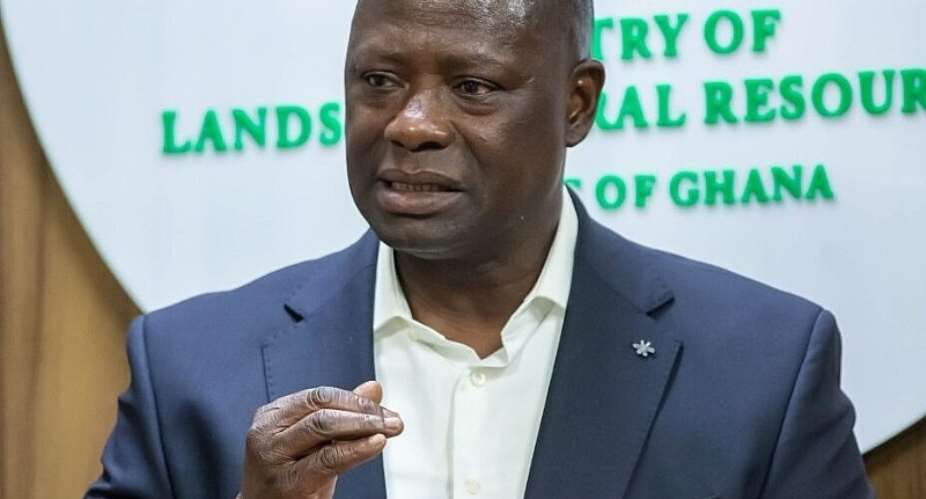
Minister of Lands and Natural Resources, Emmanuel Armah-Kofi Buah, disclosed the projected revenue at a press conference in Accra on Monday, revealing that buyers had already committed approximately US$43 million to purchase four million tonnes of the credits.
He said the remaining 2.5 million credits could generate an additional US$25 million when sold.
Mr Armah-Kofi Buah described the development as the outcome of sustained efforts by successive governments to protect the country's forest resources, noting that the initiative had been pursued since 2008.
“We have taken this journey since 2008.Successive Governments have contributed to making sure we continue to protect our forests,” he said.
He praised the Forestry Commission for its role in implementing forest conservation measures, saying its work had helped Ghana achieve internationally recognised and measurable reductions in emissions resulting from deforestation and forest degradation.
The 6.5 million credits were issued by ART after an independent verification of emission reductions recorded by Ghana between 2017 and 2021 under its REDD+ programme.
The programme covers approximately 2.5 million hectares of forest across 10 regions in southern and central Ghana, with particular attention to the cocoa-forest landscape. Its interventions include promoting sustainable cocoa production and responsible land-use practices.
Chief Executive of the Forestry Commission, Dr Hugh Clement Adokwei Brown, said Ghana had secured the credits through a demanding international assessment process rather than receiving them as an automatic allocation.
“These credits were not simply allocated to Ghana. They were earned through results that had to be achieved, measured, reported, independently validated, and verified,” he stated.
Dr Brown said members of the LEAF Coalition and other prospective buyers had committed to purchasing four million tonnes at prices ranging from US$10 to US$13 per tonne, representing approximately US$43 million.
He said the remaining 2.5 million credits were available for sale and could bring in a further US$25 million.
However, he cautioned that the commitments did not mean the government had already received the money, explaining that payments would follow the conclusion of sales agreements, verification requirements and other transaction procedures.
“Government is yet to receive the proceeds from the committed purchases,” he explained.
Under an approved benefit-sharing arrangement, 46 per cent of the revenue is expected to go to communities, farmers and traditional authorities, while 39 per cent will be allocated to government institutions, including the Forestry Commission and district assemblies.
Dr Brown said the next monitoring phase would assess emission reductions achieved between 2022 and 2026, but warned that illegal mining, illegal logging, bushfires and unsustainable agricultural practices could threaten the country's forests and affect future carbon credit earnings.
He assured that the Forestry Commission would continue collaborating with the government, traditional authorities and local communities to protect forest resources and sustain the gains recorded under the programme.
The development is also expected to strengthen Ghana's position in the international carbon market, with climate finance partners indicating that the country could become the first in Africa to access large-scale results-based financing through the LEAF Coalition.
The anticipated proceeds are expected to support forest conservation, biodiversity protection, community livelihoods and long-term economic development, while highlighting Africa's growing participation in global carbon markets.

 Tullow Oil, govt reach agreement to settle $387m tax disputes
 Prof. Agyemang Calls for Targeted PhD Regulation, Research Funding
 Tenants Union opposes proposal to increase rent advance limit from six to 12 mon...
 Mahama urges Germany, EU to sustain support for Sahel states amid terrorism thre...
 Ablakwa gives domestic worker assaulted by boss in Iraq GH¢50,000; considers rec...
 Mahama urges Oti chiefs to identify lands for agriculture under US$10bn New Econ...
 Remove your 'bomb' SRC President, that 'unfit' boy is in bed with university man...
 Power Has Moved North. What Next?
 Five ministers to face 41 parliamentary questions as House races to pass 2027 bu...


