




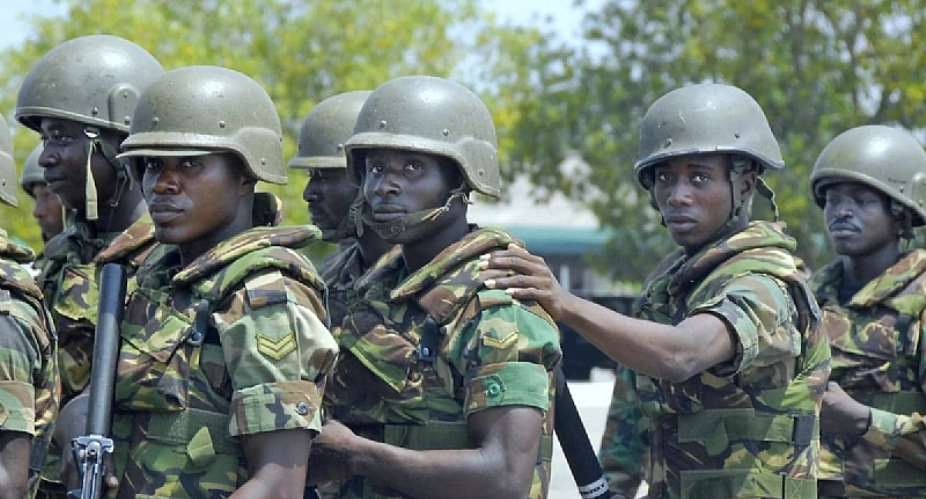
On 18 November, at Tano-Nimiri in the Western Region, the Ghana Army's 14 Engineer Brigade handed over fifty hectares of forest reserve it had put back together. The works are worth understanding in detail, because they describe what is actually required. The Brigade excavated and backfilled abandoned mine pits, reshaped and graded disturbed ground, improved the drainage, spread topsoil, and reopened blocked watercourses so that water could run where it used to run. It built 13.6 kilometres of access road into terrain that had become impassable, and it left behind a forward operating base.
Fifty hectares, within a project the Ghana Gold Board funded at 35 million cedis and describes as part of its corporate social responsibility.
Sit on that sentence for a moment. The repair of a national forest reserve is being carried out as the corporate social responsibility of the board that oversees our gold. Not as a budget line of the Forestry Commission. Not as a vote approved by Parliament and defended on the floor of the House. A charity project, generously undertaken, in a republic whose forests are an inheritance and not a donation.
And when the engineers had finished, the land was handed to the Gold Board, which will in turn hand it to the Forestry Commission for reforestation and long-term protection. Read the chain again. The soldier builds. The gold regulator pays. And the last link, the body that must hold that ground for the next thirty years, is the one with no engineers, no soldiers and no visible establishment with which to hold anything.
The record of what was lost is precise. Illegal mining destroyed some 192.4 hectares of woodland at that same site between 2021 and 2024. Fifty have been restored, which is about a quarter of one reserve's recent damage, at an average of 700,000 cedis a hectare once the roads and the base are counted.
So here is the question I cannot answer, and I have tried. Why is the Forestry Commission not a uniformed service of the state, with the pay, the pension, the death benefit and the discipline we accept without argument for the man in camouflage?
Consider what we already concede. A soldier is paid, housed, pensioned and insured, and his family is provided for if he is killed. We argue about the adequacy of it, never about the principle of it. A forest guard, whose work puts him in the same forest, against the same men, at night, unarmed, is a civil servant on a civil service salary with a civil service pension and no more protection than his own courage. Senior Ranger Nana Richard Otwey was killed protecting Kakum, and we have not reorganised anything since.
That is the asymmetry at the centre of this. We fund the repair and not the maintenance. We fund the operation and not the occupation. We will send engineers, money and a forward operating base to undo four years of destruction, and then hand the finished work to an institution we decline to staff, pay, arm or insure.
My proposition is therefore simple, and I offer it knowing it will be called extreme. Absorb the protective mandate of the Forestry Commission into the Ghana Armed Forces as a specialised corps of forest rangers: trained in forestry, disciplined as soldiers, and posted permanently to the reserves that are still standing, while the engineers of the 14 Brigade are put on a standing restoration task rather than a single project.
To those who object that a statutory commission cannot be commanded by the military, I answer: then do the opposite and arrive at the same place. Leave the commission where it is. Give its protection wing the status of a uniformed service. Pay it on the military scale, pension it on the military scale, set its death and disability benefits on the military scale, and give it a funded establishment that Parliament votes for and can question. The point is not the uniform. The point is parity, because parity is what turns a job into a career, and a career is what keeps a young man at a boundary instead of in a taxi to Accra.
Either route costs money, and both are cheaper than what we are doing now. At 700,000 cedis a hectare the arithmetic of repair is now public, and it will only go up. A restored forest that is guarded for thirty years is bought once. A restored forest that is not guarded is bought again in three years, at a higher price, and then again after that.
In the wake of the COP31 impasse, there are three things I would ask to see, and all three are simple documents.
First, the national restoration liability: how many hectares of forest reserve across Ghana stand degraded by illegal mining, and what reclamation would cost at the price we have now established per hectare.
Second, the end of corporate social responsibility as the funding model for a public good. Reclamation and the ranger establishment should sit on the Forestry Commission's budget, voted, reported and questioned.
Third, a bill. If the government believes the commission should remain civil, let it bring the amendment that makes the protection wing a uniformed service. If it believes the army should hold the forest, let it bring the bill that says so. What cannot continue is the present arrangement, in which we ask young men to do the work of soldiers on the wages of clerks.
The engineers of the 14 Brigade have shown what this state can do when it decides to do it. They have proved the capability exists. The remaining question is whether we have the nerve to keep the ground they reclaimed, or whether we will photograph the handover, praise the Brigade, and let the pits reopen while the Forestry Commission waits for a budget that never comes.
Ghanafuor, a word to the wise: a nation that can rebuild a forest and cannot pay anyone to stand in it has not restored anything. It has only postponed the loss, oooo. Yooooooooooo…
#Ghana #ForestryCommission #Galamsey #TanoNimiri #GhanaArmedForces


 Tullow Oil, govt reach agreement to settle $387m tax disputes
 Prof. Agyemang Calls for Targeted PhD Regulation, Research Funding
 Tenants Union opposes proposal to increase rent advance limit from six to 12 mon...
 Mahama urges Germany, EU to sustain support for Sahel states amid terrorism thre...
 Ablakwa gives domestic worker assaulted by boss in Iraq GH¢50,000; considers rec...
 Mahama urges Oti chiefs to identify lands for agriculture under US$10bn New Econ...
 Remove your 'bomb' SRC President, that 'unfit' boy is in bed with university man...
 Power Has Moved North. What Next?
 Five ministers to face 41 parliamentary questions as House races to pass 2027 bu...


