




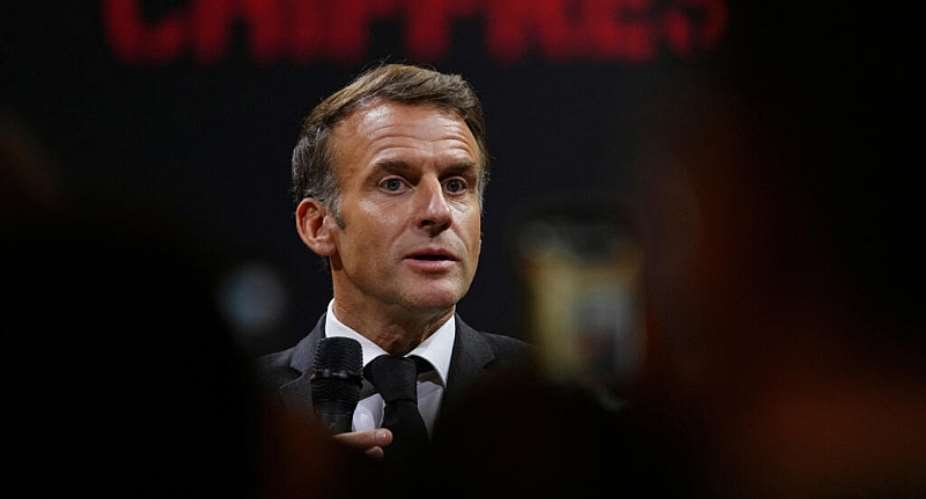
In the two-and-a-half years since President Emmanuel Macron called a disastrous snap election, successive minority governments have spent much of their time labouring to push unpopular “deficit-reducing” budgets through a hostile parliament.
Now, Macron is weighing whether to saddle his successors with a further budgetary constraint, in what could be his last major domestic policy initiative.
The French president, whose second and final term ends in May next year, has suggested reviving a 15-year-old proposal aimed at capping government spending and keeping future deficits in check. The move would require changing the French constitution, either by referendum or by a three-fifths majority of lawmakers in a joint session of parliament known as Congress.
Macron told Le Figaro he could consult with both houses of parliament as soon as January if he decides to pursue the measure. His Prime Minister Sébastien Lecornu is said to have already begun sounding out political parties to assess which options are feasible.
The initiative is aimed at reassuring investors at a time when bond markets have been fretting over the dire state of France's public finances. Analysts suggest it is also about restoring the legacy of a president widely lambasted for the gaping budget deficit he has left after a decade in power.
Read more French economy 'headed for a wall' as GDP shrinks, finance minister warns
An eye on jittery markets
Lecornu's government – France's third since the ill-fated 2024 election – is struggling to pass a budget for next year even as it contends with a huge protest movement demanding higher spending on education and other public services.
France's deficit will hit 5.4 percent of GDP this year, according to the government, well above the EU limit of 3 percent. International investors are increasingly concerned about French public debt that stands at almost 120 percent of GDP, one of the highest levels in the eurozone and well above the EU cap of 60 percent.
The Elysée Palace is also closely monitoring the evolution of the interest rates at which France borrows on bond markets, which have surged in recent weeks amid growing doubts the country will deliver on repeated pledges to reduce its massive debt load.
“If there is still volatility between now and January, considering a golden rule like the one from 2011 could be an idea worth exploring,” Macron told Le Figaro.
The draft constitutional reform, endorsed by parliament in 2011 but never fully enacted, would set binding targets over several years for a gradual return to balanced budgets, with France's Constitutional Council empowered to strike down legislation that breaches the rules.
Le Pen claims credit
Several political forces have already voiced support for the principle of a constitutional cap on spending, including Macron's allies, the mainstream right and the far-right National Rally (RN).
Marine Le Pen, the RN candidate and frontrunner in the presidential polls, was quick to claim credit for Macron's move, noting that her lieutenant Jordan Bardella had put forward his version of the “golden rule” just weeks ago.
“We were the ones who called for it. It would be a shame not to support it. I am delighted that Emmanuel Macron has listened to Jordan Bardella,” she told France Inter radio.
Le Pen has nevertheless hinted that she might call for amendments to the 2011 bill, which would then require a fresh reading in both houses of parliament.
Macron's former prime ministers and presidential hopefuls Édouard Philippe and Gabriel Attal are both considering the introduction of a “golden rule” in one form or another.
So is conservative candidate Bruno Retailleau, who welcomed Macron's suggestion even as he mocked a president who “waited until he had emptied the coffers before deciding to put a lock on them”.
Setting the record straight
Wounded pride offers one explanation for the timing of Macron's initiative, said Jean Petaux, a political analyst at Spirales Institut in Bordeaux.
“For a man once presented as the 'Mozart of finance', it's somewhat embarrassing to now come across as the one who set fire to the till,” he said. “Ensuring his successors can't do the same would be a first step towards setting the record straight.”
Petaux also pointed to Macron's desire to “leave his mark on history”, noting that French presidents “are generally eager to have constitutional revisions on their record when leaving office”.
Thwarting the left – the only bloc that is broadly opposed to the golden rule – could be a further incentive.
The Elysée Palace is particularly alarmed by the prospect of leftist firebrand Jean-Luc Mélenchon qualifying for next year's presidential runoff against Le Pen, which opinion polls say is increasingly likely. Mélenchon, whose economic platform is antithetical to Macron's, notably wants the European Central Bank to cancel a large chunk of France's debt.
“Should Mélenchon come to power, Macron could at least claim he prevented his successor from wreaking havoc with France's finances and setting the country on a collision course with its partners,” Petaux said.
Éric Coquerel, the chair of the National Assembly's Finance Committee and a member of Mélenchon's France Unbowed (LFI) party, has duly slammed the "golden rule” proposal, warning that it would “drastically limit the ability of future governments to pursue a different economic policy”.
Wishful thinking
Investing France's Constitutional Council with the power to act as an arbiter of budgetary policy could also allow political parties to pass the buck and blame others for their shortcomings.
“Just as governments and politicians routinely blame EU rules for constraining national policy, it's easy to imagine them blaming the 'golden rule' for imposing austerity measures,” said Petaux. “One can also imagine a populist leader challenging the rule altogether, pitting popular legitimacy against constitutional legality.”
The focus on a binding, top-down rule is also a distraction from the hard work of planning a sustainable budget, argued economist Clara Léonard, co-founder of the Paris-based think tank Institut Avant-Garde.
“To believe that a golden rule will make France's deficit problem simply vanish is wishful thinking,” she said. “What would really reassure the markets is having a genuine medium- to long-term budgetary adjustment strategy. It is a matter of prioritising objectives, determining which expenditures are essential and ensuring enough revenue is generated to pay for them.”
Read more France's purchasing power crisis: Navigating the pinch
Failure to identify which expenditures are truly essential has proved costly for France, Léonard added.
Since 2007, she said, 50 percent of the increase in France's public debt has been linked to crisis spending, for instance to offset the impact of sharp fluctuations in fuel costs or to cushion the blow from successive heatwaves.
“The risk with this 'golden rule' is that we focus solely on the fiscal austerity aspect and not on the investments that could stave off future costs, such as adapting France's infrastructure and economy to the changing climate,” she argued.
Such investments require a form of consensus-building that has been sorely lacking in French politics, Léonard acknowledged. She added: “A technocratic rule alone won't fix France's budgetary problems, the roots of which are political.”


 Tullow Oil, govt reach agreement to settle $387m tax disputes
 Prof. Agyemang Calls for Targeted PhD Regulation, Research Funding
 Tenants Union opposes proposal to increase rent advance limit from six to 12 mon...
 Mahama urges Germany, EU to sustain support for Sahel states amid terrorism thre...
 Ablakwa gives domestic worker assaulted by boss in Iraq GH¢50,000; considers rec...
 Mahama urges Oti chiefs to identify lands for agriculture under US$10bn New Econ...
 Remove your 'bomb' SRC President, that 'unfit' boy is in bed with university man...
 Power Has Moved North. What Next?
 Five ministers to face 41 parliamentary questions as House races to pass 2027 bu...


