




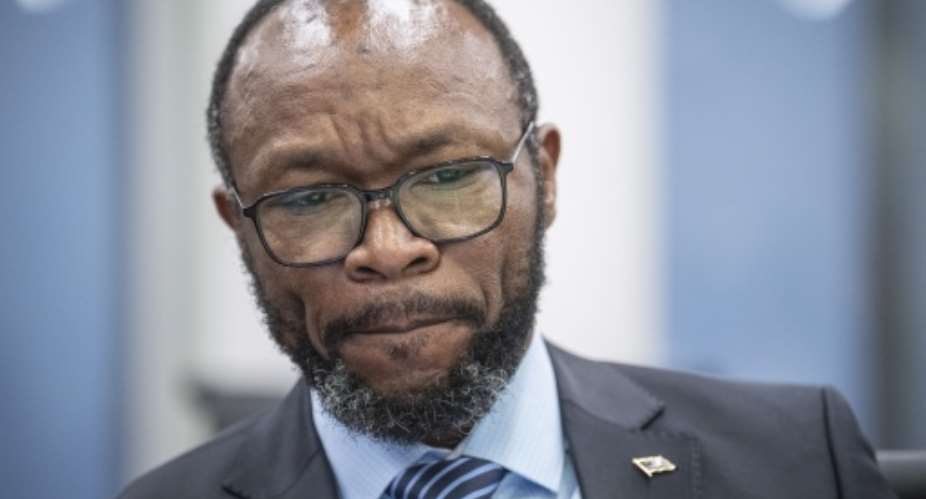
Cameroon separatist leader Lucas Cho Ayaba pleaded not guilty in a Norwegian court on Tuesday to being an accessory to war crimes and terrorism by plotting and ordering attacks by messenger.
Ayaba, also known as Cho Lucas Yabah, has lived in Norway since 2008. The 54-year-old rejected nine charges against him, for which he faces up to 30 years behind bars if convicted.
Wearing thick glasses and a graying beard, a smiling Ayaba gave the court his name and, when asked his nationality, replied "Ambazonian" -- a reference to the separatist state he wants to establish in western Cameroon.
The trial in the Oslo district court is expected to last until March 19.
Francophone-majority Cameroon has been gripped for nearly a decade by a bloody conflict between state security forces and separatists demanding the independence of two English-speaking regions in the west of the country to form Ambazonia.
According to the Norwegian prosecution authority, Ayaba led the separatist Ambazonia Governing Council (AGovC) and commanded its armed wing, the Ambazonia Defence Forces (ADF), from 2017 until September 2024, when he was arrested in Norway.
He is accused of involvement in planning two attacks in Cameroon from Norway, helping to select the targets and finance the explosives.
On February 25, 2023, during a mountain run race near Buea in Cameroon's southwest, three improvised devices exploded, killing a 38-year-old woman and wounding at least 19 civilians, two seriously.
A year later, during a Youth Day celebration in Nkambe in the northwest, an improvised device killed a 15-year-old girl and wounded 92 civilians, some of whom had to undergo amputations.
Ayaba is also alleged to have encouraged or ordered the murder or attempted murder of captives, and to have remotely orchestrated the torture or humiliation of four women accused of having intimate relations with Cameroonian soldiers.
"Messages on WhatsApp are key evidence in this case," prosecutor Carl Fredrik Fari told AFP.
'Send him to hell'
"Wrap a rope around his neck and send him to hell," Ayaba allegedly said in an audio message sent on WhatsApp in October 2023, after receiving videos showing a mistreated prisoner, believed to be a Cameroonian soldier whose fate remains unknown.
Ayaba's lawyer Morten Engesbak told AFP that Ayaba "sees himself as the leader of a struggle to liberate a population that has been oppressed for very many years by the Cameroonian authorities."
"He believes that Ambazonia's struggle for independence is legitimate. In his view, it is a war of liberation," he added.
Drawing a parallel with anti-apartheid figures in South Africa such as Jacob Zuma and Thabo Mbeki, who served time in prison, Ayaba sees his detention as one step on the road to the regions' liberation.
"So my people, have no fear. Independence is yours," he said in a handwritten note dated November 6, after he was charged.
The conflict in Cameroon is rooted in protests that were violently repressed by the government in the two English-speaking regions at the end of 2016.
Teachers and lawyers had denounced the growing grip of the largely French-speaking authorities on the educational and judicial systems in the two regions, where 20 percent of Cameroonians live.
After the repression, a conflict broke out in 2017 between separatists -— who subsequently declared the "Republic of Ambazonia" -- and the Yaounde government.
Caught in the crossfire, civilians became targets of extortion, violence, kidnappings for ransom, and killings. At least 6,000 civilians have died since 2016, according to the UN.
More than 330,000 people were displaced within Cameroon in 2025, and over 100,000 others took refuge in neighbouring Nigeria because of the conflict.


 Public sector CEOs cannot serve beyond 65 under retirement re-engagement rules –...
 Presidency orders public institution CEOs above 60 without valid contracts to va...
 Cameroon separatist pleads not guilty at Norway war crimes trial
 China to launch first space mission with a foreign astronaut
 Madagascar parliament ousts speaker in surprise overnight vote
 Jensen Huang’s return has calmed markets but fears of an AI bubble still run dee...
 Jihadist kidnappings for ransom surge in Cameroon's Far North
 US flew surveillance drone over Mexico to help capture top drug lord
 Zelensky urges four-way peace talks with Russia, Europe and US 'as soon as possi...
 14 countries acknowledge ICJ ruling of genocide against Rohingya


