




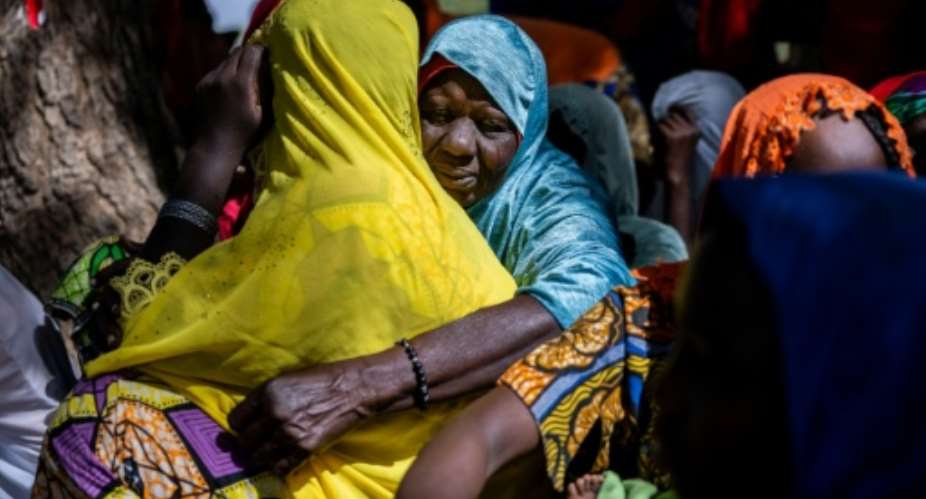
Atom Moussa was abducted by Boko Haram in Cameroon's restive Far North region, where kidnappings for ransom by jihadist groups have surged.
Leaning against a stack of mattresses in a reed shelter at Hile Alifa refugee camp near the border with Nigeria, the 29-year-old recounted his ordeal.
He is lucky to be alive after the night-time attack on the village of Tchika more than a month ago, in which seven other people were also kidnapped.
"When I opened my eyes, I was surrounded by Boko Haram fighters," Moussa said, pulling at the threads of his tattered trousers.
To fund their operations, jihadist groups have stepped up kidnappings in the Far North, a wedge of Cameroon pointing towards Lake Chad and bordering Nigeria and Chad.
Moussa and the others were taken to an island in Lake Chad, where around a dozen men and a few women were already being held.
Lake Chad, a vast, marshy expanse dotted with hundreds of islets, has since 2009 provided cover for Boko Haram's two rival factions -- JAS and ISWAP.
Moussa said his kidnappers asked for a family member's phone number.
If the family does not answer or cannot raise the demanded ransom, "they kill us", he said.
"They slit the throat of a 45-year-old man right in front of me. My family is of modest means. I thought the same thing would happen to me."
'Predatory economy'
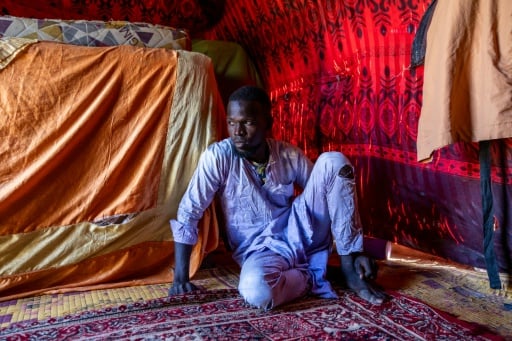 Atom Moussa, 29, is sits in his shelter at the camp for internally displaced persons in Hilé Alifa, Far North Region, Cameroon, on November 3, 2026. By - (AFP)
Moussa's village scraped together some of the 2.5 million CFA francs (more than $4,000) demanded and he was freed after two weeks.
For more than a year, Cameroon's Far North region has seen "a resurgence" in kidnappings for ransom, Aicha Pemboura, from the Observatory on Organized Crime and Violence in Central Africa, told AFP.
She said "269 civilians were abducted during the first seven months of 2026, a figure that exceeds the total recorded for the whole of 2025, which stood at 249 cases".
"Military pressure in Nigeria... is forcing Boko Haram fighters to withdraw" to the Mandara Mountains and the islands of Lake Chad, the researcher said.
Deprived of their usual funding sources, "the armed groups have turned towards a predatory economy, demanding ransoms ranging from 500,000 to several million CFA francs", Pemboura said.
The first thing a family does after a kidnapping is inform the village chief.
"My role is to drive down the ransom and then rally the prominent families to raise the negotiated sum," said Mahamat Andris, chief of Karena village in Cameroon's Far North.
In July, he helped negotiate the release of seven people kidnapped in three attacks on Karena.
A total of 30 million CFA francs was handed over.
Sometimes several family members are kidnapped and "they slit one person's throat to put pressure on the relatives", Andris explained.
"The little savings we had, Boko Haram took from us," the 51-year-old village chief added.
He was also speaking from the Hile Alifa refugee camp, about 12 kilometres (7.5 miles) from the Nigerian border, from the shelter that serves as his office, a corn depot and a motorcycle garage.
"Before, we had fields and we worked for ourselves," he said. Now villagers' earnings end up going to armed groups.
Nearly 1,000 killed
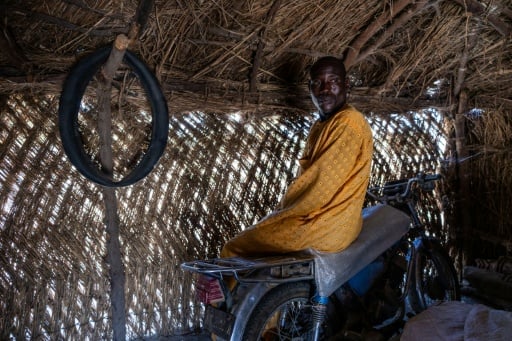 Mahamat Andris, 51, chief of the village of Karena, is sitting on a motorcycle in a shelter at the internally displaced persons camp in Hilé Alifa, Far North Region, Cameroon, on November 4, 2026. By - (AFP)
Between January and September, 977 people were killed and more than three million displaced across the countries of the Lake Chad Basin -- Chad, Cameroon, Nigeria and Niger, conflict monitoring group Acled said.
The NGO said it recorded 908 security incidents in that period, with Cameroon's Far North seeing 105 incidents in September alone.
Celestin Delanga, of the Institute for Security Studies (ISS), said the Far North had always seen "the highest rate of abuses" because both of Boko Haram's rival splinter groups were present.
It is "a strategic zone for their economy of violence, with fishing, pasture, agriculture and the payment of taxes", he said.
It also hosts more than 500,000 displaced people, according to the United Nations' refugee agency.
"More than a dozen attacks on military posts since last year show the intention to extend the armed groups' grip over the area around Darak and Hile Alifa," Delanga said.
Since April, Boko Haram's resurging JAS faction "has restructured its organisation to appoint Cameroonian chiefs and deputy chiefs, who control the terrain", he added.
Since 2022, it has also directed its fighters to kidnap for ransom.
Sometimes other armed gangs abduct civilians and then sell them to Boko Haram, Delanga said.
Amid the growing insecurity, the Cameroonian army has set up strategic elite bases in Hile Alifa and nearby Bargaram.


 Public sector CEOs cannot serve beyond 65 under retirement re-engagement rules –...
 Presidency orders public institution CEOs above 60 without valid contracts to va...
 Cameroon separatist pleads not guilty at Norway war crimes trial
 China to launch first space mission with a foreign astronaut
 Madagascar parliament ousts speaker in surprise overnight vote
 Jensen Huang’s return has calmed markets but fears of an AI bubble still run dee...
 Jihadist kidnappings for ransom surge in Cameroon's Far North
 US flew surveillance drone over Mexico to help capture top drug lord
 Zelensky urges four-way peace talks with Russia, Europe and US 'as soon as possi...
 14 countries acknowledge ICJ ruling of genocide against Rohingya


