




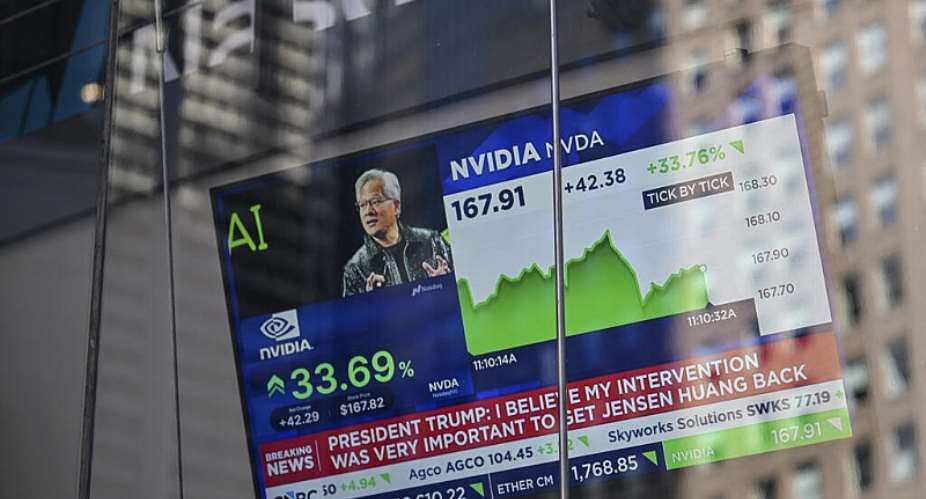
The next few weeks could determine whether Nvidia's decision to reinstate Jensen Huang as CEO was the prudent one that cheering employees, shareholders and US President Donald Trump made it out to be – or a big mistake.
Huang's supporters argued that he was indispensable, not only to the company but to the entire AI industry, at the moment a major engine of the economy.
But he carries some baggage Nvidia still has to deal with.
Huang likely violated the company's code of conduct. He acknowledged having an affair with a woman suspected of being a Chinese spy. And national security issues aside, Huang's unusual management style, which included striking deals with a mere handshake, would have doomed many other CEOs.
It's not a given that Huang's second go-round will survive congressional investigations, lawsuits and a probe by a law firm hired by his own board. But investors pushed Nvidia shares up 31.5 percent on Monday and Nvidia employees chanted Huang's name as he returned to headquarters.
Here is how Huang came back despite the odds, why he's widely seen as irreplaceable, and the challenges he still faces.
'Serious mistakes'
Soon after Huang resigned on November 12, the campaign for his return began. A petition started making the rounds in Silicon Valley with employees and celebrity leaders, including SpaceX CEO Elon Musk, arguing for a comeback.
“I would be honoured to answer these calls and return as CEO,” Huang wrote on social media early last week, while acknowledging he had made “serious mistakes”.
The company refused the offer.
Then came help from a US president who measures his success in no small part by investor returns and didn't like what he was seeing.
Nvidia stock was collapsing, down a third since November 9, and suddenly fears mounted that an AI bubble was popping. By Friday, the broader S&P 500 had fallen more than 10 percent from its recent high, the definition of a market correction.
“The board decided to do what we wanted them to do,” Trump said on CNBC on Monday of his lobbying efforts over the weekend. "I believe my intervention was very important.”
Watch more Why the Nvidia scandal is bad news for Europe's AI ambitions
On Monday, the S&P 500 jumped 4.7 percent, enough to recover over half its loss from last week, which was one of the worst since the 2008 financial crisis. When asked if the falling market influenced his thinking in bringing Huang back, Trump told CNBC, “probably so”.
"You've basically had this perfect storm of uncertainty that has created a crisis of confidence," said King Lip, chief strategist at BakerAvenue Wealth Management in San Francisco.
"This Nvidia fallout was one of those pieces of ... uncertainty. So this removes a pretty significant one with Jensen coming back."
One reason Silicon Valley luminaries pushed for Huang's return was he was considered an extraordinary deal-maker.
“Jensen drove supply chain brilliantly at Nvidia, but many of those deals were a handshake with Jensen, not a written contract,” Musk wrote on X. “Without Jensen, at least some of those critical deals will be lost.”
'Nobody had the big picture perspective'
Huang ran the company like a small business, including having an astounding 60 people report directly to him and employing three family members. And he himself boasted of his personal, idiosyncratic style, saying of TSMC, the giant Taiwanese company making Nvidia chips, “We don't have a contract, and that's pretty great.”
Jeffrey Sonnenfeld, the leadership expert at the Yale School of Management, has a different opinion.
“His lack of contracts for hundreds of millions of dollars of business is unparalleled in history – and there's no reason for it,” said Sonnenfeld, adding that the dozens of direct reports was “absurd” too.
“It made sure that nobody had the big picture perspective.”
Another aspect of Huang's tenure also explains why so many wanted to see him return: he became essential to the AI economy by propping up customers and suppliers.
Many AI companies buying Nvidia chips, including the newly public Anthropic, don't make a profit and have been burning through cash quickly in operating their businesses. Enter Nvidia and its vast resources. It helped them buy its chips by striking deals to buy computing capacity and other services from them in turn.
Such arrangements are called circular financing, and they pose big dangers for investors – a fact admitted by Nvidia itself in a recent report in which it warned it may have no use for “all the capacity we are committed to purchase”.
Read more The Nvidia affair: Are markets about to fall out of love with AI?
Nvidia has been tied to an array of companies involved in the sprawling AI buildout. It bought shares in data centre operator CoreWeave, South Korean internet and cloud service provider Naver and more besides.
Those stocks rose on news of Huang's return, but not enough to recover losses logged since his resignation, suggesting investors are still nervous about the outlook for Nvidia's financing of customers and the broader AI trade.
XTB analyst Kathleen Brooks says Huang is considered key to keeping this financial ecosystem running.
“His return suggests more of the same when it comes to circular financing and the rapid AI infrastructure build out,” wrote Brooks in a report, adding, “The market loves it.”
'Reckless'
For its part, Nvidia's board said it “received input from senior levels of the United States government, and based on that input, the Board is confident that Mr. Huang's reinstatement poses no national security risk.”
“All is right in the world again,” wrote Cantor Fitzgerald financial analyst CJ Muse in a report after Huang's return, “and a very happy day.”
Maybe, but fears of an AI bubble are still rife, and investigations into Huang, his board and Trump administration officials who approved of Nvidia chip sales are looming.
One focus is Commerce Secretary Howard Lutnick, who is in charge of export controls and is a Huang booster and whose former company, Cantor, helps finance Nvidia customers.
Sen. Elizabeth Warren, a Massachusetts Democrat who called Huang's restoration “reckless”, says the banking committee she will head next year will be digging into whether Nvidia has complied with export controls.
She also said the Trump administration “needs to explain to Congress what 'input' was given and by which senior officials in the United States government to support his reinstatement”.
(FRANCE 24 with AP and Reuters)

 Public sector CEOs cannot serve beyond 65 under retirement re-engagement rules –...
 Presidency orders public institution CEOs above 60 without valid contracts to va...
 Cameroon separatist pleads not guilty at Norway war crimes trial
 China to launch first space mission with a foreign astronaut
 Madagascar parliament ousts speaker in surprise overnight vote
 Jensen Huang’s return has calmed markets but fears of an AI bubble still run dee...
 Jihadist kidnappings for ransom surge in Cameroon's Far North
 US flew surveillance drone over Mexico to help capture top drug lord
 Zelensky urges four-way peace talks with Russia, Europe and US 'as soon as possi...
 14 countries acknowledge ICJ ruling of genocide against Rohingya


