




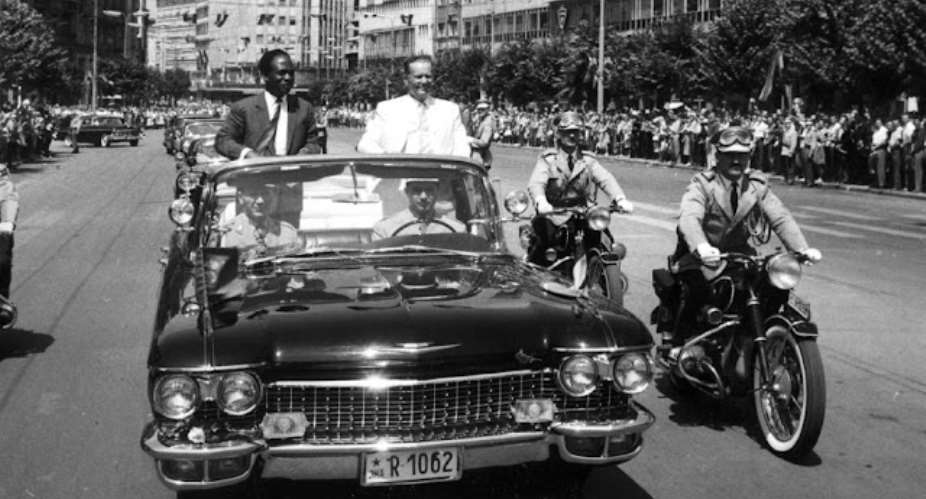
Kwame Nkrumah arrived at the First Non-Aligned Movement Summit in Belgrade, Yugoslavia, in 1961. Photo courtesy of the Archives of Yugoslavia
Few Ghanaians could have imagined that one day one of the world's most influential internet personalities and a former president of the United States would collaborate to promote a documentary about Ghana's first president, Dr. Kwame Nkrumah. Yet that is precisely what has happened with "The Eyes of Ghana," a documentary that has rapidly attracted international attention and reignited discussion about the man many regard as the father of modern Ghana.
The documentary tells a story that extends beyond Nkrumah himself. At its center is veteran cinematographer Chris Tsui Hesse, who served as Nkrumah's personal cameraman and spent decades preserving valuable footage documenting Ghana's struggle for independence and the rise of the Pan-African movement. The film highlights the enormous historical significance of these archives and the efforts made to ensure they would not be lost to future generations.
According to the filmmakers, thousands of reels of footage survived despite attempts to destroy much of Ghana's visual history after the 1966 coup that overthrew Nkrumah. Many observers have asked what inspired IShowSpeed and Barack Obama to become involved in a documentary about Ghana's founding leader. The answer appears to lie in a shared interest in storytelling, history, and the importance of preserving cultural memory.
Obama has long supported projects that elevate overlooked historical stories through Higher Ground Productions, while IShowSpeed has repeatedly expressed his personal connection with Ghana following his visit to the country. He has described Ghana as feeling like home and has spoken openly about discovering a deeper appreciation of African history and identity during his travels.
Equally important is the enormous audience that IShowSpeed brings to the project. Unlike traditional documentaries that often reach limited audiences, "The Eyes of Ghana" has been introduced to millions of young viewers worldwide through social media and YouTube. The partnership effectively transformed what might have remained a niche historical film into an international cultural event.
The documentary's producers openly stated their desire to share the story with as many people as possible and introduce younger generations to Ghana's history. For Ghana, the documentary represents more than entertainment. It is an opportunity to reclaim and re-examine a crucial chapter of national history. For decades, younger generations have known Nkrumah largely through textbooks, political arguments, and competing narratives.
"The Eyes of Ghana" offers something different: visual evidence from the period itself. Through preserved footage and eyewitness accounts, viewers are transported back to the years of Ghana's independence struggle and the optimism that accompanied the birth of Africa's first independent sub-Saharan nation. The renewed interest generated by the documentary has also elevated Nkrumah's international profile.
Although he was already recognized globally as a leading advocate of Pan-Africanism and African liberation, the film has introduced his story to millions who would otherwise have known little or nothing about him. In an age dominated by social media, documentaries can accomplish what academic books and political speeches often cannot. They bring history to life for audiences who may never have actively searched for it.
The growing popularity of the documentary has also reopened old political debates. Nkrumah remains one of the most admired and controversial figures in Ghanaian history. Supporters celebrate his role in securing independence, promoting industrialization, building national institutions, and championing African unity. Critics, however, point to concerns about authoritarian tendencies, the Preventive Detention Act, and the concentration of political power during his administration.
THE EYES OF GHANA (Full Film)
IShowSpeed presents this love letter to cinema, in which 93-year-old Chris Hesse, Kwame Nkrumah’s personal cinematographer, races against blindness and time to save over 1,000 films that reveal the hidden origin story of African independence. Executive produced by Barack and Michelle Obama. Directed by two-time Academy Award® winner Ben Proudfoot.
These debates existed long before the documentary and are unlikely to disappear. Some Ghanaians, including members of political traditions historically opposed to Nkrumah's ideology, may be uncomfortable with a documentary that presents his era through the lens of historical footage preserved by one of his closest associates. For such critics, the concern may not necessarily be that history is being falsified, but rather that the documentary highlights achievements and aspirations that have often been overshadowed by decades of political disagreement.
Whenever historical figures are revisited through powerful storytelling, old assumptions are likely to be questioned. Whether one views Nkrumah as a visionary statesman, a flawed revolutionary, or a combination of both, "The Eyes of Ghana" has achieved something remarkable. It has compelled a new generation of Ghanaians and global viewers to revisit the country's history and engage with one of Africa's most influential leaders.
Few documentaries succeed in generating both national reflection and international curiosity. This one appears to have accomplished both. Ultimately, the significance of "The Eyes of Ghana" may not rest solely in the image it presents of Kwame Nkrumah. Its greatest contribution may be that it encourages Ghanaians to look again at their history, ask difficult questions, challenge old narratives, and develop a deeper appreciation of the sacrifices and struggles that helped shape the nation they know today.

 Five ministers to face 41 parliamentary questions as House races to pass 2027 bu...
 Presidency orders public institution CEOs above 60 without valid contracts to va...
 Cameroon separatist pleads not guilty at Norway war crimes trial
 China to launch first space mission with a foreign astronaut
 Madagascar parliament ousts speaker in surprise overnight vote
 Jensen Huang’s return has calmed markets but fears of an AI bubble still run dee...
 Jihadist kidnappings for ransom surge in Cameroon's Far North
 US flew surveillance drone over Mexico to help capture top drug lord
 Zelensky urges four-way peace talks with Russia, Europe and US 'as soon as possi...
 14 countries acknowledge ICJ ruling of genocide against Rohingya


