




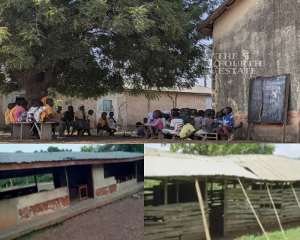
A child’s opportunity to learn should not depend on the size of the community in which that child happens to be born. Yet the condition of some rural basic-school classrooms in Ghana raises a difficult question: why should children who are already enrolled and attending school continue to learn in buildings that are visibly deteriorating, when those facilities could be assessed, repaired and made safer and more conducive to teaching and learning?
This is not simply a call to construct more schools. It is a call to pay attention to the classrooms that already exist and are already in use. In deprived communities, children report to school, teachers are expected to teach, and parents make sacrifices to keep their children in education. But where roofs leak, walls crack, windows are broken, floors are damaged or furniture is insufficient, access to a school does not necessarily mean access to a suitable learning environment.
The infrastructure deficit is documented
The problem is not merely anecdotal. A 2022 assessment by the Ghana Center for Democratic Development (CDD-Ghana) and Africa Education Watch reviewed implementation of the Education Sector Medium-Term Development Plan for 2018–2021. It examined indicators that included school buildings and seating and writing facilities. The report notes that the plan had targeted the refurbishment of 372 dilapidated kindergarten, primary and junior high school facilities. It also cautions that the Ministry of Education’s Education Management Information System did not capture refurbished-school data in a way that allowed the review to assess progress on that refurbishment target. This is an important accountability gap: if rehabilitation is not adequately recorded, the public cannot easily determine how much of the need is being addressed.
The same report records that 795 kindergarten, 700 primary and 864 junior high school buildings were constructed between 2017/18 and 2020/21, exceeding the respective construction targets. That is evidence of construction activity, but it does not answer the separate question of whether dilapidated facilities already serving pupils were adequately repaired and maintained. New construction and rehabilitation are both necessary; one should not be treated as a substitute for the other.
Why does rehabilitation remain difficult?
There are real constraints. Public funds are limited, districts face competing demands, and some buildings may require structural assessment and substantial reconstruction rather than minor repairs. Procurement delays, unclear project responsibilities, weak maintenance planning and uneven local capacity can also slow delivery. These constraints should be acknowledged. But they should lead to transparent prioritization and phased action, not to the indefinite neglect of schools serving communities least able to finance improvements themselves.
The 2018–2021 Education Sector Medium-Term Development Plan itself set out an intention to refurbish and maintain basic-school classrooms and to audit infrastructure needs across basic schools. The policy direction is therefore not new. The challenge is to ensure that such commitments are translated into funded, monitored and publicly reported work.
The Pre-Tertiary Education Act, 2020 (Act 1049) assigns District Assemblies responsibilities to build, equip, manage and maintain public basic schools, with financial assistance provided by government. That statutory responsibility must be understood alongside the roles of the Ministry of Education, the Ghana Education Service and relevant funding bodies. Effective rehabilitation requires coordination: a school should not be left waiting because agencies disagree over who should assess, fund, procure or supervise the work.
A classroom is also a teacher’s workplace
The condition of a school building matters not only to pupils but also to the teachers expected to work there every day. A teacher posted to a deprived rural community may arrive with professional commitment, enthusiasm and a genuine desire to serve. A safe, clean, adequately furnished and reasonably comfortable classroom can support the teacher’s work and affirm the value placed on teaching.
The reverse is also worth considering. Persistent leaks, excessive heat, poor ventilation, damaged furniture, inadequate sanitation and the absence of basic facilities can add to the pressures of an already demanding posting. Such conditions may weaken morale and make rural service less attractive. A conducive classroom cannot, by itself, guarantee that a teacher will remain. Accommodation, access to healthcare and transport, professional support, school leadership, career development and fair incentives also matter. Nevertheless, the physical teaching environment is one practical part of the conditions that may influence a teacher’s willingness to stay.
It would therefore be short-sighted to treat school infrastructure and teacher retention as entirely separate policy issues. A school is not only a place where children receive lessons; it is also a workplace in which teachers plan, teach, assess and support learners. Improving that workplace is an investment in the conditions under which meaningful teaching can take place.
A practical programme for restoring schools
Ghana needs a transparent, needs-based programme for rehabilitating existing basic-school facilities, with particular attention to deprived rural communities. It need not promise that every school will be rebuilt at once. It should establish a credible sequence of priorities, beginning with buildings that present safety risks or seriously obstruct teaching and learning.
First, the Ministry of Education and the Ghana Education Service should work with District Assemblies to maintain an up-to-date register of school infrastructure conditions. Assessments should cover structural safety, roofing, walls, floors, doors, windows, ventilation, lighting, water, sanitation, accessibility and furniture. The register should distinguish urgent safety repairs from routine maintenance and major reconstruction.
Second, annual education infrastructure plans should identify a clear allocation for rehabilitation and preventive maintenance. Districts should publish which schools have been prioritised, why they were selected, the estimated cost, the funding source, the implementation timeline and the status of completed work. Rehabilitation should also be tracked in Education Management Information System (EMIS) or an equivalent public monitoring system so that progress can be measured rather than assumed.
Third, funding and responsibilities must be coordinated. The Ministry of Education, GES, GETFund and District Assemblies should ensure that approved projects are properly assessed, costed, funded, supervised and completed. Partnerships with businesses, faith-based organisations and civil society can contribute, but they should complement a transparent public plan. Communities should be consulted and involved in monitoring; they should not be expected to finance major repairs beyond their means.
Finally, maintenance must become routine rather than waiting until a building has deteriorated beyond ordinary repair. Timely work on roofs, gutters, doors, windows, drainage, painting and furniture can prevent more expensive reconstruction later. A policy that counts only newly constructed buildings risks overlooking the public assets already in use.
Population should not determine the dignity of a classroom
Population figures are relevant to planning. They help authorities estimate enrolment, staffing, classroom demand and the efficient use of public resources. But they should not become the sole measure of whether a rural school deserves attention. A child in a small settlement has the same need for protection from rain, heat and unsafe structures as a child in a large town. The obligation to provide a suitable learning environment does not disappear because a community has fewer households. In the same vein, parents’ financial circumstances should not determine the quality of the classroom their children occupy. Community participation can be valuable, but it cannot replace the responsibility of public institutions to ensure that public basic schools are safe and functional. Asking a poor community to raise money for major structural repairs is not a sustainable answer to a public infrastructure deficit.
The question, then, is not whether Ghana can construct a new school in every community immediately. It is whether the country can organise its limited resources more deliberately so that classrooms already serving children are not left to deteriorate year after year. If a building can be safely restored, why should its pupils have to wait until it becomes unusable? If a teacher is expected to deliver meaningful lessons there, why should the working environment be treated as an afterthought?
Ghana’s education debate must move beyond counting the number of new buildings to asking whether the schools already operating are safe, functional and fit for learning. Restoring a dilapidated classroom is not a lesser achievement than opening a new building. For the pupils who use it and the teachers who work in it, it may be the most urgent investment of all.
The Author
Demagnala Folly-Bebe is a PhD Candidate in Education with interest in Transformational Leadership. He is a Professional and Qualified Teacher, Teacher of English to Speakers of Other Language (TESOL) Certified, Mentor of Aspiring Teachers Online as well as CAF and CONCACAF Diploma C holder.


 Musah Superior Dismisses Government’s $10bn Economic Plan as Unrealistic
 Zaato Accuses Ablakwa, NDC of Politicising Akufo-Addo’s Chartered Flights
 Akufo-Addo Never Sought Approval for New Presidential Jet, Says Dr Zaato
 Beyuo Defends Acquisition of New Presidential Jet
 Auditors Should Help Shape GIFMIS Relaunch, Says Seth Terkper
 Rent Commissioner Seeks Police Protection After UG Hostel Confrontation
 Zenith University College law students gain practical knowledge in copyright, mu...
 NAP Graduates to Receive Start-Up Kits, Tools, and Monthly Stipends
 'Unacceptable': EU chief condemns alleged Russian plot to kill US-Ukrainian citi...
 Nkrumah used secret walking stick signals to direct cameraman Chris Hesse – Docu...


