




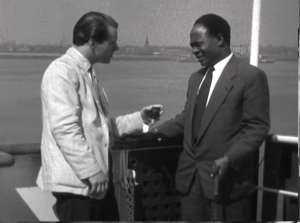
Ghana's first President, Dr Kwame Nkrumah, had a discreet way of communicating filming instructions to his personal cameraman, Rev. Dr Chris Tsui Hesse, using signals from his walking stick, a new documentary has revealed.
Now 94, Rev. Dr Hesse recounts in The Eyes of Ghana how he and Nkrumah developed a system of confidential signals that allowed the President to indicate when an event should be filmed and when the camera should be switched off.
He explained that the walking stick was not merely an accessory but served as a communication tool between the two, eliminating the need for verbal instructions during important occasions.
"He had a walking stick, not because he had a bad leg. We used the stick to talk. When he wanted me to film something, I know. When he doesn't want, I know."
According to Hesse, the arrangement enabled him to understand Nkrumah's wishes discreetly while documenting sensitive political and official activities.
The veteran cinematographer also recalled how Nkrumah recruited him and entrusted him with the responsibility of preserving significant moments in Ghana's history through film.
"My son, I'm depending on you as the filmmaker to tell the story," he said Nkrumah told him.
Hesse served as Nkrumah's personal cameraman during the 1950s and 1960s, capturing major political events, presidential engagements and developments within the wider African liberation movement.
Directed by Ben Proudfoot, The Eyes of Ghana explores Hesse's remarkable career and his role in documenting Ghana's independence era from behind the camera.
The documentary places the veteran filmmaker at the centre of a historical journey, highlighting how his footage captured defining moments that have remained largely unseen for decades.
It also follows his efforts to preserve and bring back to Ghana an extensive collection of historical recordings made during Nkrumah's presidency.
At the heart of the film is Hesse's race against time and declining eyesight to recover and repatriate more than 1,000 reels of archival footage.
The collection documents the emergence of African independence movements during the 1950s and 1960s, providing a rare African perspective on one of the continent's most significant historical periods.
Through Hesse's personal experiences and the recovered footage, The Eyes of Ghana highlights the importance of preserving Ghana's historical record and the contribution of those who documented the country's journey to independence.
 Ghana to establish US$1bn pharmaceutical manufacturing hubs in Eastern, Central ...
 Rent Control to deploy 2,000-member taskforce to enforce rent laws nationwide
 Man remanded over alleged attempt to burn Kona Chief’s palace
 Pastor arrested over alleged currency counterfeiting after hiding since June
 GRA arrests 3 China Mall operators at Ashaiman, Weija and Nsawam over alleged E-...
 Court orders GH¢3.75m reward for whistleblower over Melcom tax evasion disclosur...
 Free SHS suppliers suspend picketing ahead of planned talks with Education Minis...
 Akufo-Addo left GH¢680bn debt burden for Mahama – Adongo
 Court injunction hits CLOGSAG congress scheduled for November 23 to 25
 Nkrumah used secret walking stick signals to direct cameraman Chris Hesse – Docu...


