




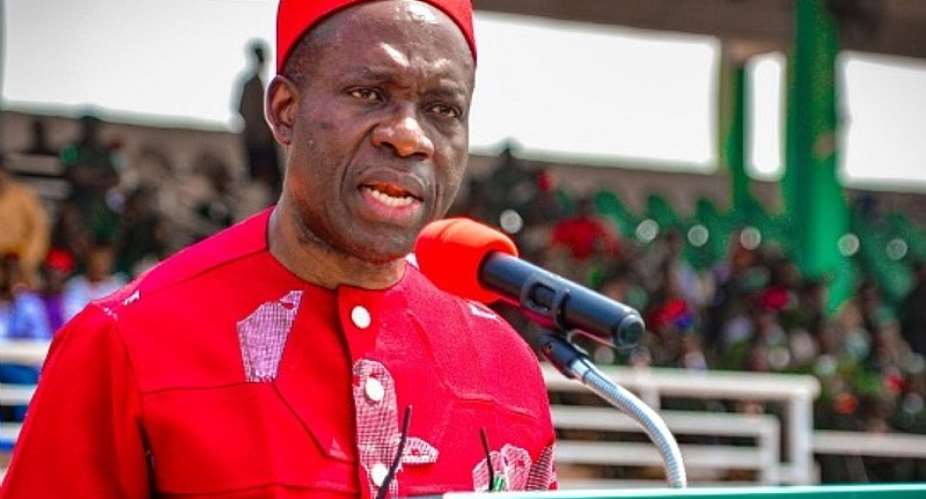
There is something rather unsettling about the spectacle of intellectual distinction being overshadowed by the rough edges of partisan politics. When an individual has attained the heights of academic scholarship, served as Governor of the Central Bank of Nigeria (CBN) and subsequently become governor of a state, the public naturally expects a corresponding level of intellectual maturity, political restraint and leadership disposition. Such accomplishments should ordinarily translate into a capacity to engage political opponents through reasoned arguments rather than what may be perceived as personal antagonism.
This is why the seemingly unending political disagreement between Professor Chukwuma Soludo, Governor of Anambra State, and his predecessor, Peter Obi, deserves attention. Beyond the personalities involved, the situation raises questions about political tolerance, leadership temperament and the ability of supposedly distinguished public figures to accommodate competing political ambitions.
Indeed, what makes the disagreement particularly intriguing is the impression that Soludo has become unusually preoccupied with Obi's political activities and presidential ambition. Although the governor is entitled to disagree with Obi, question his political calculations and support a different presidential candidate, the frequency and tone of his interventions have encouraged some observers to interpret his disposition as bitterness towards the former Anambra governor.
For the sake of historical context, it is pertinent to recall that the controversy dates back to November 2022, when Soludo published his widely discussed article titled “History Beckons and I Will Not Be Silent.” In the article, he questioned Obi’s presidential ambition, asserting that the former Anambra governor knew he stood no chance of winning the 2023 presidential election. He also cast doubt on the value of the investments Obi claimed to have made with Anambra State resources.
While Soludo was entitled to express his political assessment, the choice of language and the certainty with which he dismissed Obi's presidential prospects generated considerable controversy. Rather than simply presenting an alternative political argument, his intervention appeared to many supporters of Obi to be an attempt to diminish the former governor's political standing.
In fact, events since then have continued to fuel that perception. The disagreements have extended to questions about Obi's record in office, the financial obligations allegedly inherited by successive administrations and the political direction of the South-East.
In September 2026, the Anambra State Government released loan records to support its position that Obi's administration left outstanding financial obligations. Obi had disputed earlier allegations that his administration left debts that the present government was still servicing. Such claims and counterclaims deserve examination through independently verifiable financial records, not political insinuations.
However, the larger question remains whether the governor's repeated interventions concerning Obi's political record and presidential ambition are entirely driven by policy disagreements or whether political rivalry has become an increasingly dominant consideration.
It is important to acknowledge that Soludo has rejected suggestions of a personal feud. In a November 3, 2026 interview with BBC Igbo, he described Obi as a great friend, maintaining that their families have close relationships and that their differences are strictly political. He also recalled that Obi supported another candidate during the 2021 Anambra governorship election, which he eventually won.
That clarification deserves consideration. Nevertheless, public perception is often shaped not merely by what political leaders say about their relationships but also by the consistency, tone and substance of their public interventions.
There is nothing inherently wrong with Soludo supporting President Bola Tinubu's re-election while Obi pursues the presidency under the Nigeria Democratic Congress(NDC). Both politicians are entitled to their political preferences. The governor can make a case for Tinubu without necessarily making Obi the recurring subject of political criticism.
After all, the democratic right to contest an election does not depend on securing the approval of another politician, however influential or intellectually accomplished that politician may be.
This is where Soludo's academic and professional credentials become relevant. As an economics professor and former CBN governor, he should appreciate the importance of intellectual discipline, evidence-based arguments and the ability to distinguish between personal disagreements and public responsibilities.
Politics is undoubtedly competitive. It is also an arena in which personal ambitions, ideological differences and competing interests frequently collide. But political competition should not become an excuse for abandoning civility or reducing public discourse to exchanges that do little to advance democratic understanding.
More importantly, the South-East deserves better than a political environment in which prominent leaders appear more interested in contesting one another's relevance than articulating a common vision for the region's development and national political inclusion.
The region's quest for greater participation in national leadership requires strategic thinking, constructive engagement and political accommodation. It does not require every prominent politician to support the same candidate. Rather, it requires an understanding that political differences should not automatically translate into hostility.
If Soludo believes Obi lacks the political structure, alliances or strategy necessary to secure the presidency, he should present his arguments and allow Nigerians to interrogate them. If he believes Tinubu offers a better political arrangement for the South-East, he should explain the benefits of that position. Such arguments would be more meaningful than repeatedly questioning the legitimacy or prospects of another politician's ambition.
Indeed, a leader's stature is not measured by how effectively he discredits political opponents but by his ability to defend his convictions without diminishing the democratic rights of others.
There is also a lesson in the transient nature of political power. Today's political adversaries can become tomorrow's allies, just as today's political alliances can eventually collapse. Consequently, public officials should be careful not to allow temporary political disagreements to create permanent divisions.
For Soludo, the challenge is therefore bigger than his disagreement with Obi. It is about demonstrating that his impressive academic and technocratic accomplishments have translated into a leadership disposition capable of accommodating dissent, respecting opposing ambitions and engaging political disagreements without appearing consumed by them.
After all, being a professor is more than an academic title, just as being a former CBN governor is more than an entry on a curriculum vitae. Both accomplishments carry expectations of intellectual responsibility and institutional maturity.
A professor should be able to disagree without appearing bitter, compete without appearing threatened and defend his political choices without making another person's ambition seem like a personal affront.
That, perhaps, is the distinction between possessing impressive credentials and demonstrating the political maturity expected of someone who has earned them.


 Musah Superior Dismisses Government’s $10bn Economic Plan as Unrealistic
 Zaato Accuses Ablakwa, NDC of Politicising Akufo-Addo’s Chartered Flights
 Akufo-Addo Never Sought Approval for New Presidential Jet, Says Dr Zaato
 Beyuo Defends Acquisition of New Presidential Jet
 Auditors Should Help Shape GIFMIS Relaunch, Says Seth Terkper
 Rent Commissioner Seeks Police Protection After UG Hostel Confrontation
 Zenith University College law students gain practical knowledge in copyright, mu...
 NAP Graduates to Receive Start-Up Kits, Tools, and Monthly Stipends
 'Unacceptable': EU chief condemns alleged Russian plot to kill US-Ukrainian citi...
 Nkrumah used secret walking stick signals to direct cameraman Chris Hesse – Docu...


