




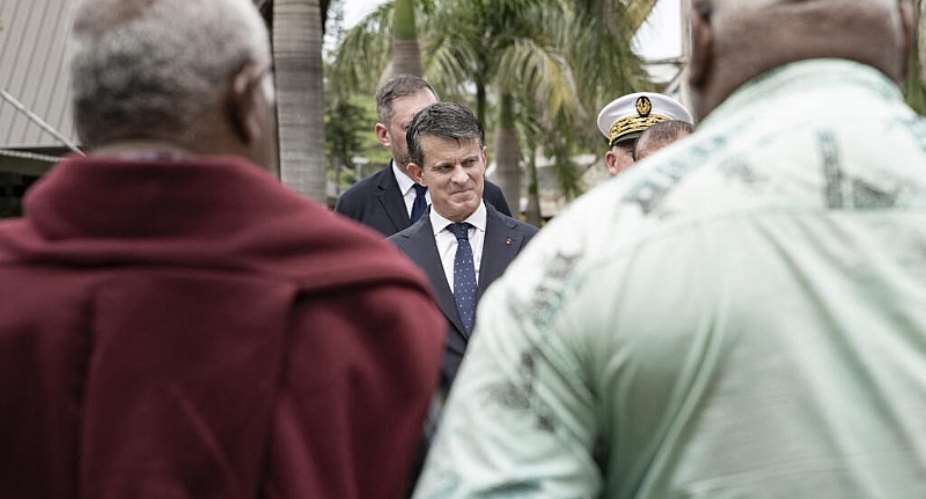
Valls, who was France's prime minister from 2014 to 2016, served as overseas minister from December 2024 to October 2025.
During his time in office, he pushed for greater autonomy from the central government, as well as support for populations struggling with poverty, high living costs, limited opportunities, poor health outcomes and natural disasters.
One of his biggest undertakings was to oversee negotiations on a new political framework for New Caledonia, the South Pacific territory where calls for greater sovereignty have been loudest.
Known as the Bougival Accord, it would have created a "State of New Caledonia" within the French Republic, with its own nationality and the possibility of additional powers.
The agreement was signed by political leaders in July 2025, but has since stalled after meeting opposition both in New Caledonia and mainland France.
At the same time, China is eyeing New Caledonia's valuable mineral reserves and strategic maritime location. Researchers have identified attempts at Chinese interference in the archipelago going back decades.
Meanwhile, the French government has accused Russia and Azerbaijan of seeking to stir unrest in New Caledonia and other overseas territories through disinformation.
In a new book, Overseas Territories: Emergency, Valls argues that relations are reaching a breaking point. In an interview with RFI on Wednesday, he warns that France must "demetropolise" – reduce the central power of the government in Paris – or risk seeing its global footprint shrink. Manuel Valls, former prime minister and former minister for overseas France, speaking to RFI on 18 November 2026.
RFI: In your book, you point out that Russia, Azerbaijan and China have all targeted French overseas territories. What is at stake in these parts of France?
Manuel Valls: Essentially, France's place in the world. They enable us to be present across three oceans and five continents. I always like to point out this rather extraordinary figure: 12 million square kilometres of ocean belong to France.
We are the world's second-largest maritime power. This means influence through language, culture, the economy and, above all, through our overseas compatriots: nearly 3 million people living in these territories who are all too often forgotten and go unmentioned.
And that's why, in my book, I declare a sense of emergency. If we do not change our relationship with these territories, we quite simply risk losing them to China or to Russia which, together with Azerbaijan, is seeking to destabilise us in the Pacific and the Indian Ocean.
France launches €35m fund to attract private investment to overseas territories
RFI: You say we risk losing them. Is that really what the relationship between mainland France and the overseas territories has come to?
MV: Yes. That's why I use this slightly strange term, "demetropolisation". It's a question of shifting our perspective, moving away from a form of paternalism and infantilism that continues to be shown towards these territories.
There are various ways we could lose them, there's no question, because they might quite simply declare their independence. But I'm also thinking of the massive drug trafficking that is in the process of devastating societies in the French Caribbean, in Guadeloupe and Martinique. We know how financially powerful and deadly it is in the Indian Ocean. There is also all this interference in the Comoros by Russia or Azerbaijan.
It is time to recognise this and to change our economic, political and cultural relations with what I call these "peoples of the oceans", these "demetropolised" peoples.
RFI: You suggest going as far as creating tailor-made arrangements to keep them within France's sphere of influence.
MV: Of course, you have to take a bespoke approach to enable these territories to develop within their own spaces. Let's not forget that French Guiana, for example, is a continental territory and it needs a special relationship with Brazil, where European and French standards are sometimes too heavy a burden. And so I'm calling for "à la carte" statuses, effectively, with greater autonomy for Guadeloupe, for Martinique...
RFI: This isn't the prelude to a withdrawal from these territories?
MV: No, on the contrary – because otherwise we'll be forced into a withdrawal, possibly violently. That's why I'm proposing what I proposed for New Caledonia and what the Bougival Accord pursued: an associated state of New Caledonia – in other words, shared sovereignty. It's a way to develop these territories, but also to protect them from predators, like China with New Caledonia.
Tiny French outpost off Canada the unlikely stage for new transatlantic courtship
RFI: Wouldn't you say that the overseas territories suffer, first and foremost, from a lack of respect and a lack of understanding from French politicians as a whole?
MV: Yes, generally speaking. Firstly, there is the weight of historical wounds: the crime against humanity that was slavery, and of course colonisation. A great deal of progress was made thanks to the Law on Departmentalisation in 1946 [which converted four of France's oldest colonies – Guadeloupe, Martinique, Réunion and French Guiana – into full French departments]...
RFI: Sure, but there's no sense of political commitment. Who has been responsible for the overseas territories at national level since Emmanuel Macron has been president? Nine or 10 different ministers.
MV: Yes, it's absurd. It shows contempt and reflects a lack of awareness of what this priority issue actually involves.
Because I spent 10 months at the helm of that ministry, and because [then prime minister] François Bayrou had the good sense to appoint a former prime minister who was well versed in these matters, there was a moment – particularly through the dialogue that resumed in New Caledonia, which was also, in terms of image, very important for all these territories – when something happened that we need to get back to. Namely, respect.
Fundamentally, we must build on what [French prime minister] Michel Rocard, [leader of the New Caledonian independence movement] Jean-Marie Tjibaou and [loyalist leader] Jacques Lafleur achieved for New Caledonia [by negotiating the 1988 Matignon Accords that ended a period of mounting civil unrest], but do so everywhere. It is this dialogue and this respect that will make us stronger.
Anything else will lead to what we are experiencing today – a sense of alienation, a feeling that France, the state, Paris and successive governments no longer take these territories into consideration, except when there is a medal at the Olympic Games, when there is a cyclone or when there are riots.
This article was adapted from an interview in French by RFI's Arnaud Pontus. It has been edited for length and clarity.


 NAP Graduates to Receive Start-Up Kits, Tools, and Monthly Stipends
 Ghana to establish US$1bn pharmaceutical manufacturing hubs in Eastern, Central ...
 Man remanded over alleged attempt to burn Kona Chief’s palace
 Pastor arrested over alleged currency counterfeiting after hiding since June
 GRA arrests 3 China Mall operators at Ashaiman, Weija and Nsawam over alleged E-...
 Court orders GH¢3.75m reward for whistleblower over Melcom tax evasion disclosur...
 Free SHS suppliers suspend picketing ahead of planned talks with Education Minis...
 Akufo-Addo left GH¢680bn debt burden for Mahama – Adongo
 Court injunction hits CLOGSAG congress scheduled for November 23 to 25
 Nkrumah used secret walking stick signals to direct cameraman Chris Hesse – Docu...


