




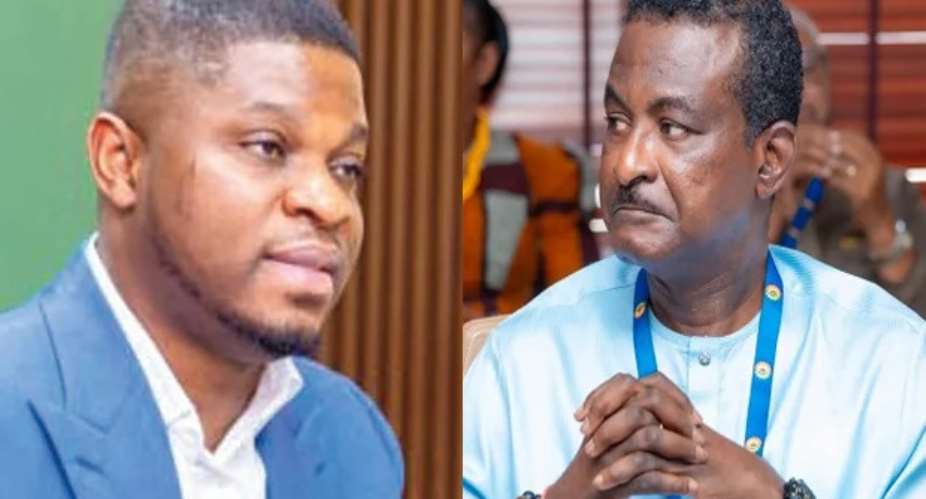
Deputy Majority Leader George Kweku Ricketts-Hagan has questioned claims that the Bank of Ghana (BoG) suffered substantial losses from financing the Ghana Gold Board (GoldBod), arguing that the profits generated by the gold trading institution must be considered in evaluating the central bank's financial position.
He said it was difficult to understand how GoldBod could record significant profits from gold trading while the Bank of Ghana, which provided funding for its gold purchasing operations, was reported to have incurred losses from the same transactions.
Contributing to the debate on the 2027 Budget in Parliament, the Cape Coast South MP suggested that the International Monetary Fund (IMF) might have focused on only one side of the central bank's balance sheet when assessing the financial implications of its support for GoldBod.
Mr Ricketts-Hagan disclosed that he raised the issue during a recent engagement between an IMF delegation and members of Parliament's Finance Committee, questioning the Fund's assessment of the central bank's exposure to the gold purchasing programme.
According to him, the IMF representatives agreed to review the matter following his concerns.
“They were only looking at one side of the balance sheet because there is no way that they can be funding GoldBod to purchase gold, GoldBod then makes profits, but Bank of Ghana actually loses,” he told Parliament.
He maintained that the central bank's reported losses should not be considered in isolation if GoldBod was generating substantial returns from the gold trading activities financed through its support.
“If indeed GoldBod is making money, making astronomical profit, there is no way Bank of Ghana is going to incur losses as a result of funding gold purchasing,” he said.
The Deputy Majority Leader insisted that GoldBod's financial performance must form part of any comprehensive assessment of the costs and benefits of the gold purchasing programme.
Beyond defending the institution's financial operations, Mr Ricketts-Hagan described GoldBod's establishment as a major shift in Ghana's management of its gold resources.
He argued that despite mining gold for more than 70 years and being among the world's leading producers, Ghana had not exercised adequate control over the resource or fully benefited from the way it was priced on the international market.
He said GoldBod was established to ensure that more of the gold produced locally remained in Ghanaian hands and contributed directly to the country's economic development.
According to him, the initiative would help Ghana mobilise resources from its gold production to support development without depending excessively on costly external borrowing.
Mr Ricketts-Hagan also defended the government's broader economic management strategy, saying it was focused on channeling resources into productive sectors while curbing what he described as reckless public expenditure.
He further justified the government's domestic borrowing approach, arguing that raising funds locally to finance development was preferable to relying on Eurobond borrowing.
He maintained that GoldBod was helping Ghana generate resources from its natural wealth while reducing its dependence on external financing.

 Ricketts-Hagan challenges claims of BoG losses from GoldBod financing
 Electronic filing, virtual hearings help address judicial delays – Supreme Court...
 Wontumi’s lawyer head to Court of Appeal over refusal to disclose former General...
 NDC Greater Accra Deputy Youth Organiser Eric Afeme dies a week after election
 Floyd Mayweather arrives in Ghana, welcomed by Cheddar
 'Are you not ashamed?' – Nitiwul takes on NDC over new presidential jet
 GPHA, DVLA recruit 3,158 workers under 24-Hour Economy
 Fiji declares nationwide disaster as El Nino drought reaches crisis levels
 Middle East crisis poses 'largest threat' to energy security in history, warns I...
 Two remanded over murder of woman in attempt to GH¢19,000 owed her at Dormabin


